

When can a child ride a pedal bike
A child can ride a pedal bike when they can fit it, balance, steer, start, stop and reach the brakes with control—not simply when they reach a certain age.
Check readiness before choosing a size
Look for practical signs of control. The child should follow simple safety directions, look ahead while moving, steer around an easy curve and stop when asked. They should be willing to practise; pressure or fear can make learning harder even when the bicycle fits.
Previous balance-bike experience may help, but it is not required. Training wheels can support early pedalling practice, although they do not prove that a child is ready to balance independently. Confidence should be judged alongside physical fit and control.
Measure the rider, then try the bicycle
Measure the child’s height without shoes. Also measure inseam from the floor to the crotch while the child stands straight with feet slightly apart. Use height to identify a starting wheel size, then have the child try the actual bicycle.
During the fit check, confirm that the child can stand over the bike without being forced onto tiptoes or against the frame. Seated, they should reach the handlebars without an extreme stretch. They must be able to turn the bars, operate the available brakes and put a foot down without losing control. Do not buy an oversized bicycle merely to allow room for growth.
Use wheel size only as a starting point
| Wheel size | Starting age | Rider height |
|---|---|---|
| 12 Inch | 3–4 | 34–40 in / 86–102 cm |
| 14 Inch | 3–6 | 37–45 in / 94–114 cm |
| 16 Inch | 4–7 | 40–48 in / 102–122 cm |
| 18 Inch | 5–9 | 43–52 in / 109–132 cm |
| 20 Inch | 7–12 | 48–60 in / 122–152 cm |
| 24 Inch | 10–14 | 54–64 in / 137–163 cm |
| 26 Inch | Youth and adults | Over 60 in / 153 cm |
Overlapping ranges are normal. Age is only a rough starting point, while measured height, inseam, reach, brake control and current confidence decide whether a particular bike works. Frame shapes and adjustment ranges can differ even when wheel labels match.
Compare the relevant XBikes options
These catalog options help by providing 12, 14, 16, 20, 24 and 26 Inch comparison points, including two models identified as training-wheel bikes. They do not replace an individual fit check, and there is no supplied 18 Inch option.
 XJD Boys & Girls BMX Bike with Training Wheels, 12/14/16" – Blue
Available in 12, 14 and 16 Inch sizes, this training-wheel BMX model provides comparison points across XBikes’ early-rider height ranges; the child still needs an individual fit and control check.
 XJD Pink Beach Cruiser for Girls – Rear Rack & V-Brake
Available in 20, 24 and 26 Inch sizes, this beach cruiser is relevant to taller children and youth. Confirm stand-over, reach and control of the title-listed V-brake on the actual bicycle.
 Girls' Training Wheel Bike by XJD with Basket – Purple
Its 14, 16 and 20 Inch options span several XBikes starting ranges. Training wheels make it relevant to early pedalling practice, but they do not establish independent balance readiness or correct fit.
The XJD Boys & Girls BMX Bike with Training Wheels, 12/14/16" – Blue offers 12 Inch, 14 Inch and 16 Inch choices. Those labels cover several early-rider starting ranges in the table, while the training wheels make it relevant when a child is learning to pedal before balancing independently.
The Girls' Training Wheel Bike by XJD with Basket – Purple is available in 14 Inch, 16 Inch and 20 Inch. It provides another training-wheel comparison and reaches the 20 Inch starting range for taller riders. Do not select 20 Inch solely because it offers more growing room.
The XJD Pink Beach Cruiser for Girls – Rear Rack & V-Brake comes in 20 Inch, 24 Inch and 26 Inch. Its sizes align with later starting points in the table, so it is relevant for a taller child or youth who can already demonstrate suitable reach and control. The title identifies a V-brake, but the rider still needs to try its brake reach and operation.
If the child’s measured starting point is 18 Inch, these products are nearest-size comparison points, not substitutes. A 16 Inch bike is not equal to an 18 Inch bike, and neither is a 20 Inch bike; assess an actual correctly sized option.
Run a short, controlled riding check
- Choose a flat area away from traffic and obstacles.
- Have the child mount and dismount several times without assistance.
- Ask them to start, pedal and steer toward a clear marker.
- Check that they can operate the brakes without shifting their hands into an unstable position.
- Ask for several smooth, predictable stops before increasing distance.
If the child cannot reach comfortably, repeatedly tips while stopping, cannot steer while looking ahead or becomes frightened, pause. Recheck the setup and size rather than treating the problem as something they must push through. Follow the exact product manual for assembly, adjustment, maintenance, compatibility and load limits, or use a qualified bicycle mechanic.
Make the go-or-wait decision
Before every ride, use a properly fitting bicycle helmet. It should sit level, fit securely and have its straps adjusted according to the helmet manufacturer’s instructions. Begin under close adult supervision in a traffic-free place.
The child is ready for a pedal bike when the measured size leads to a successful hands-on fit check and they can consistently start, steer and stop with control. If any of those checks fail, wait, practise the missing skill or try a more appropriate size—never solve the problem by buying larger for growth.
Bikes for your next adventure
-
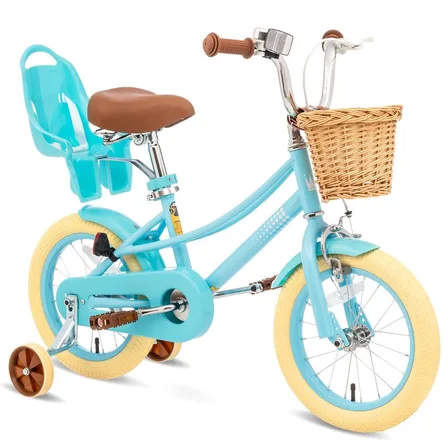
Girls' Training Wheel Bike by XJD, 12–20 Inch Wheels – Blue
This XJD girls' training wheel bike in Blue covers one of the widest fit ranges …$139
$159 -

Pink 12/14/16/20" XJD Girls Bike with Training Wheels & Basket
The Pink XJD Girls Bike with Training Wheels & Basket is a first-bike pick f…$65.99
$75.99 -

Blue XJD Girls Bike with Training Wheels – 12/14/16 Inch
If you're shopping for a first pedal bike for a daughter roughly 3 to 8 years ol…$149
$169