

When can baby go in bike trailer
A baby can go in a bike trailer only when the child meets the trailer maker’s minimum requirements and can ride in its approved seat without losing a stable, upright position. There is no single age that overrides the manual.
Check readiness before the first ride
Start with the exact trailer manual, including any instructions for minimum age, seating inserts, helmet use, passenger size and load limits. Trailer designs differ, so a limit from another model is not a safe substitute. If the manual is missing or unclear, contact the manufacturer or ask a qualified bicycle mechanic before carrying the baby.
Then assess the child, not just the calendar. The baby should be able to maintain the position required by the trailer throughout the ride, including over starts, turns and ordinary surface vibration. Confirm that the approved harness fits as directed and that the child’s head and helmet do not force an awkward posture against the seat.
If the baby was premature, has delayed head or trunk control, or has a condition that could affect safe positioning, ask the child’s healthcare professional before riding. Waiting is the appropriate choice whenever either the manual’s requirements or the child’s readiness is uncertain.
Measure and compare the right things
Before each ride, compare the child and planned setup with these checkpoints:
- Manual requirements: Confirm every stated minimum and maximum for the exact trailer and approved passenger seat.
- Body position: Check that the baby remains upright and supported rather than slumping sideways or forward.
- Harness fit: Adjust it exactly as the manufacturer instructs, without adding unapproved cushions or supports.
- Helmet fit: Use a bicycle helmet that fits properly, sits level and has its straps adjusted according to the helmet manufacturer’s instructions.
- Total load: Include the passenger and anything carried in the trailer when checking the manual’s load limit.
- Bicycle compatibility: Verify that the towing bicycle, hitch and trailer combination is permitted by their manuals.
Prepare the equipment, route and first outing
Follow the exact manuals for assembly, hitch attachment, restraints, tires, maintenance and any torque values. This article cannot supply model-specific procedures or limits. If a component is damaged, loose, incomplete or unfamiliar, do not improvise; have a qualified bicycle mechanic inspect the setup.
For the first outing, choose a short, familiar route away from busy traffic, steep slopes and rough surfaces. Practice towing the empty trailer first so you can feel its extra width and the changes in turning and stopping. Add the child only after the equipment checks pass, then stop early to recheck posture, comfort and attachment.
When to wait
Do not carry the baby if the trailer’s minimum requirements are not met, the required seating arrangement is unavailable, the child cannot maintain the prescribed position, or the helmet and harness cannot both fit correctly. Also wait if you cannot confirm compatibility or load limits from the manuals.
A sleeping child may shift position, so readiness at departure is not the only consideration. Monitor the passenger during the ride and stop if posture changes, the child becomes distressed, weather becomes unsuitable or the equipment behaves unexpectedly.
How the supplied kids’ bikes relate
The supplied products are children’s bicycles, not baby trailers or trailer accessories. They do not establish when a baby is ready to ride as a passenger. They become relevant later, when comparing options for a child learning to ride independently: Black XJD Kids' BMX Bicycle with Training Wheels and Pink Girls' 12/14/16" Bike by XJD – Basket & Doll Seat are both offered in 12 Inch, 14 Inch and 16 Inch labels.
These particular catalog options help answer the title by drawing a clear boundary between passenger readiness now and bicycle fit later; they are comparison points for independent riding, not substitutes for an approved trailer.
 Black XJD Kids' BMX Bicycle with Training Wheels
A later independent-riding comparison offered in 12 Inch, 14 Inch and 16 Inch labels. It is a kids’ BMX bicycle with training wheels, not a baby trailer or readiness aid.
 Pink Girls' 12/14/16" Bike by XJD – Basket & Doll Seat
A training-wheel bicycle offered in 12 Inch, 14 Inch and 16 Inch labels, with a basket and doll seat. It is relevant only to later independent-bike fitting, not trailer passenger readiness.
If the child is ready for an independent bike later
Use measured height only as a starting point: 12 Inch corresponds to 34–40 in (86–102 cm) and ages 3–4; 14 Inch to 37–45 in (94–114 cm) and ages 3–6; and 16 Inch to 40–48 in (102–122 cm) and ages 4–7. Overlapping ranges mean the label alone cannot decide fit.
Have the child try the bicycle. Prioritize measured height, inseam, stand-over clearance, reach, brake control and current confidence over age. Do not buy an oversized bicycle merely for growth. The exact product manual or a qualified bicycle mechanic should resolve assembly, maintenance and model-specific setup questions.
Your decision today
Find the exact trailer manual, verify every passenger requirement, and place the baby in the approved setup while stationary to check stable posture, harness fit and helmet fit. Ride only if both the equipment rules and the child’s present readiness are clearly satisfied; otherwise, wait and reassess later.
Bikes for your next adventure
-

Kids Bike Helmet by XJD for Girls – Pink
The XJD Kids Bike Helmet in Pink is a lightweight multi-sport helmet for girls r…$59.99
$99 -

Blue XJD Kids Bike Helmet for Boys & Girls
The Blue XJD Kids Bike Helmet is a lightweight, adjustable multi-sport helmet fo…$59.99
$99 -
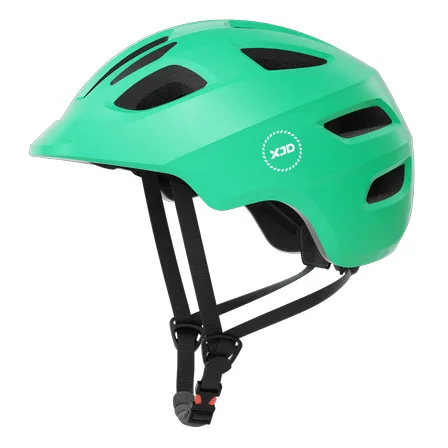
Green XJD Kids Bike Helmet for Boys & Girls
The Green XJD Kids Bike Helmet is a lightweight multi-sport helmet for toddlers …$59.99
$99