

When can baby ride bike trailer
A baby can ride in a bike trailer only after they can sit upright steadily, control their head and neck throughout the trip, and meet every minimum in the trailer manual.
Do not use a birthday as the only test
There is no single age that overrides a child’s development or the trailer manufacturer’s rules. Compare your child’s age, measured height and weight with the exact trailer manual, then apply whichever requirement is more restrictive. Check local passenger and helmet laws as well.
A child who still slumps, tips sideways, or cannot keep their head stable is not ready for a moving trailer. This remains true even if they have reached an age printed in advertising or suggested informally by another parent. If your baby was premature, has low muscle tone, or has a medical or developmental concern, ask their pediatric clinician before riding.
What to measure and observe
Before the first ride, record the child’s current height and weight and compare both with the trailer’s permitted passenger range. Do not estimate, and do not assume an infant insert changes the stated minimums unless the exact manual says it does.
- Head control: The child can keep their head centered without repeated bobbing or support.
- Seated stability: They remain upright without slumping forward or falling to either side.
- Harness fit: The trailer’s restraint adjusts to the child as its manual describes, without loose or improvised padding.
- Helmet fit: When a helmet is required by the trailer instructions or local law, it must fit properly, sit level, and have straps adjusted according to its manufacturer’s instructions.
- Trailer limits: The child meets every stated minimum, and the complete passenger and cargo load remains within the manual’s limits.
If any one of these checks fails, wait and reassess later. Never invent a workaround for a harness, seat, coupling, load limit, or compatibility issue; use the exact product manual or a qualified bicycle mechanic.
Prepare the bicycle and trailer together
Confirm that the towing bicycle, hitch and trailer are explicitly compatible. Follow their manuals for assembly, tire pressure, attachment, safety retention devices, maintenance and fastener torque. Those details vary, so a general article cannot replace the instructions for the exact equipment.
With no child aboard, inspect the connection and take a short practice ride. Learn the added width, longer stopping distance and different turning behavior. For the child’s first outing, choose a brief, smooth, low-traffic route and stop immediately if the child’s position or head control deteriorates.
How the supplied kids’ bikes relate
The supplied products are not bike trailers and are not suitable substitutes for one. They become relevant later, when a child is ready to control a bicycle directly. Their 12-, 14- and 16-inch choices can help a family compare the next riding stage, but trailer readiness cannot be inferred from any of those wheel sizes.
XJD Boys 12/14/16" Training Wheel Bike – Blue, Black XJD Kids Bike for Boys – 12, 14 & 16 Inch Sizes, and XJD Kids' Training Wheel Bike for Boys & Girls, 12/14/16 Inch – White are all cataloged as training-wheel bikes with 12 Inch, 14 Inch and 16 Inch SKU labels. These particular options help answer the title by showing the clear difference between carrying a baby in a compatible trailer and fitting an older child to their own bicycle.
 XJD Boys 12/14/16" Training Wheel Bike – Blue
A later-stage comparison option, not a baby trailer. This blue training-wheel bike is offered in 12 Inch, 14 Inch and 16 Inch SKU labels and requires an individual rider fit check.
 Black XJD Kids Bike for Boys – 12, 14 & 16 Inch Sizes
This training-wheel bicycle is relevant only when the child is ready to ride independently. Its supplied size choices are 12 Inch, 14 Inch and 16 Inch; it does not establish trailer readiness.
 XJD Kids' Training Wheel Bike for Boys & Girls, 12/14/16 Inch – White
A white training-wheel bike offered with 12 Inch, 14 Inch and 16 Inch SKU labels. It illustrates the later independent-riding stage and is not a substitute for a compatible baby trailer.
Use wheel size only when the child becomes the rider
For these three bicycles, XBikes uses the following starting points. They do not determine trailer readiness and do not replace an individual bicycle fit check.
| Wheel size | Starting age | Rider height |
|---|---|---|
| 12 Inch | 3–4 | 34–40 in / 86–102 cm |
| 14 Inch | 3–6 | 37–45 in / 94–114 cm |
| 16 Inch | 4–7 | 40–48 in / 102–122 cm |
When that later stage arrives, measure the child’s standing height and inseam. Have them try the bicycle rather than buying an oversized model for growth. Check stand-over clearance, reach, steering control, access to the brakes and present confidence. Age overlaps between sizes, so measured fit and control take priority.
The decision to make now
Ride only if your baby has stable independent sitting and head control, fits the restraint correctly, meets every manual minimum, and the towing setup is compatible and correctly assembled. Otherwise, postpone the trailer ride. The listed XJD bikes should enter the decision only when the child is old and capable enough to be fitted individually as the rider.
Bikes for your next adventure
-

Kids Bike Helmet by XJD for Girls – Pink
The XJD Kids Bike Helmet in Pink is a lightweight multi-sport helmet for girls r…$59.99
$99 -

Blue XJD Kids Bike Helmet for Boys & Girls
The Blue XJD Kids Bike Helmet is a lightweight, adjustable multi-sport helmet fo…$59.99
$99 -
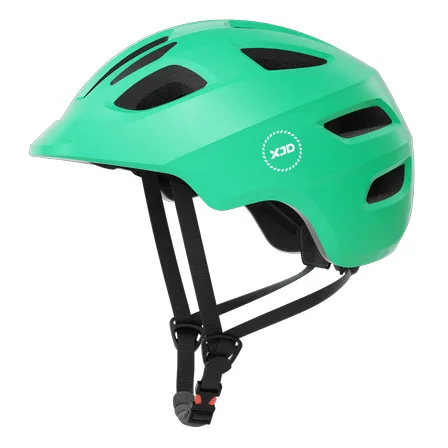
Green XJD Kids Bike Helmet for Boys & Girls
The Green XJD Kids Bike Helmet is a lightweight multi-sport helmet for toddlers …$59.99
$99