

When can baby ride in a bike trailer
A baby can ride in a bike trailer only when they can sit upright steadily, support their head throughout the ride, and meet the trailer maker’s minimum age, size and seating rules.
Check readiness before choosing a date
There is no single birthday that proves every baby is ready. Development, the trailer design and its instructions all matter. Before riding, confirm that your baby can maintain an upright seated position without slumping and can keep their head stable while wearing a properly fitted bicycle helmet.
Ask your pediatrician before the first ride, especially if your baby was born prematurely or has concerns involving muscle tone, head control, the neck, breathing or development. If the clinician’s advice and the trailer manual differ, follow the more cautious limit.
Measure and compare the trailer requirements
Find the exact manual for your trailer model rather than relying on advice for a similar-looking product. Check its stated minimum rider requirements, permitted seating configuration, harness instructions and load limits. Measure your child’s current height and weight accurately, then compare those measurements with the manual.
- Development: Can the baby sit steadily and control their head for the full outing?
- Manual limits: Does the child meet every minimum-age, size and seating requirement?
- Harness fit: Can the restraint be adjusted as the manufacturer specifies, without slack or interference?
- Helmet fit: Does the helmet sit level and remain secured with its straps adjusted according to its instructions?
- Space: Is there adequate headroom for the helmet without forcing the baby’s head forward?
If any answer is no—or the manual cannot be found—wait. Do not improvise with cushions, inserts or alternative restraints unless the trailer manufacturer explicitly approves them for that exact model.
Prepare the bicycle and trailer
Before carrying a child, inspect the towing bicycle and trailer and complete all assembly, attachment and maintenance steps in their manuals. Confirm that the hitch, wheels, tires, restraints and closures are installed and operating exactly as directed. Use a qualified bicycle mechanic when a component is damaged, a connection is uncertain or the required procedure is unclear.
The adult rider should also be comfortable with the added length, width and handling of the trailer. Practice first with an empty trailer in a traffic-free area. For the first occupied trip, choose a short, smooth and familiar route away from traffic, steep slopes and rough surfaces. Stop immediately if the baby slumps, appears distressed or cannot maintain head position.
Helmet and passenger checks for every ride
A bicycle helmet must fit properly, sit level and use its straps according to the helmet manufacturer’s instructions. Recheck the fit as the child grows. A helmet that is pushed forward by the trailer seat or that cannot sit level is not an acceptable fit; reassess the seating setup and manual requirements before riding.
Secure the child using the trailer’s complete restraint system exactly as instructed. Keep loose clothing and objects away from moving parts. Never exceed the trailer’s stated passenger or load limits, and do not assume that an accessory changes those limits unless the exact product manual says so.
How the supplied kids bike relates
A trailer passenger is not yet being fitted to a pedal-bike wheel size. The Black XJD Kids Bike for Boys – 12, 14 & 16 Inch Sizes is therefore relevant only as a later-stage comparison for a child preparing to ride independently, not as a trailer, trailer accessory or substitute for trailer readiness. Its available catalog sizes are 12 Inch, 14 Inch and 16 Inch.

When that later transition arrives, start with measured rider height: 12 Inch corresponds to 34–40 in (86–102 cm), 14 Inch to 37–45 in (94–114 cm), and 16 Inch to 40–48 in (102–122 cm). The respective age starting points are 3–4, 3–6 and 4–7, but age alone does not establish fit.
Have the child try the bicycle. Check stand-over clearance, reach, brake control and current confidence, and do not buy an oversized bicycle merely for growth. Treat “Kids Bike for Boys” in the exact catalog title as naming, not evidence that the bicycle fits a particular child.
Make the go-or-wait decision
Ride only when your baby has stable independent sitting and head control, fits the helmet and restraint correctly, meets every requirement in the exact trailer manual, and has no unresolved concern from their pediatrician. Otherwise, wait and recheck development and measurements later. The next useful step today is to locate the trailer’s model-specific manual, measure your child, test helmet position in the seat and record which requirement—if any—is not yet met.
Bikes for your next adventure
-

Kids Bike Helmet by XJD for Girls – Pink
The XJD Kids Bike Helmet in Pink is a lightweight multi-sport helmet for girls r…$59.99
$99 -

Blue XJD Kids Bike Helmet for Boys & Girls
The Blue XJD Kids Bike Helmet is a lightweight, adjustable multi-sport helmet fo…$59.99
$99 -
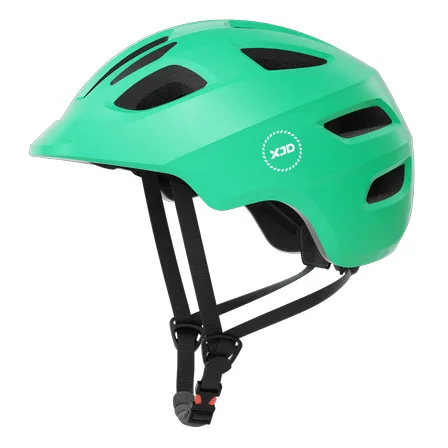
Green XJD Kids Bike Helmet for Boys & Girls
The Green XJD Kids Bike Helmet is a lightweight multi-sport helmet for toddlers …$59.99
$99