

When can baby ride in bike carrier
A baby can ride in a bike carrier only when the carrier manual permits it, the child can sit unsupported with steady head and neck control, and a helmet fits properly. Age alone is not enough.
Use three checks before the first ride
First, read the instructions for the exact carrier and bicycle. Confirm the permitted child stage, load limit, bicycle compatibility, required hardware and installation method. These details vary, so do not transfer a limit or procedure from another model. If the manual is missing or unclear, contact the manufacturer or ask a qualified bicycle mechanic.
Second, assess the baby rather than relying on a birthday. The child should remain upright without support and keep the head stable while wearing a properly fitted bicycle helmet. If the head slumps, the body folds forward or the child cannot tolerate the helmet comfortably, wait. Ask the child’s pediatrician when development, prematurity or a medical condition makes readiness uncertain.
Third, check the complete setup. The child must fit within the carrier’s harness and seating system exactly as its manufacturer specifies. The carrier must also be approved for its mounting position and for the particular bicycle. A secure-looking improvised installation is not a substitute for documented compatibility.
Measure and compare what matters
Record the child’s current weight and any other measurement requested by the carrier manual. Compare those figures with both the minimum and maximum requirements—not merely the advertised age wording. Then check whether the helmet sits level, stays in position and uses its straps according to the helmet manufacturer’s instructions.
- Child readiness: unsupported sitting, stable head and neck, and no slumping in the seat.
- Carrier fit: the child fits the seat and harness as the exact manual requires.
- Equipment limits: the child is within every stated limit for the carrier and mounting system.
- Bicycle compatibility: the frame or rack, mounting points and installation match the manufacturer’s directions.
- Adult control: the rider can start, steer, brake and stop confidently with the changed balance.
Why carrier position changes the decision
Front-mounted seats, rear-mounted seats and trailers affect a bicycle differently. They can alter steering, balance, stopping and the space needed to mount or dismount. Use only the instructions for the actual setup; do not assume that approval for one carrier type applies to another.
Before carrying the child, inspect the installation and take a short practice ride with the carrier empty in a quiet, traffic-free area. If the bicycle feels difficult to control, the mount shifts or any fastener requirement is uncertain, stop and have a qualified bicycle mechanic check it. Follow the product manual for maintenance and torque because no universal value applies.
Keep the first ride controlled
Choose a short, smooth and familiar route away from traffic, steep descents and rough surfaces. Secure the child exactly as directed, check that clothing and limbs cannot contact moving parts, and recheck the helmet. Never leave a child in a carrier on a parked bicycle: the added weight can make the bicycle unstable.
During the ride, stop promptly if the baby slumps, becomes distressed or cannot maintain a stable position. Reinspect the carrier after the first outing and at the intervals specified in its manual. Growth can change harness fit and may eventually place the child outside a stated limit.
How the listed kids’ bikes relate
Neither supplied XBikes product is a baby bike carrier. They become relevant only later, when a child is ready to control a bicycle independently. Their available wheel sizes help compare future starting points, but they cannot establish present readiness for a carrier.
 XJD Kids' Training Wheel Bike for Boys & Girls, 12/14/16 Inch – White
A later-stage independent-riding comparison with 12 Inch, 14 Inch and 16 Inch options; it is a training wheel bike, not a baby carrier or evidence of carrier readiness.
 Girls' Training Wheel Bike by XJD, 12–20 Inch Wheels – Blue
Offers 12 Inch, 14 Inch, 16 Inch and 20 Inch options for comparing a child’s future bicycle fit; it is not a baby carrier and does not determine when carrier use can begin.
XJD Kids' Training Wheel Bike for Boys & Girls, 12/14/16 Inch – White is offered in 12 Inch, 14 Inch and 16 Inch labels. Girls' Training Wheel Bike by XJD, 12–20 Inch Wheels – Blue is offered in 12 Inch, 14 Inch, 16 Inch and 20 Inch labels. Those are catalog options, not carrier specifications or evidence that a baby is ready to ride.
| Wheel size | XBikes starting point |
|---|---|
| 12 Inch | Ages 3–4; height 34–40 in / 86–102 cm |
| 14 Inch | Ages 3–6; height 37–45 in / 94–114 cm |
| 16 Inch | Ages 4–7; height 40–48 in / 102–122 cm |
| 20 Inch | Ages 7–12; height 48–60 in / 122–152 cm |
When that later transition arrives, measure height and inseam and have the child try the bicycle. Prioritize stand-over clearance, reach, brake control and current confidence over age. Do not buy an oversized bicycle merely for growth.
Make the go-or-wait decision
Ride only if every answer is yes: the exact manual permits the child, developmental control is steady, the helmet fits, the harness fits, the installation is compatible and the adult can handle the loaded bicycle. If one answer is no or unknown, wait and resolve it with the manufacturer, pediatrician or qualified mechanic before putting the baby in the carrier.
Bikes for your next adventure
-

XJD Pink Beach Cruiser for Girls – Rear Rack & V-Brake
The XJD Pink Beach Cruiser for girls is the step-up bike for riders who've outgr…$179.99
$209.99 -
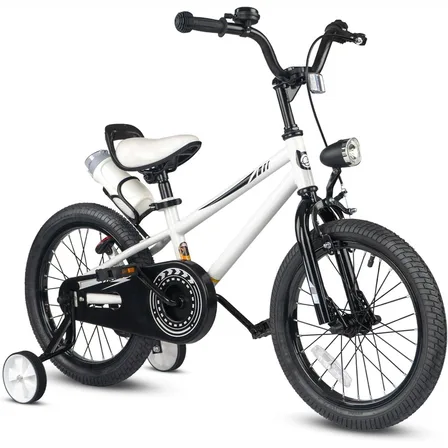
XJD Kids' Training Wheel Bike for Boys & Girls, 12/14/16 Inch – White
The XJD kids' training wheel bike in White is made for riders ages 3–8 (roughly …$169
$199 -

Kids Bike Helmet by XJD for Boys & Girls – Black, Blue, Green, Pink, Purple
The XJD Kids Bike Helmet covers a wide 2-to-8-year age range thanks to two head-…$59.99