

When do kids typically learn to ride a bike
Most children typically learn to ride a bike between ages 3 and 8, but readiness matters more than a birthday. Check fit, control, confidence and interest before deciding when to start.
What “typically” means for your child
There is no single correct learning age. Some children begin balancing and pedalling early; others need more time to develop coordination, confidence or interest. A child is ready to practise when they willingly get on, can pay attention to simple instructions and can control a correctly fitted bicycle without feeling overwhelmed.
Do not move a reluctant child up to a larger bicycle to encourage progress. A bike that is difficult to stand over, steer or stop can make learning harder. Age is only a starting point; the rider’s measurements and actual control decide whether a bicycle fits.
Measure and check before practice
Measure the child’s height and inseam while they are wearing the shoes they will ride in. Then have them try the actual bicycle. Compare these five points:
- Stand-over: the child must be able to straddle the bicycle securely rather than being forced onto tiptoes.
- Reach: they should hold the handlebar and steer without stretching, locking their arms or leaning too far forward.
- Brake control: confirm they can comfortably reach and operate the bicycle’s braking controls.
- Starting and stopping: they should be able to get underway and stop in a controlled way with adult supervision.
- Confidence: hesitation is a reason to slow the process down, not to choose a bigger size.
The American Academy of Pediatrics advises having the child try the bicycle, checking stand-over and control, and avoiding an oversized bike bought for future growth.
Use wheel size as a starting point
XBikes uses the following age and height ranges for initial comparison. Height is more useful than age, but neither replaces an individual fit check.
| Wheel size | Starting age | Rider height |
|---|---|---|
| 12 Inch | 3–4 | 34–40 in / 86–102 cm |
| 14 Inch | 3–6 | 37–45 in / 94–114 cm |
| 16 Inch | 4–7 | 40–48 in / 102–122 cm |
| 18 Inch | 5–9 | 43–52 in / 109–132 cm |
| 20 Inch | 7–12 | 48–60 in / 122–152 cm |
| 24 Inch | 10–14 | 54–64 in / 137–163 cm |
| 26 Inch | Youth and adults | Over 60 in / 153 cm |
If a child falls into overlapping ranges, compare the actual bicycles rather than automatically selecting the larger wheels. Prioritize inseam clearance, comfortable reach, brake control and current confidence.
Where the supplied training-wheel bikes fit
The XJD Kids' Training Wheel Bike for Boys & Girls, 12/14/16 Inch – White provides 12 Inch, 14 Inch and 16 Inch catalog options. The Girls' Training Wheel Bike by XJD, 12–20 Inch Wheels – Blue provides 12 Inch, 14 Inch, 16 Inch and 20 Inch options. These particular catalog choices help families compare several common starting sizes while considering whether training wheels suit the child’s present confidence.
 XJD Kids' Training Wheel Bike for Boys & Girls, 12/14/16 Inch – White
Available in 12 Inch, 14 Inch and 16 Inch labels, this training-wheel bike offers three common starting-size comparison points. The child still needs an individual height, inseam, reach, brake-control and confidence check.
 Girls' Training Wheel Bike by XJD, 12–20 Inch Wheels – Blue
This training-wheel bike has 12 Inch, 14 Inch, 16 Inch and 20 Inch labels, making it the broader supplied size comparison. Its catalog labels do not replace an individual fit and control check.
The Blue model is the only supplied option with a 20 Inch label; neither supplied product has an 18 Inch, 24 Inch or 26 Inch option. For a child whose fit check points to one of those absent sizes, these products are nearest-size comparison points only—not substitutes. A different wheel size is not equivalent.
Training wheels can provide support while a child learns pedalling and steering, but the catalog facts do not establish that either model suits every beginner or predict when a child will ride independently. Use the size label only to identify which version to try, then repeat the physical fit and control checks.
Practise in a manageable sequence
- Choose a flat, open area away from traffic and obstacles, with close adult supervision.
- Let the child become comfortable mounting, looking ahead, steering and stopping before adding speed.
- Keep early sessions short enough that fatigue and frustration do not take over.
- Progress only when the child can repeat the current skill calmly and under control.
A properly fitting bicycle helmet is essential for every session. The U.S. Consumer Product Safety Commission advises that the helmet sit level, fit properly and have its straps adjusted according to the helmet manufacturer’s instructions.
For assembly, adjustments, maintenance, load limits, compatibility or torque, follow the exact bicycle’s manual or ask a qualified bicycle mechanic; those details are not established by the supplied catalog information.
Decide what to do next
Measure height and inseam today, identify the wheel-size starting range, and arrange an actual fit check. If the child can stand over the bike, reach and operate the controls, start and stop with support, and wants to continue, begin calm supervised practice. If any check fails—or the child is frightened—change the fit or pause and try again later rather than using age alone to force the milestone.
Bikes for your next adventure
-
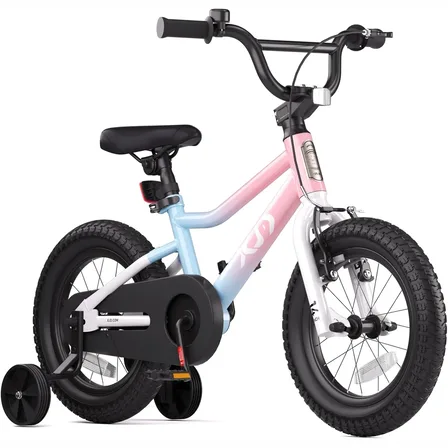
XJD Girls BMX Bike 12/14/16 Inch with Training Wheels – Pink Blue
The XJD Girls BMX Bike in Pink/Blue is built as a first pedal bike for kids roug…$99.99
$119.99 -

Pink Girls' 12/14/16" Bike by XJD – Basket & Doll Seat
The XJD Pink Girls' Bike with Basket & Doll Seat is made for riders 71–122 cm ta…$75.99
$99.99 -

Kids Bike Helmet by XJD for Boys & Girls – Black, Blue, Green, Pink, Purple
The XJD Kids Bike Helmet covers a wide 2-to-8-year age range thanks to two head-…$59.99