

When do most kids learn how to ride a bike
Most kids learn to ride when they can balance, steer, brake and follow simple directions—not at one universal age. Readiness and correct bicycle fit matter more than the birthday on the calendar.
What “ready to learn” looks like
A child is ready to practise independent riding when they are interested rather than pressured, can stay attentive, and can coordinate several actions at once. They should be able to look ahead, steer around a simple obstacle, start and stop on request, and reach and operate the bicycle’s brakes.
Confidence also counts. Hesitation is normal, but persistent fear, loss of control or inability to stop means it is better to simplify the session, adjust the fit or try again later. Children in the same family may learn at very different times.
Measure before choosing a bicycle
Measure the child’s standing height without shoes and check their inseam. Use height to identify a starting wheel size, then have the child try the actual bicycle. Wheel size alone does not establish fit because frame shape, saddle position and reach can differ.
During the fit check, confirm that the child can stand over the bicycle without being trapped against the frame. Seated, they should reach the handlebar without stretching or losing a controlled posture. They must also reach and operate the brake controls. Do not buy an oversized bicycle simply to leave room for growth.
XBikes wheel-size starting points
| Wheel size | Age starting point | Rider height |
|---|---|---|
| 12 Inch | 3–4 | 34–40 in / 86–102 cm |
| 14 Inch | 3–6 | 37–45 in / 94–114 cm |
| 16 Inch | 4–7 | 40–48 in / 102–122 cm |
| 18 Inch | 5–9 | 43–52 in / 109–132 cm |
| 20 Inch | 7–12 | 48–60 in / 122–152 cm |
| 24 Inch | 10–14 | 54–64 in / 137–163 cm |
| 26 Inch | Youth and adults | Over 60 in / 153 cm |
These ranges are starting points, not guarantees. When age and measured height suggest different choices, prioritize measured height and the child’s individual stand-over position, reach, brake control and current confidence. Compare overlapping sizes by having the child try each one rather than assuming the larger option will last longer and therefore fit better.
How the supplied training-wheel bikes compare
The two catalog options are relevant when a family wants to compare training-wheel bicycles across common early-rider wheel sizes. They help narrow the size discussion, but their catalog labels cannot replace the fit checks above.
 XJD Kids Bike for Girls – Pink, 12/14/16/20 Inch with Training Wheels
A Training Wheel Bike offered in 12 Inch, 14 Inch, 16 Inch and 20 Inch SKU labels, making it relevant for comparing several XBikes rider-height starting points after an individual fit check.
 XJD Pink Girls' Bike – Kids 12/14/16 Inch Training Wheel Bicycle
A Training Wheel Bike with 12 Inch, 14 Inch and 16 Inch SKU labels, relevant when measured height indicates those starting sizes should be compared and verified through a hands-on fit check.
XJD Kids Bike for Girls – Pink, 12/14/16/20 Inch with Training Wheels is listed in the Training Wheel Bikes category and offers 12 Inch, 14 Inch, 16 Inch and 20 Inch SKU labels. Its size range provides comparison points for several rider-height bands, including the later 20 Inch starting point.
XJD Pink Girls' Bike – Kids 12/14/16 Inch Training Wheel Bicycle is also listed as a Training Wheel Bike, with 12 Inch, 14 Inch and 16 Inch SKU labels. It is relevant when the child’s measured height leads you to compare those three starting sizes.
The first product adds a 20 Inch option; the second stops at 16 Inch. That is the only supplied size-range distinction to use here. Availability of a labeled wheel size does not prove that the bicycle fits a particular child.
What to do during learning sessions
- Choose a flat, open area away from traffic and obstacles.
- Begin with short sessions while the child remains alert and willing.
- Practise looking ahead, steering and controlled stopping before adding speed.
- Give the child enough space to correct small wobbles without sudden grabbing or pushing.
- Stop if fatigue or frustration begins to reduce control.
Training wheels may help a child become familiar with pedalling and steering while supported, but readiness for independent riding still requires balance and controlled stopping. Follow the exact product manual for assembly, adjustment, maintenance, compatibility and load limits. If the instructions are unavailable or the setup is uncertain, use a qualified bicycle mechanic.
Helmet fit and the final decision
A bicycle helmet must fit properly, sit level and have its straps adjusted according to the helmet manufacturer’s instructions. Check the helmet before every practice session and replace guesswork with the maker’s fitting guidance.
The answer is therefore not a deadline: most children learn when readiness, confidence, practice and a correctly fitted bicycle come together. Measure height and inseam now, compare the matching wheel-size starting points, test stand-over, reach and brake operation, and choose only the size the child can control today.
Bikes for your next adventure
-

Black XJD Kids Bike for Boys – 12, 14 & 16 Inch Sizes
For a son between roughly 3 and 8 years old, the XJD Kids Bike in Black covers t…$169
$199 -

Blue XJD Girls Bike with Training Wheels – 12/14/16 Inch
If you're shopping for a first pedal bike for a daughter roughly 3 to 8 years ol…$149
$169 -
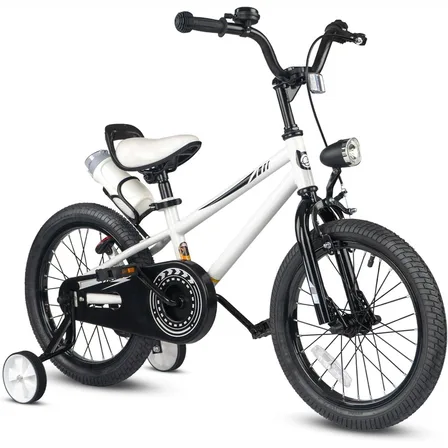
XJD Kids' Training Wheel Bike for Boys & Girls, 12/14/16 Inch – White
The XJD kids' training wheel bike in White is made for riders ages 3–8 (roughly …$169
$199