

When should a child start riding a bike
A child should start riding a bike when they are confident enough to try and can control a correctly fitted bicycle—not simply when they reach a certain age.
Use readiness and fit to decide
Age is only a starting point. Before choosing a bike, measure the child’s height and inseam, then have them try the actual bicycle. Compare how comfortably they stand over it, reach the controls and operate the brakes. Their current confidence matters too: a hesitant child may need more time or a setup that feels easier to manage.
Do not buy an oversized bicycle for the child to grow into. A larger wheel size may make standing, reaching and controlling the bike harder today. Choose for the rider they are now, and repeat the fit check as they grow.
Measure before comparing wheel sizes
Measure height without shoes, with the child standing straight against a wall. Measure inseam from the floor to the crotch while they stand upright. Height helps narrow the wheel-size range; inseam must then be compared with the actual bicycle’s stand-over fit because wheel size alone does not determine frame clearance.
Use these XBikes figures only as starting points:
| Wheel size | Starting age | Rider height |
|---|---|---|
| 12 Inch | 3–4 | 34–40 in / 86–102 cm |
| 14 Inch | 3–6 | 37–45 in / 94–114 cm |
| 16 Inch | 4–7 | 40–48 in / 102–122 cm |
| 18 Inch | 5–9 | 43–52 in / 109–132 cm |
| 20 Inch | 7–12 | 48–60 in / 122–152 cm |
| 24 Inch | 10–14 | 54–64 in / 137–163 cm |
| 26 Inch | Youth and adults | Over 60 in / 153 cm |
Where ranges overlap, do not decide from age or height alone. Compare the child’s inseam, reach, brake control and confidence on each candidate bicycle.
What to check during the bicycle trial
A correctly sized starting option should let the child manage the bicycle without stretching, leaning awkwardly or feeling overwhelmed. During a supervised fit check, look for these practical signs:
- Stand-over: The child can straddle the bicycle with suitable clearance rather than being pressed against the frame.
- Reach: They can hold the steering controls in a natural position without overextending.
- Brake control: They can reach and operate the bicycle’s brakes effectively.
- Control: They can start, steer and stop without the bicycle feeling too large to manage.
- Confidence: They remain attentive and willing to practise rather than becoming frightened or freezing.
If any of these checks fail, do not treat a matching age label as proof of fit. Try a different size or postpone the transition while the child develops confidence.
When training-wheel options are relevant
The Light Pink XJD Girls' Bicycle with Basket & Training Wheels is cataloged as a training-wheel bike and is offered in 12 Inch, 14 Inch, 16 Inch and 20 Inch labels. Those sizes provide comparison points across several XBikes starting ranges, but each still requires an individual fit check.
This particular catalog option helps answer when to start because parents can compare available wheel-size labels with the child’s measured height, then assess stand-over, reach, brake control and confidence on the actual bicycle.

It is relevant when a training-wheel bicycle is the type being considered and one of its supplied size labels falls within the child’s measured-height starting range. It is not automatically suitable because of the product name, appearance or wheel label. It also does not provide an 18 Inch, 24 Inch or 26 Inch option; if the fit check points to one of those sizes, the listed models are comparison points, not equal substitutes.
Prepare for the first rides
Choose a controlled practice area away from traffic and obstacles, and provide close adult supervision. The child should wear a bicycle helmet that fits properly, sits level and has its straps adjusted according to the helmet manufacturer’s instructions. A helmet that is merely labeled for children is not enough if its individual fit is wrong.
Before riding, follow the exact bicycle manual for assembly, adjustment, maintenance, compatibility and load limits. If the manual is unavailable, an adjustment is unclear or the bicycle’s condition is uncertain, use a qualified bicycle mechanic rather than inventing a procedure or torque value.
Make the decision today
Measure the child’s height and inseam, shortlist the relevant wheel-size range, and arrange an actual fit trial. Start now only if the child can stand over the bicycle, reach and operate its controls and brakes, and ride with current confidence; otherwise choose a better-fitting size or wait and reassess.
Bikes for your next adventure
-

XJD Kids Bike for Girls – Pink, 12/14/16/20 Inch with Training Wheels
The XJD Kids Bike for Girls in Pink is a training-wheel bike built to carry your…$139
$159 -
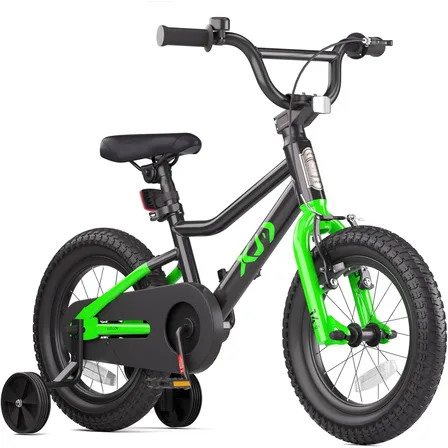
Black XJD Kids' BMX Bicycle with Training Wheels
The XJD Kids' BMX Bicycle with Training Wheels is built for children roughly 3 t…$99.99
$119.99 -

XJD Girls Bike for Kids Ages 3-8, 12/14/16 Inch with Training Wheels – Purple
The XJD Girls Bike in Purple is a training-wheel bicycle for kids ages 3 to 8, f…$149
$169