

When should kids start riding bikes
Most kids can start riding a bike when they can balance, steer, stop and follow simple directions—often around age 3, but readiness and fit matter more than age.
Look for readiness before choosing a bike
A birthday does not determine whether a child is ready. Watch what the child can do now. A ready beginner can walk and run steadily, look ahead while moving, understand when to stop, and stay interested through short practice sessions. The child should also be willing to wear a properly fitted bicycle helmet.
Confidence matters, too. Hesitation is a reason to slow down, not to buy a larger bike or push through fear. Begin in a flat, open place away from traffic. If the child cannot yet steer predictably or stop on request, continue with closely supervised practice before treating independent riding as the next step.
Measure height, inseam and reach
Measure the child without shoes for a useful height comparison. For inseam, have the child stand straight with feet slightly apart and measure from the floor to the crotch. These measurements narrow the choices, but the child still needs to try the bicycle.
During the fit check, compare the child's body with the actual bike:
- Stand-over: The child should be able to straddle the bicycle comfortably rather than being forced onto tiptoes or against the frame.
- Reach: The child should reach the handlebar without stretching, locking the elbows or losing a stable seated position.
- Brake control: If the bicycle has hand controls, confirm that the child can reach and operate them deliberately.
- Overall control: Ask the child to start, steer and stop in a controlled setting. A nominal size is not a successful fit if these actions are difficult.
Do not buy an oversized bicycle merely to leave growing room. A bike that is too large can make mounting, steering and stopping harder.
Use wheel size only as a starting point
The XBikes ranges below help identify which sizes to try. When age and measured height point in different directions, prioritize measured height, inseam, reach, brake control and current confidence.
| Wheel size | Starting age | Starting rider height |
|---|---|---|
| 12 Inch | 3–4 | 34–40 in / 86–102 cm |
| 14 Inch | 3–6 | 37–45 in / 94–114 cm |
| 16 Inch | 4–7 | 40–48 in / 102–122 cm |
| 18 Inch | 5–9 | 43–52 in / 109–132 cm |
| 20 Inch | 7–12 | 48–60 in / 122–152 cm |
| 24 Inch | 10–14 | 54–64 in / 137–163 cm |
| 26 Inch | Youth and adults | Over 60 in / 153 cm |
Overlapping ranges are expected. They mean two sizes may deserve an in-person comparison; they do not mean the sizes fit identically. Choose the bike on which the child demonstrates the more comfortable stand-over, natural reach and reliable control.
When training-wheel options are relevant
The supplied catalog option, Purple XJD Girls' Bike with Doll Seat & Basket, is categorized as a Training Wheel Bike and is offered with 12 Inch, 14 Inch and 16 Inch SKU labels. Those sizes correspond to XBikes starting ranges spanning ages 3–7 and heights 34–48 in / 86–122 cm, with substantial overlap. It is relevant when a beginning rider's measurements lead you to compare one of those three wheel sizes and a training-wheel model suits the child's present confidence.
These particular catalog options help answer when to start because they provide three adjacent sizes for comparison within common beginning-rider ranges; the labels still do not replace trying the bike and checking control.

This product is not a fit-based recommendation for children whose measurements indicate 18 Inch, 20 Inch, 24 Inch or 26 Inch wheels. It should not be treated as an equivalent substitute for those sizes. No supplied fact establishes its brake type, load limit or compatibility details, so consult the exact product manual or a qualified bicycle mechanic for those questions.
Complete the safety check
A bicycle helmet should fit properly, sit level on the head and have its straps adjusted according to the helmet manufacturer's instructions. An adult should also check that the bicycle is assembled and operating as its exact manual directs. For maintenance, assembly steps or torque requirements not stated in the catalog facts, use that manual or a qualified bicycle mechanic rather than guessing.
Choose a low-traffic practice area and supervise closely. Start with brief sessions focused on looking ahead, steering a simple path and stopping on command. Increase independence only after those actions are repeatable.
Make the start-or-wait decision
Start now if the child wants to ride, follows basic directions, fits a correctly sized bike, reaches its controls and can practise starting, steering and stopping without being overwhelmed. Wait and build balance or confidence if the child cannot control the candidate bike, resists practice or fits only an oversized model.
Your next step is concrete: measure height and inseam, shortlist the matching wheel-size range, have the child try the actual bicycle, and choose only after stand-over, reach, braking and confidence all work together.
Bikes for your next adventure
-

XJD Kids Bike for Girls – Pink, 12/14/16/20 Inch with Training Wheels
The XJD Kids Bike for Girls in Pink is a training-wheel bike built to carry your…$139
$159 -
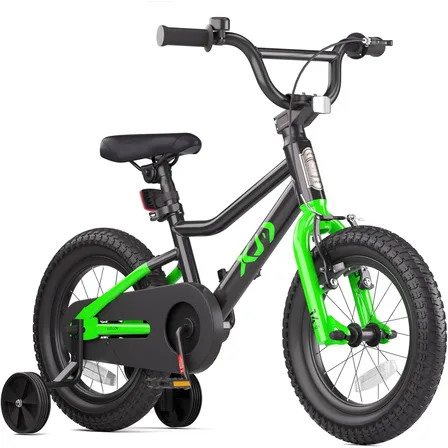
Black XJD Kids' BMX Bicycle with Training Wheels
The XJD Kids' BMX Bicycle with Training Wheels is built for children roughly 3 t…$99.99
$119.99 -

Black XJD Kids Bike for Boys – 12, 14 & 16 Inch Sizes
For a son between roughly 3 and 8 years old, the XJD Kids Bike in Black covers t…$169
$199