

When to start riding bike toddler
A toddler can start riding when they can sit securely, steer, stop, and reach the controls while staying balanced—not simply when they reach a certain birthday.
Use readiness and fit to choose the moment
Begin by watching what your child can do now. They should follow simple directions, look ahead while moving, keep their hands on the handlebar, and remain interested without being pressured. For a pedal bicycle, they also need enough coordination to pedal and steer together and enough control to stop on request.
Age is only a starting point. The XBikes guide begins 12-inch bicycles at ages 3–4 and heights of 34–40 in (86–102 cm). A younger or shorter toddler may not yet fit any size in that standard. Waiting is appropriate if the child cannot control the bicycle confidently.
Measure before comparing bicycles
Measure the child’s height without shoes. Also measure inseam from the floor to the crotch while the child stands straight with feet slightly apart. The inseam must then be compared with the actual stand-over and seat adjustment information for the specific bicycle; wheel diameter alone does not establish fit.
Have the child try the bicycle whenever possible. Check that they can stand over it, mount and dismount without struggling, turn the handlebar without overreaching, and operate the brakes with their hands in a natural position. The American Academy of Pediatrics advises against buying an oversized bicycle for a child to grow into.
Compare the relevant wheel-size starting points
| Wheel size | Starting age | Rider height |
|---|---|---|
| 12 Inch | 3–4 | 34–40 in / 86–102 cm |
| 14 Inch | 3–6 | 37–45 in / 94–114 cm |
| 16 Inch | 4–7 | 40–48 in / 102–122 cm |
| 20 Inch | 7–12 | 48–60 in / 122–152 cm |
These ranges help narrow the search, but overlapping ages do not make the sizes interchangeable. Start with measured height, then verify inseam clearance, reach, brake control, and confidence on the exact bicycle. If your toddler is below 34 in (86 cm), the table does not provide a qualifying bicycle size.
Where the supplied training-wheel bikes fit
The supplied products are useful comparison options for a child who is ready for a pedal bicycle and whose individual fit check points to one of their listed wheel sizes. Their training wheels may suit a family specifically comparing training-wheel bicycles, but their presence does not correct poor reach, inadequate clearance, or an oversized frame.
 Pink 12/14/16/20" XJD Girls Bike with Training Wheels & Basket
A training-wheel bicycle offered in 12, 14, 16, and 20 Inch labels. Its 12-inch option is relevant to toddlers who meet the supplied height range and pass an individual fit and control check.
 Light Pink XJD Girls' Bicycle with Basket & Training Wheels
This training-wheel bicycle lists 12, 14, 16, and 20 Inch choices. Compare the 12-inch version first only when the child measures within the starting range and can comfortably stand over, reach, steer, and brake.
 Blue XJD Girls Bike with Training Wheels – 12/14/16 Inch
A blue training-wheel bicycle available in 12, 14, and 16 Inch labels. The 12-inch option may be relevant at the toddler stage; the larger labels require their own height, reach, inseam, and control checks.
Pink 12/14/16/20" XJD Girls Bike with Training Wheels & Basket and Light Pink XJD Girls' Bicycle with Basket & Training Wheels each list 12 Inch, 14 Inch, 16 Inch, and 20 Inch options. Blue XJD Girls Bike with Training Wheels – 12/14/16 Inch lists 12 Inch, 14 Inch, and 16 Inch options. For a toddler near the beginning of the supplied standard, compare the 12-inch label first, then perform the full fit check; do not move up merely to allow growth.
A 14-inch option can be considered only when the child’s measured height and actual control support it. The listed 16-inch and 20-inch versions correspond to later starting ranges in the XBikes table and should not be treated as toddler equivalents. No other differences in braking, construction, weight, or adjustability are established by the supplied catalog facts.
Run a short control check
- Let the child stand over the exact bicycle and confirm comfortable clearance.
- Seat them and check that the handlebar can be reached without stretching or locking the elbows.
- Confirm they can reach and operate the brakes reliably.
- Ask them to start, steer around a simple obstacle, stop on request, and dismount under close adult supervision.
- Stop if they appear frightened, cannot look ahead, or repeatedly lose control.
Use a properly fitting bicycle helmet every ride. The U.S. Consumer Product Safety Commission advises that it sit level and that its straps be adjusted according to the helmet manufacturer’s instructions. Follow the exact bicycle manual for assembly, adjustments, maintenance, load limits, compatibility, and torque; use a qualified bicycle mechanic when those requirements are unclear.
Make the decision today
If your toddler is at least 34 in (86 cm), shows the necessary coordination, and passes the stand-over, reach, braking, and control checks on a 12-inch bicycle, it may be time to begin. If any check fails, wait and remeasure later rather than buying larger. Compare the supplied 12-inch training-wheel options only after readiness and fit point to that size.
Bikes for your next adventure
-

XJD Kids Bike for Girls – Pink, 12/14/16/20 Inch with Training Wheels
The XJD Kids Bike for Girls in Pink is a training-wheel bike built to carry your…$139
$159 -
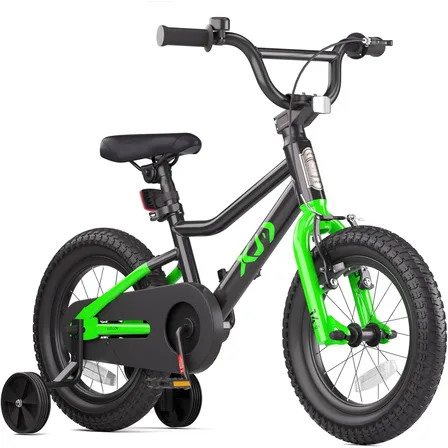
Black XJD Kids' BMX Bicycle with Training Wheels
The XJD Kids' BMX Bicycle with Training Wheels is built for children roughly 3 t…$99.99
$119.99 -
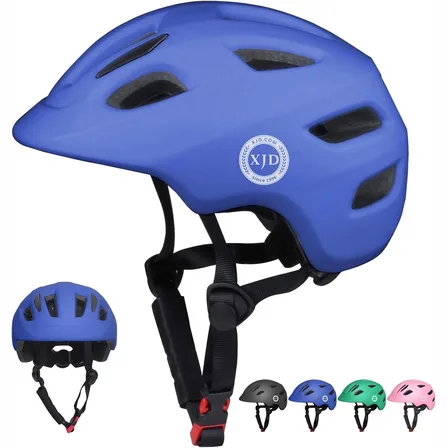
Blue XJD Kids' Bike Helmet, Adjustable Fit – Sizes XS & S
The Blue XJD Kids' Bike Helmet is a lightweight, adjustable helmet for toddlers …$20.39