

When to start your toddler on a bike
Start your toddler on a bike when they fit an available bike and can control it confidently—not when they reach a particular birthday. Measure height and inseam, then check stand-over clearance, reach and brake control on the actual bicycle.
The practical signs that your toddler is ready
Age is only a starting point. Your child should be willing to sit on the bike, hold the handlebar and follow simple directions. They should also be able to place their feet where the bicycle’s design requires without stretching or losing balance.
Pause and try again later if your toddler is frightened, cannot remain in control at walking speed, or must overreach for the handlebar or brakes. A smaller, properly fitting bicycle is more useful than an oversized one bought for future growth.
Measure before comparing wheel sizes
- Height: Measure your child without shoes, standing straight against a wall.
- Inseam: Measure from the floor to the crotch while the child stands naturally. This helps you evaluate stand-over clearance, but it does not determine wheel size by itself.
- Reach: On the actual bike, check that your child can hold the handlebar without locking their elbows or leaning excessively.
- Brake control: If the bicycle has hand controls, confirm that your child can reach and operate them while maintaining a secure grip.
Record these measurements rather than relying on clothing size or a remembered height. Bicycle geometry can differ, so matching a height band still requires an individual fit check.
Use age and height as starting points
| Wheel size | Starting age range | Rider height |
|---|---|---|
| 12 Inch | 3–4 | 34–40 in / 86–102 cm |
| 14 Inch | 3–6 | 37–45 in / 94–114 cm |
| 16 Inch | 4–7 | 40–48 in / 102–122 cm |
| 18 Inch | 5–9 | 43–52 in / 109–132 cm |
| 20 Inch | 7–12 | 48–60 in / 122–152 cm |
| 24 Inch | 10–14 | 54–64 in / 137–163 cm |
| 26 Inch | Youth and adults | Over 60 in / 153 cm |
For many toddlers, the first relevant XBikes starting point is 12 Inch, listed for ages 3–4 and heights 34–40 inches / 86–102 cm. A three-year-old outside that height band should not be forced into it, and a younger child should not be assumed ready merely because their height overlaps. Current confidence, inseam, reach and control remain decisive.
Check the bicycle in person
Have your child try the bicycle. They need appropriate clearance when standing over it, a comfortable seated position and enough control to steer without wrestling the handlebar. Confirm that they can reach and use the brakes provided on that exact model.
Do not accept tiptoeing, a stretched torso or unreachable controls as problems they will quickly grow into. If the smallest suitable option is still too large, wait and remeasure rather than using an oversized bike.
How the supplied catalog option helps
The Light Pink XJD Girls' Bicycle with Basket & Training Wheels is a relevant comparison because its supplied sizes include 12 Inch, 14 Inch, 16 Inch and 20 Inch. The 12 Inch and 14 Inch options overlap common toddler and preschool starting ranges, while the larger labels show later size steps; each still needs a hands-on fit check.

Compare only the exact size label you are considering. The 14 Inch starting range is ages 3–6 and 37–45 inches / 94–114 cm, but it is not equivalent to 12 Inch. Likewise, the 16 Inch and 20 Inch options should not be treated as room-to-grow substitutes for a toddler who fits a smaller bicycle. The basket and training wheels are catalog features, not proof that the bicycle fits a particular child.
Helmet, setup and the next decision
Use a bicycle helmet that fits properly, sits level and has straps adjusted according to the helmet manufacturer’s instructions. Supervise early practice in a flat area away from traffic and other hazards.
Follow the exact bicycle manual for assembly, maintenance, compatibility, load limits and torque requirements. If anything about setup or brake operation is uncertain, use a qualified bicycle mechanic.
Your next step is simple: measure your toddler today, compare the recorded height with the XBikes starting bands, and arrange a fit check on the candidate size. Start now only if your child can stand over, reach, brake and steer comfortably; otherwise, wait and measure again later.
Bikes for your next adventure
-

Black XJD Toddler Bike Helmet, Adjustable – Kids' Protective Helmet
The XJD Toddler Bike Helmet in black is an adjustable protective helmet for kids…$20.39
-
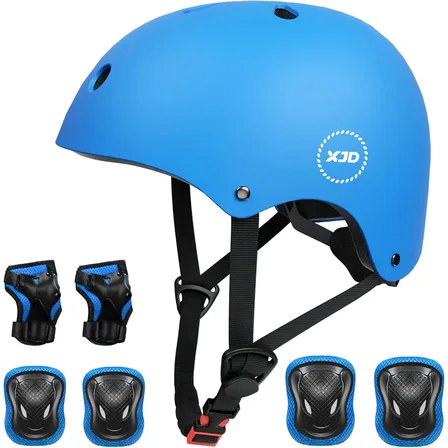
Blue XJD Helmet & Protective Gear Set for Kids, Sizes S/M
The Blue XJD Helmet & Protective Gear Set is made for kids roughly 3 to 8 years …$23.79
-

XJD Kids Bike for Girls – Pink, 12/14/16/20 Inch with Training Wheels
The XJD Kids Bike for Girls in Pink is a training-wheel bike built to carry your…$139
$159