

Which baby bike seat
A baby bike seat should match your child’s measurements, the seat maker’s limits and your bicycle’s approved mounting points. None of the supplied XBikes products is a baby passenger seat, so do not use these children’s bicycles as substitutes. If you meant a first bicycle with its own saddle, choose by measured fit—not age alone.
First decide which kind of seat you mean
“Baby bike seat” can mean a passenger seat attached to an adult bicycle, or it can refer informally to the saddle on a young child’s first bike. These are different decisions.
For a passenger seat, start with the exact seat and bicycle manuals. Confirm that the child falls within every stated size and developmental requirement, and that the bicycle is approved for the specified mounting method. Load limits, attachment points, hardware and tightening requirements vary; if either manual is unclear, ask a qualified bicycle mechanic rather than improvising.
For a first bicycle, wheel size is only a starting point. The child should try the bicycle so you can check stand-over clearance, reach, steering control and access to the brakes.
What to measure before comparing options
- Standing height: Measure without shoes and compare it with the XBikes wheel-size starting points below.
- Inseam: Measure from the floor to the crotch while the child stands naturally. Compare this measurement with the actual bicycle’s stand-over and saddle adjustment information.
- Reach: On the bicycle, check whether the child can hold the controls and steer without stretching, locking the elbows or shifting awkwardly.
- Brake control: The child must be able to reach and operate the fitted brake controls as directed for that bicycle.
- Current confidence: Consider whether the child can start, stop, balance and turn with control. A nominal age range cannot establish this.
For a passenger seat, also record the child’s current measurements requested by its manual and identify the adult bicycle’s exact model, frame or rack details, mounting points and relevant clearances. Compare those facts directly with the seat manufacturer’s compatibility instructions.
XBikes wheel-size starting points
| Wheel size | Age starting point | Rider height |
|---|---|---|
| 12 Inch | 3–4 | 34–40 in / 86–102 cm |
| 14 Inch | 3–6 | 37–45 in / 94–114 cm |
| 16 Inch | 4–7 | 40–48 in / 102–122 cm |
| 18 Inch | 5–9 | 43–52 in / 109–132 cm |
| 20 Inch | 7–12 | 48–60 in / 122–152 cm |
| 24 Inch | 10–14 | 54–64 in / 137–163 cm |
| 26 Inch | Youth and adults | Over 60 in / 153 cm |
Use measured height to identify a starting size, then require an individual fit check. Overlapping ranges are a reason to try both sizes, not permission to buy the larger one for future growth. Inseam, reach, brake control and confidence can rule out a size even when height or age appears to match.
How the supplied bicycles help with comparison
The catalog options provide 12-, 14-, 16-, 20-, 24- and 26-inch bicycles for fit comparison. They can help when “bike seat” means choosing a first or next child’s bicycle, but they are not passenger seats and provide no passenger-seat compatibility information.
 XJD Boys & Girls BMX Bike with Training Wheels, 12/14/16" – Blue
A 12, 14 or 16 Inch kids' BMX bicycle with training wheels for first-bike fit comparisons; it is not a baby passenger seat.
 XJD Pink Beach Cruiser for Girls – Rear Rack & V-Brake
Available in 20, 24 and 26 Inch sizes for older or taller rider fit comparisons. Its rear rack does not establish baby-seat compatibility.
 Girls' Training Wheel Bike by XJD with Basket – Purple
A training wheel bicycle available in 14, 16 and 20 Inch sizes. It is relevant to child-bike sizing, not as a baby passenger seat.
The XJD Boys & Girls BMX Bike with Training Wheels, 12/14/16" – Blue offers 12 Inch, 14 Inch and 16 Inch labels. Those sizes cover several overlapping height starting points, so compare the child on the relevant sizes rather than selecting from the title alone.
The Girls' Training Wheel Bike by XJD with Basket – Purple is available in 14 Inch, 16 Inch and 20 Inch. The jump to 20 Inch is meaningful: it begins at the XBikes starting point of 48 inches / 122 cm, but still requires a complete fit and control check.
The XJD Pink Beach Cruiser for Girls – Rear Rack & V-Brake has 20 Inch, 24 Inch and 26 Inch labels. Its rear rack must not be assumed to accept a baby passenger seat. Only the bicycle and seat manuals can establish mounting compatibility and load limits.
Try the bicycle instead of buying for growth
Have the child stand over the bicycle and then sit in a normal riding position. Check that mounting and dismounting are manageable, steering feels controlled, and the brake controls are within usable reach. Do not choose an oversized bicycle merely to extend its useful life.
Any assembly, adjustment or maintenance should follow the exact product manual. Where compatibility, torque or a procedure is not stated, use a qualified bicycle mechanic. A properly fitting bicycle helmet should sit level and use its straps according to the helmet manufacturer’s instructions.
Make the title-specific decision
If you need a baby passenger seat, pause here: none of these three products answers that need. Take your child’s current measurements and your bicycle’s exact model information to a compatible-seat check based on both manuals. If you need a young child’s bicycle, use height to shortlist wheel sizes, arrange a hands-on fit check, and choose only after stand-over, reach, braking and confidence all work for that child today.
Bikes for your next adventure
-
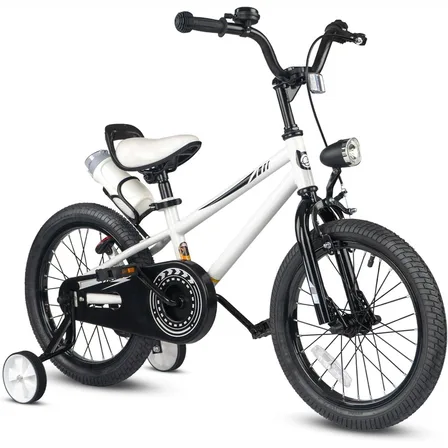
XJD Kids' Training Wheel Bike for Boys & Girls, 12/14/16 Inch – White
The XJD kids' training wheel bike in White is made for riders ages 3–8 (roughly …$169
$199 -

Kids Bike Helmet by XJD for Boys & Girls – Black, Blue, Green, Pink, Purple
The XJD Kids Bike Helmet covers a wide 2-to-8-year age range thanks to two head-…$59.99
-

Light Purple XJD Toddler Bike Helmet, Adjustable, Size XS (46–51 cm)
This Light Purple XJD toddler bike helmet is made for the smallest riders — the …$20.39