

Which bike is best for 5 year old
For most 5-year-olds, a 14-inch or 16-inch bike is the right starting point—but measured height, inseam, reach and control decide the fit.
Start with height, not the birthday
XBikes places both 14-inch and 16-inch wheels within the range for age five. A 14-inch bike is a starting point for riders 37–45 inches (94–114 cm) tall, while a 16-inch bike is a starting point for riders 40–48 inches (102–122 cm) tall. There is deliberate overlap: age alone cannot tell you which one your child can control.
An 18-inch bike enters the chart at age five, but its height range starts at 43 inches (109 cm). Consider it only when the child falls within its stated 43–52-inch (109–132 cm) range and passes an individual fit check. Do not move up merely to leave room for growth.
| Wheel size | XBikes age starting point | Rider-height starting point | Relevance at age five |
|---|---|---|---|
| 14 Inch | Ages 3–6 | 37–45 in / 94–114 cm | Compare for shorter riders within range |
| 16 Inch | Ages 4–7 | 40–48 in / 102–122 cm | Compare for riders within range |
| 18 Inch | Ages 5–9 | 43–52 in / 109–132 cm | Consider only if height and control support it |
Measure before comparing bikes
Measure the child’s height without shoes, standing straight against a wall. Measure inseam from the floor to the crotch while the child stands naturally. Use height to narrow the wheel-size choices, then use inseam and an actual try-on to judge clearance and control.
The American Academy of Pediatrics advises having the child try the bicycle and avoiding an oversized bike bought for future growth. With the child standing over the bike, check that there is comfortable clearance rather than contact with the frame. Exact clearance requirements can vary by bicycle, so follow the product manual.
Use a simple fit check
Once height has narrowed the choice, ask the child to sit in a normal riding position. The bike is relevant only if all of these checks work together:
- The child can mount, start and stop without the bicycle overwhelming them.
- The handlebars are within easy reach without an exaggerated forward stretch.
- The child can steer through a controlled turn while looking ahead.
- Each brake control can be reached and operated reliably, where applicable.
- The child appears composed and in control at their current confidence level.
If the larger candidate makes starting, steering, braking or stopping harder, choose the smaller correctly fitting option. If neither candidate provides suitable stand-over clearance, reach and control, keep looking rather than forcing a size choice.
How the supplied XBikes options compare
The two supplied catalog options help because each is offered in 14-inch and 16-inch labels, the two principal starting sizes for many 5-year-olds. Both also have training wheels, making them relevant comparison points when the rider currently needs that form of support. Their supplied facts do not establish geometry, brake type, weight or final fit, so the child must still try the exact configuration.
 Pink 12/14/16/20" XJD Girls Bike with Training Wheels & Basket
Relevant because 14 Inch and 16 Inch versions are available for comparison, with training wheels and a basket. Select only after checking the child’s measured height, reach, stand-over clearance and control on the exact size.
 Light Pink XJD Girls' Bicycle with Basket & Training Wheels
Offers 14 Inch and 16 Inch size labels relevant to many 5-year-olds, plus a basket and training wheels. Availability of a labeled size does not establish fit; the child still needs an individual try-on and control check.
Pink 12/14/16/20" XJD Girls Bike with Training Wheels & Basket
This Training Wheel Bikes model has 12 Inch, 14 Inch, 16 Inch and 20 Inch SKU labels. For this question, compare its 14-inch and 16-inch versions against the child’s measured height and hands-on fit. Its 12-inch label starts at ages 3–4 and 34–40 inches (86–102 cm), while its 20-inch label starts at ages 7–12 and 48–60 inches (122–152 cm), so neither should be selected solely because it is available.
Light Pink XJD Girls' Bicycle with Basket & Training Wheels
This is also a Training Wheel Bikes model with 12 Inch, 14 Inch, 16 Inch and 20 Inch SKU labels. Its supplied catalog facts provide the same relevant size choices and identify a basket and training wheels. They do not prove that its fit is identical to the other model, so compare reach, stand-over, brake access and control on the exact bike.
Decide whether training wheels are relevant
Training wheels can make these two products relevant for a child who is not yet riding independently. Their presence does not override sizing: the bicycle still needs appropriate clearance, reach and controllability. If the child already rides confidently without training wheels, these catalog options may be less relevant to the intended riding setup even when a listed wheel size matches the height range.
For assembly, adjustment, maintenance, compatibility and torque instructions, use the exact product manual or a qualified bicycle mechanic. Do not improvise procedures or assume that instructions transfer between models or sizes.
Complete the choice safely
Before buying, shortlist 14 inches or 16 inches from measured height; include 18 inches only when the child is at least 43 inches (109 cm) tall. Then have the child try the bicycle and reject any option that compromises stand-over clearance, reach, braking or calm control.
Add a properly fitting bicycle helmet. The U.S. Consumer Product Safety Commission says it should sit level and its straps should be used according to the helmet manufacturer’s instructions.
For a 5-year-old, the next step is therefore concrete: measure height and inseam today, try the shortlisted size, and choose the bike the child can control now—not the larger one they may grow into.
Bikes for your next adventure
-

Kids Bike Helmet by XJD for Boys & Girls – Black, Blue, Green, Pink, Purple
The XJD Kids Bike Helmet covers a wide 2-to-8-year age range thanks to two head-…$59.99
-

Light Purple XJD Toddler Bike Helmet, Adjustable, Size XS (46–51 cm)
This Light Purple XJD toddler bike helmet is made for the smallest riders — the …$20.39
-
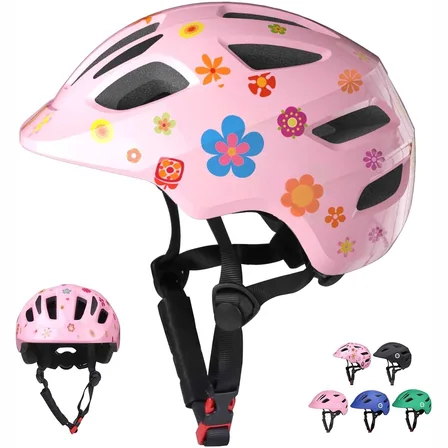
XJD Kids Bike Helmet for Girls, Pink Flowers, Adjustable (XS–S)
The XJD Kids Bike Helmet in Pink Flowers is an adjustable toddler-and-kids helme…$21.24
$24.99