

Who is a 24 inch bike for
A 24 inch bike is generally for a rider 54–64 inches (137–163 cm) tall, often around ages 10–14, who can stand over and control it confidently.
Start with height, not age
XBikes lists a 24 inch bicycle as a starting point for riders ages 10–14 and 54–64 inches (137–163 cm) tall. The height range is more useful than the age range because children of the same age can have very different proportions, reach and riding ability.
Measure the child’s current height without shoes, standing straight against a wall. Do not choose from an old measurement or expected growth. A rider below 54 inches (137 cm) should compare the fit of a 20 inch bike; a rider above 60 inches (153 cm) may also be approaching the 26 inch youth-and-adult starting point. Overlapping ranges are a reason to try both sizes, not proof that either one will fit.
Measure inseam and check stand-over space
Measure inseam from the floor to the crotch while the child stands upright with feet slightly apart. Use that measurement to evaluate the actual frame rather than trying to convert it into a universal wheel-size formula.
With the child standing over the bicycle’s top tube, both feet should reach the ground securely and there should be comfortable clearance between the rider and frame. Frame shapes vary even when wheel labels match. If the child has to lean the bike sharply, balance on tiptoes or press against the top tube, that particular 24 inch bike is too large.
Do not buy an oversized bicycle solely to leave room for growth. A bike the child cannot mount, stop or steer comfortably now is not an appropriate current fit.
Check reach, braking and real control
Have the child sit in a normal riding position and hold the grips. The rider should reach the handlebar without locking the elbows, stretching the torso or losing a stable seated position. Check that turns can be made without the knees or hands becoming awkwardly crowded.
Next, confirm that the child can reach and operate the brake controls reliably while keeping control of the handlebar. Brake type alone does not establish fit: hand size, lever position and the rider’s coordination matter. Any adjustment, assembly detail or torque requirement should follow the exact product manual or be handled by a qualified bicycle mechanic.
A practical tryout should answer four questions:
- Can the rider mount and dismount without help?
- Can both feet reach the ground securely when needed?
- Can the rider start, steer and make a controlled turn?
- Can the rider operate the brakes and stop predictably?
If anxiety or loss of control appears even though the height range looks correct, compare a smaller bicycle. Current confidence is part of fit, not an afterthought.
Compare the neighboring wheel sizes
| Wheel label | XBikes starting point | When to compare it |
|---|---|---|
| 20 Inch | Ages 7–12; 48–60 in / 122–152 cm | For a shorter rider or one who cannot comfortably control a 24 inch bike |
| 24 Inch | Ages 10–14; 54–64 in / 137–163 cm | For a rider in this height range who passes the individual fit checks |
| 26 Inch | Youth and adults over 60 in / 153 cm | For a taller rider who can safely manage the larger bicycle during a direct tryout |
Wheel size is only a category label. Saddle position, frame shape and handlebar reach can make two bicycles with the same wheel size feel different. Compare complete bicycles with the rider present rather than treating the table as a purchase guarantee.
How the supplied bicycle helps with the decision
The XJD Kids Beach Cruiser Bicycle, Rear Rack & V-Brakes, Mint Green is offered with 20 Inch, 24 Inch and 26 Inch SKU labels. Those three catalog options make it relevant for comparing the requested 24 Inch size with its neighboring sizes while keeping the listed model family consistent. The rear rack, V-brakes and mint green finish describe the catalog option, but they do not prove fit.

Choose its 24 Inch option only after the rider passes the stand-over, reach, brake-control and confidence checks. The 20 Inch and 26 Inch options are comparison points, not equivalent substitutes. Confirm the selected SKU label before ordering, and consult the exact product manual or a qualified bicycle mechanic for assembly, maintenance, compatibility and load-limit questions.
Make the final 24 inch decision
- Measure the child’s current height and inseam.
- Use 54–64 inches (137–163 cm) and ages 10–14 only as starting points.
- Have the child try the complete bicycle and check stand-over clearance, reach, turning and brake operation.
- Compare 20 Inch or 26 Inch only when the rider’s measurements or control make that sensible.
- Fit a bicycle helmet so it sits level and secure, with straps used according to the helmet manufacturer’s instructions.
A 24 inch bike is the right choice only when the rider fits it today and can mount, steer and stop with confidence; if those checks fail, choose the better-fitting neighboring size rather than waiting for the child to grow into it.
Bikes for your next adventure
-

26-Inch XJD Beach Cruiser Bike for Girls – Purple, V-Brake
This XJD 26-inch purple beach cruiser is sized for big kids and teens — suggeste…$218.49
$229.99 -
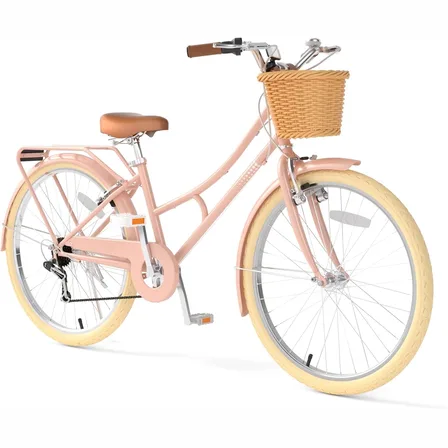
Pink XJD Beach Cruiser Bike, 24"/26", U-Brake
The XJD Pink Beach Cruiser Bike is a single-speed cruiser built for older kids a…$159.99
-
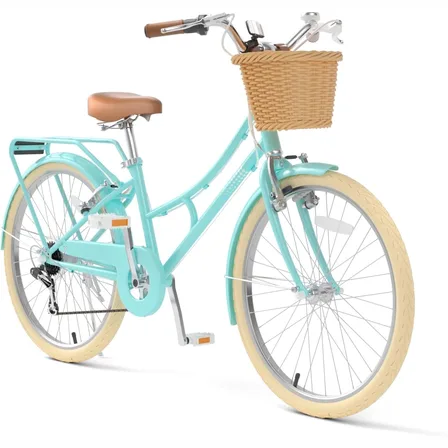
XJD Kids Beach Cruiser Bicycle, Rear Rack & V-Brakes, Mint Green
The XJD Beach Cruiser in Mint Green is a geared, multi-speed cruiser bike for ol…$179.99
$209.99