

Who should ride a 20 inch bike
A 20-inch bike usually suits a child who is 48–60 inches (122–152 cm) tall, often around ages 7–12, but it is right only if the rider can stand over, steer, brake and start confidently.
Start with height, not age
XBikes uses 48–60 inches (122–152 cm) as the starting height range for a 20-inch bike. The age range of 7–12 is only an initial reference because children of the same age can differ greatly in leg length, arm reach and riding ability.
Measure the child’s standing height without shoes. Then measure inseam from the floor to the crotch while the child stands upright. Use height to identify the likely wheel-size range and inseam to judge stand-over room on the actual bicycle. Frame shapes vary, so wheel diameter alone cannot confirm fit.
Compare the neighboring wheel sizes
| Wheel size | XBikes age starting point | Rider-height starting point |
|---|---|---|
| 18 Inch | Ages 5–9 | 43–52 in / 109–132 cm |
| 20 Inch | Ages 7–12 | 48–60 in / 122–152 cm |
| 24 Inch | Ages 10–14 | 54–64 in / 137–163 cm |
The overlapping ranges are intentional starting points, not proof that either size will work. A rider near 48 inches may need to compare an 18-inch and a 20-inch bike. A rider approaching 60 inches may need to compare a 20-inch and a 24-inch bike. Choose the bicycle the child controls now; do not buy an oversized model merely to leave growing room.
What the child must demonstrate
Have the child try the exact bicycle, with its setup adjusted according to its product manual. A suitable 20-inch bike should let the rider complete these checks without stretching, wobbling or appearing intimidated:
- Stand over the frame with usable clearance and no uncomfortable contact.
- Reach the handlebar while keeping a controlled, natural posture.
- Turn the handlebar in both directions without losing balance or striking the knees.
- Reach and operate the bicycle’s braking controls reliably.
- Mount, start, stop and dismount with confidence.
If the rider freezes, cannot control a stop or must overreach, the bike is not a good current fit even when height and age fall within the 20-inch starting range. Conversely, a confident rider still needs adequate stand-over clearance, reach and brake control.
How the supplied 20-inch options are relevant
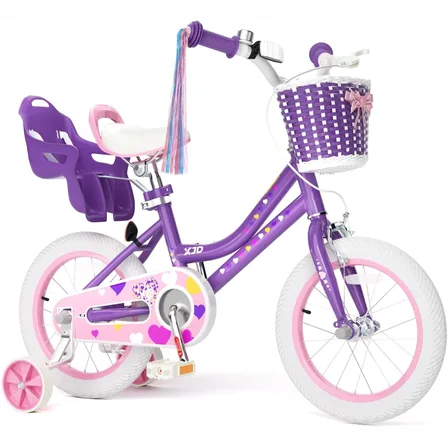
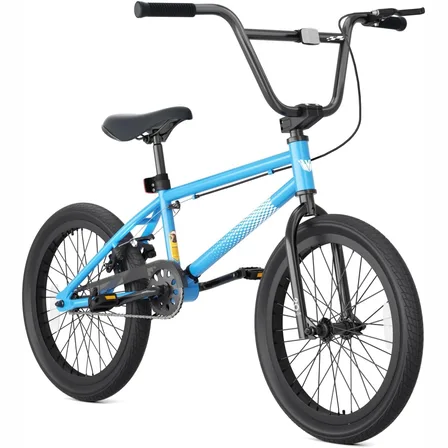
The supplied catalog includes two useful 20-inch possibilities with different catalog classifications. Girls' Training Wheel Bike by XJD with Basket – Purple is categorized as a Training Wheel Bike and offers 14 Inch, 16 Inch and 20 Inch SKU labels, so select the 20 Inch label when evaluating it for this question. Blue XJD Freestyle BMX Bike, 20-Inch – No Pegs is categorized as a Kids' BMX Bike and its exact title identifies it as 20-inch. These options help families compare catalog types after confirming that a 20-inch wheel size is appropriate; their categories alone do not establish individual fit.
 Girls' Training Wheel Bike by XJD with Basket – Purple
Available with a 20 Inch SKU label, this Training Wheel Bikes catalog option is relevant after the rider passes individual height, stand-over, reach, braking and confidence checks.
 Blue XJD Freestyle BMX Bike, 20-Inch – No Pegs
Its exact title identifies a 20-inch model in the Kids' BMX Bikes category, making it relevant for riders who fit the 20-inch starting range and pass an individual fit check.
Neither title supplies frame geometry, component specifications, load limits or adjustment details. Do not infer that the two bikes will feel or fit identically simply because both can be considered at 20 inches. Compare each exact bicycle in person where possible, and follow its manual for assembly, adjustment, compatibility and maintenance. Use a qualified bicycle mechanic when the manual does not resolve a setup question.
When a 20-inch bike is not the answer
Look at another size when the measured height falls outside the 48–60-inch starting range, then perform the same individual checks. Within that range, reject a particular 20-inch model if the child lacks stand-over room, cannot comfortably reach the controls, struggles to brake reliably or loses confidence during basic starts and stops.
Riding experience matters, but it does not turn a poor physical fit into a good one. Training-wheel or BMX catalog classification should guide which type a family evaluates; it should never override measured height and demonstrated control.
Do this before deciding
- Record the child’s current standing height and inseam.
- Use 48–60 inches (122–152 cm) as the 20-inch starting range.
- Try the exact model and check stand-over, reach, steering, braking, starts and stops.
- Compare an overlapping neighboring size if any control check is uncertain.
- Fit a bicycle helmet so it sits level, fits properly and has straps positioned according to the helmet manufacturer’s instructions.
Choose a 20-inch bike only when the child’s measurements point to that range and the child can control the exact bicycle today; otherwise, compare the appropriate neighboring size rather than waiting for the rider to grow into it.
Bikes for your next adventure
-
XJD Light Purple Girls Bike with Basket, Training Wheels, 12/14/16/20 Inch
The XJD Girls Bike with Basket in Light Purple is a single-speed training-wheel …$99.99
$119.99 -

26-Inch XJD Beach Cruiser Bike for Girls – Purple, V-Brake
This XJD 26-inch purple beach cruiser is sized for big kids and teens — suggeste…$218.49
$229.99 -
Blue XJD Freestyle BMX Bike, 20-Inch – No Pegs
The XJD 20-Inch Blue Freestyle BMX is an entry-level BMX bike for boys and girls…$189.99