

A bike for a 5 year old girl
For most 5-year-old girls, start by comparing a 14-inch and 16-inch bike, then choose by measured height, inseam, reach, brake control and confidence—not age alone.
Start with her height
Measure her standing height without shoes, with her back against a wall. At age five, the relevant XBikes starting ranges usually overlap:
| Wheel size | XBikes starting range | What it means at age five |
|---|---|---|
| 12 Inch | Ages 3–4; 34–40 in / 86–102 cm | Consider only if her measured height still falls within this range and the bike fits properly. |
| 14 Inch | Ages 3–6; 37–45 in / 94–114 cm | A likely comparison size for a smaller or less confident five-year-old. |
| 16 Inch | Ages 4–7; 40–48 in / 102–122 cm | A likely comparison size for a taller five-year-old who can control it comfortably. |
| 18 Inch | Ages 5–9; 43–52 in / 109–132 cm | Age permits consideration, but height and hands-on control must support the larger size. |
The overlap is important: a child who is 42 inches tall could begin with either a 14-inch or 16-inch comparison. Her individual fit and control should decide. Do not jump to an oversized bike merely to leave room for growth.
Measure inseam and test stand-over clearance
Measure inseam from the floor to the crotch while she stands straight in shoes similar to those she will wear while riding. Do not convert that measurement directly into a wheel size without checking the exact bicycle, because frame shapes differ.
Have her stand over the bicycle with both feet flat on the ground. She needs comfortable clearance rather than contact with the frame. She should also be able to get on and off without the bike pulling her onto tiptoes or forcing her to lean sharply. If stand-over feels crowded, compare a smaller frame or wheel-size option.
Check reach, brakes and confidence
Seat her on the bike and watch her upper body. She should reach the handlebar without locking her elbows, stretching her shoulders or sliding forward unnaturally. Ask her to turn the handlebar both ways while remaining balanced.
She must be able to operate the bicycle’s braking controls confidently. Because the supplied catalog facts do not identify brake types, inspect the exact model and follow its product manual. If her hands cannot reach or control the brakes as intended, that bike is not a suitable fit even when her height falls within the stated range.
Current confidence matters too. A nervous beginner may handle the smaller of two correctly fitting options more easily, while a practiced rider may be comfortable on the larger one. Training wheels can provide support, but they do not make an oversized or poorly controlled bicycle appropriate.
How the supplied girls’ bikes compare
The catalog offers two relevant training-wheel bikes in the same four labeled wheel sizes, making them useful for comparing 12-, 14-, 16- and 20-inch options after you establish the likely fit range.
 XJD Girls' Bike with Training Wheels, 12/14/16/20 Inch – Purple
A purple training-wheel bike offered in 12, 14, 16 and 20 Inch labels. Its 14- and 16-inch options are relevant comparisons for many five-year-olds, subject to an individual fit check.
 XJD Kids Bike for Girls – Pink, 12/14/16/20 Inch with Training Wheels
A pink training-wheel bike available in 12, 14, 16 and 20 Inch labels. Compare its relevant size options using the child’s measured height, stand-over clearance, reach, brake control and confidence.
XJD Girls' Bike with Training Wheels, 12/14/16/20 Inch – Purple is listed as a Training Wheel Bike and is offered in 12 Inch, 14 Inch, 16 Inch and 20 Inch labels. Its purple catalog description may help with preference, but it does not establish fit.
XJD Kids Bike for Girls – Pink, 12/14/16/20 Inch with Training Wheels is also listed as a Training Wheel Bike with 12 Inch, 14 Inch, 16 Inch and 20 Inch labels. The verified facts distinguish its pink presentation, not its geometry, components or performance.
For many five-year-olds, the 14-inch and 16-inch versions are the useful first comparisons. The listed 12-inch option may remain relevant below or near 40 inches, subject to a fit check. The 20-inch label starts at ages 7–12 and 48–60 inches / 122–152 cm, so age five alone does not support choosing it. Neither supplied product offers an 18-inch label; if her measurements point toward 18 inches, these products are nearest-size comparison points, not 18-inch substitutes.
Complete the in-person check
- Measure her height and inseam before shopping.
- Use height to shortlist sizes, usually 14 or 16 inches for this age, while considering 12 or 18 inches only when her measurements support them.
- Have her try the exact bicycle and check stand-over clearance, mounting, reach, steering and brake operation.
- Reject any bike she cannot control calmly, even if its age label appears suitable.
- Fit a bicycle helmet so it sits level, fits properly and has straps adjusted according to its manufacturer’s instructions.
For assembly, adjustments, maintenance, load limits, compatibility and torque, follow the exact product manual or use a qualified bicycle mechanic.
The decision for your 5-year-old
If she measures 37–45 inches / 94–114 cm, begin by trying a 14-inch bike; at 40–48 inches / 102–122 cm, compare a 16-inch bike as well. Where the ranges overlap, choose the bicycle she can stand over, reach, steer and brake with greater control—not the one she might grow into later.
Bikes for your next adventure
-

Pink Girls' 12/14/16" Bike by XJD – Basket & Doll Seat
The XJD Pink Girls' Bike with Basket & Doll Seat is made for riders 71–122 cm ta…$75.99
$99.99 -
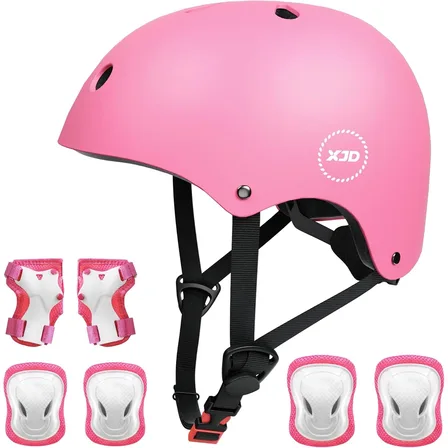
XJD Kids Helmet & Protective Gear Set for Girls, Pink
The XJD Kids Helmet & Protective Gear Set in Pink is a complete safety kit for g…$24.64
-
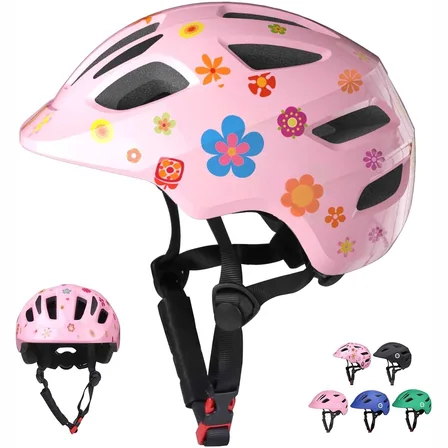
XJD Kids Bike Helmet for Girls, Pink Flowers, Adjustable (XS–S)
The XJD Kids Bike Helmet in Pink Flowers is an adjustable toddler-and-kids helme…$21.24
$24.99