

Are bikes different for girls and boys
No—girls and boys do not inherently need different bikes. Choose by the child’s measured body size, control, and confidence, not by a gender label.
What can actually be different?
A bike marketed to girls or boys may differ in colour, graphics, accessories, or frame styling. Those details can affect what a child enjoys, but they do not establish whether the bicycle fits. A “girls’ bike” is not automatically better for every girl, and a “boys’ bike” is not automatically better for every boy.
The useful comparison is practical: Can the rider stand over the bike comfortably, reach the handlebar without stretching, steer with control, and operate the brakes? The American Academy of Pediatrics advises having the child try the bicycle and avoiding an oversized model bought mainly for future growth.
Measure before comparing labels
- Measure standing height: Have the child stand upright without shoes against a wall and record the floor-to-head measurement.
- Measure inseam: With feet slightly apart, measure from the floor to the crotch. Use this when checking stand-over clearance and the child’s ability to put feet down.
- Check reach: On the bicycle, the child should be able to hold the handlebar and steer without leaning or stretching excessively.
- Check brake control: Confirm that the child can reach and operate the bicycle’s brakes as intended.
- Consider confidence: A hesitant beginner may need a more reassuring fit than a confident rider of the same height.
Record the measurements rather than relying on clothing size, school year, or whether the product is described for girls or boys.
Use wheel size only as a starting point
| Wheel size | Starting age | Rider height |
|---|---|---|
| 12 Inch | 3–4 | 34–40 in / 86–102 cm |
| 14 Inch | 3–6 | 37–45 in / 94–114 cm |
| 16 Inch | 4–7 | 40–48 in / 102–122 cm |
| 18 Inch | 5–9 | 43–52 in / 109–132 cm |
| 20 Inch | 7–12 | 48–60 in / 122–152 cm |
| 24 Inch | 10–14 | 54–64 in / 137–163 cm |
| 26 Inch | Youth and adults | Over 60 in / 153 cm |
These XBikes ranges overlap because age and height do not produce identical proportions or riding ability. Start with measured height, then confirm inseam, stand-over, reach, brake control, and confidence on the actual bike. Never move up merely because a child is near a birthday or because a larger bicycle may last longer.
How the supplied girls’ and boys’ options compare
The two catalog options help answer the question because both exact titles identify them for boys and girls, while their selectable wheel sizes allow the same fit-led comparison. They show that the meaningful choice is not the rider’s gender label but the suitable size and the type of catalog option being considered.
 XJD Boys & Girls BMX Bike with Training Wheels, 12/14/16" – Blue
A boys-and-girls Kids’ BMX Bike catalog option with training wheels and 12 Inch, 14 Inch, and 16 Inch size labels, relevant for comparing fit rather than gender.
 XJD Kids' Training Wheel Bike for Boys & Girls, 12/14/16 Inch – White
A boys-and-girls Training Wheel Bike catalog option offered with 12 Inch, 14 Inch, and 16 Inch size labels; select only after checking the individual rider’s measurements and control.
XJD Boys & Girls BMX Bike with Training Wheels, 12/14/16" – Blue is listed under Kids’ BMX Bikes and offers 12 Inch, 14 Inch, and 16 Inch SKU labels. XJD Kids' Training Wheel Bike for Boys & Girls, 12/14/16 Inch – White is listed under Training Wheel Bikes and offers the same three size labels.
Those facts let you compare category, title, colour wording, and available size labels. They do not establish dimensions beyond wheel size, brake type, weight, materials, load limits, or suitability for an individual rider. If the child’s measured range points to 18, 20, 24, or 26 Inch, these products are smaller-size comparison points—not substitutes for the indicated wheel size.
Try the bike and make the decision
With the child wearing ordinary riding footwear, have them try the candidate bike. Check that they can stand over it, get on and off without struggling, sit in a controlled position, hold the handlebar naturally, turn it, and use the brakes. Compare more than one size when height ranges overlap. Reject a bike that forces stretching, compromises control, or is deliberately oversized for growth, regardless of whether its colour or title appeals to the child.
For assembly, adjustment procedures, maintenance, compatibility, load limits, and torque, follow the exact product manual or use a qualified bicycle mechanic; these details cannot be inferred from a wheel-size label.
Do not overlook the helmet
A girls’ or boys’ designation also has no bearing on helmet fit. The U.S. Consumer Product Safety Commission advises using a bicycle helmet that fits properly, sits level, and has its straps adjusted according to the helmet manufacturer’s instructions. Recheck the fit rather than assuming an existing helmet still suits a growing child.
The next step is simple: measure the rider, shortlist the matching wheel-size range, and conduct an individual control check. Let the child choose styling only after both the “girls’” and “boys’” candidates have passed the same fit test.
Bikes for your next adventure
-
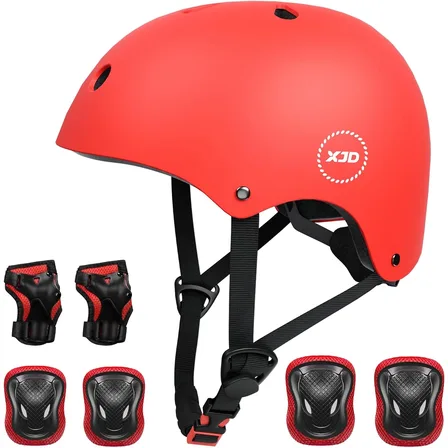
Red XJD Helmet & Protective Gear Set for Kids, Medium
If your child rides a bike, scooter, or skateboard, this red XJD helmet and prot…$25.49
$29.99 -
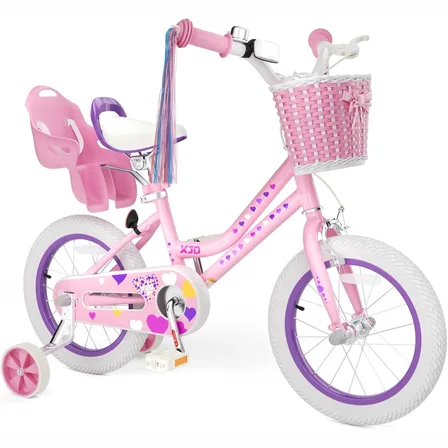
Light Pink XJD Girls' Bicycle with Basket & Training Wheels
The Light Pink XJD Girls' Bicycle with Basket & Training Wheels is a retro-style…$109.99
$129.99 -

XJD Girls BMX Bike 12/14/16 Inch with Training Wheels – Pink Blue
The XJD Girls BMX Bike in Pink/Blue is built as a first pedal bike for kids roug…$99.99
$119.99