

Can a girl ride a boy bike
Yes, a girl can ride a “boy” bike. The label does not determine fit: choose the bike she can stand over, reach, steer and brake comfortably.
What matters more than the boy or girl label
For a child, the useful comparison is between her measurements and the bicycle’s actual fit—not the gender wording in its name. Frame shape, colors and catalog labels do not tell you whether she can control a particular bike.
Have her try the bicycle whenever possible. HealthyChildren guidance from the American Academy of Pediatrics advises against buying an oversized bike for a child to grow into. A bike that is too large can make starting, stopping and steering harder.
Keep the “boy bike” only if she can use it confidently now. If the label is the only concern and the fit checks below succeed, there is no fit-based reason she cannot ride it.
Measure before comparing wheel sizes
Measure her standing height without shoes. Then measure her inseam from the floor to the crotch while she stands straight with her feet slightly apart. Use the following XBikes figures as starting points, not as proof of fit:
| Wheel size | Starting age | Rider height |
|---|---|---|
| 12 Inch | 3–4 | 34–40 in / 86–102 cm |
| 14 Inch | 3–6 | 37–45 in / 94–114 cm |
| 16 Inch | 4–7 | 40–48 in / 102–122 cm |
| 18 Inch | 5–9 | 43–52 in / 109–132 cm |
| 20 Inch | 7–12 | 48–60 in / 122–152 cm |
| 24 Inch | 10–14 | 54–64 in / 137–163 cm |
| 26 Inch | Youth and adults | Over 60 in / 153 cm |
Where ranges overlap, do not choose by age alone. Her measured height, inseam, reach, brake control and current confidence should decide which bicycle fits. Wheel size is only one part of that decision.
Run a hands-on fit check
Ask her to wear the shoes she will normally ride in, then check the bike on level ground with an adult holding it steady.
- Stand-over: Have her straddle the frame with both feet flat. She should not be forced onto tiptoes or pressed uncomfortably against the bike.
- Starting and stopping: Confirm that she can get into position, begin moving and put a foot down without panic or awkward stretching.
- Reach: With her seated in a normal riding posture, she should reach the handlebar without locking her elbows, leaning excessively or losing stable control.
- Brake control: She must be able to reach and operate the bike’s braking controls reliably. Do not assume a suitable wheel-size range guarantees this.
- Steering: Ask her to turn the handlebar both ways and make a slow, controlled turn. Her knees, hands and body should move freely.
If any check fails, adjust the bicycle only as permitted by its exact manual. If adjustment does not produce comfortable control, choose another size or model rather than expecting her to adapt.
How the supplied XBikes options are relevant
The two catalog options make the gender question especially clear: both exact titles identify the bicycles for boys and girls, and both offer 12, 14 and 16 Inch choices. They are useful comparison options only when one of those sizes matches her measurement-based starting range and the individual fit check succeeds.
 XJD Kids' Training Wheel Bike for Boys & Girls, 12/14/16 Inch – White
A boys-and-girls Training Wheel Bike offered in 12, 14 and 16 Inch labels; relevant when the rider’s measurements indicate one of those starting sizes and an individual fit check confirms control.
 XJD Boys & Girls BMX Bike with Training Wheels, 12/14/16" – Blue
A boys-and-girls Kids' BMX Bike with training wheels, offered in 12, 14 and 16 Inch labels; compare it by measured fit and control rather than the gender wording in its title.
XJD Kids' Training Wheel Bike for Boys & Girls, 12/14/16 Inch – White is categorized as a Training Wheel Bike and is available in 12 Inch, 14 Inch and 16 Inch labels. Compare the appropriate label with her measured height, then confirm stand-over, reach and control in person.
XJD Boys & Girls BMX Bike with Training Wheels, 12/14/16" – Blue is categorized as a Kids' BMX Bike and also has 12 Inch, 14 Inch and 16 Inch labels. Its title includes boys and girls, but that wording still does not replace a fit check.
These products are not suitable substitutes when her measurements and control point to 18, 20, 24 or 26 Inch wheels. No supplied product offers those wheel-size labels. Likewise, two bikes carrying the same wheel-size label may still differ in practical stand-over and reach, so compare the actual fit rather than treating them as interchangeable.
Finish the safety and setup check
Use a bicycle helmet that fits properly, sits level and has its straps adjusted according to the helmet manufacturer’s instructions, consistent with U.S. Consumer Product Safety Commission guidance. Recheck the fit rather than relying only on an age label.
For assembly, maintenance, load limits, compatibility and torque, follow the exact bicycle manual or use a qualified bicycle mechanic. Do not guess at adjustments that affect control.
The decision is simple: let her ride the “boy” bike if her measurements place her in the appropriate starting range and she passes every hands-on control check; otherwise, choose a bike that fits her now.
Bikes for your next adventure
-
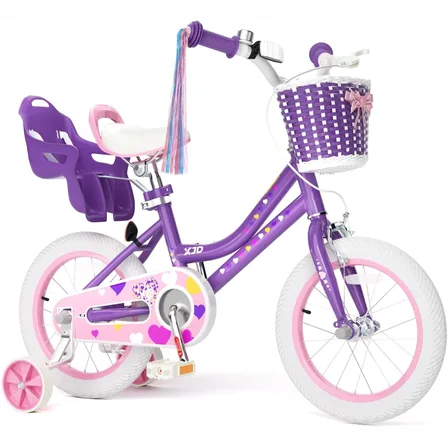
XJD Light Purple Girls Bike with Basket, Training Wheels, 12/14/16/20 Inch
The XJD Girls Bike with Basket in Light Purple is a single-speed training-wheel …$99.99
$119.99 -
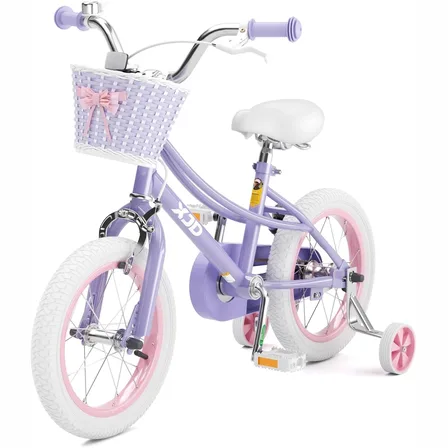
Girls' Training Wheel Bike by XJD with Basket – Purple
If you're shopping for a first bike for a girl roughly 3 to 12 years old (91–152…$75.99
-
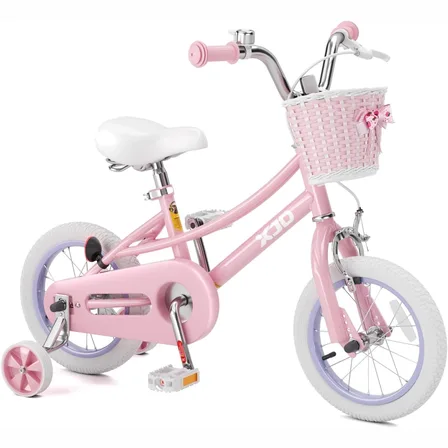
Pink 12/14/16/20" XJD Girls Bike with Training Wheels & Basket
The Pink XJD Girls Bike with Training Wheels & Basket is a first-bike pick f…$65.99
$75.99