

Can girls ride bikes
Yes—girls can ride bikes. Gender does not determine whether a child can learn, balance, pedal or enjoy cycling; correct fit, control and confidence do.
What matters instead of gender
A label such as “girls’ bike” may describe how a model is marketed, but it is not a fit measurement. Choose a bicycle by the rider’s measured height, inseam, reach, ability to operate the brakes and present confidence. Age is only a starting point.
Have the child try the bicycle whenever possible. Do not choose an oversized model merely to leave room for growth. A bike that is too large can make starting, stopping, steering and reaching the controls more difficult.
Measure and check the rider
- Measure height: Have the child stand straight without shoes against a wall, then measure from the floor to the top of the head.
- Measure inseam: With feet slightly apart, measure from the floor to the crotch. Use this measurement when checking stand-over room and saddle adjustment on the actual bicycle.
- Check stand-over: Ask the rider to straddle the bicycle with both feet on the ground. The frame should not prevent a comfortable, controlled stance.
- Check reach: Seated in a normal riding position, the child should reach the handlebar without stretching, locking the arms or losing a stable posture.
- Check brake control: The rider must be able to reach and operate the fitted brakes confidently. Because brake details are not supplied for the catalog options below, confirm them on the exact bicycle.
Also watch a short trial: can she mount, look ahead, steer, start and stop without the bicycle overwhelming her? If not, reconsider the size or learning setup.
Use wheel size as a starting point
| Wheel size | Starting age | Rider height |
|---|---|---|
| 12 Inch | 3–4 | 34–40 in / 86–102 cm |
| 14 Inch | 3–6 | 37–45 in / 94–114 cm |
| 16 Inch | 4–7 | 40–48 in / 102–122 cm |
| 18 Inch | 5–9 | 43–52 in / 109–132 cm |
| 20 Inch | 7–12 | 48–60 in / 122–152 cm |
| 24 Inch | 10–14 | 54–64 in / 137–163 cm |
| 26 Inch | Youth and adults | Over 60 in / 153 cm |
Overlapping ranges are normal. Start with measured height, then verify inseam clearance, reach, brake operation and confidence on the individual bicycle. Do not move up solely because the child is at a particular age.
How the supplied girls’ bike options compare
The two catalog options are relevant when a girl is learning with a training-wheel bicycle and her fit check points to an available size. They make it possible to compare 12-, 14-, 16- and 20-inch labels without treating “for girls” as evidence of fit.
 XJD Kids' Training Wheel Bike for Boys & Girls, 12/14/16 Inch – White
A training-wheel bicycle with supplied 12 Inch, 14 Inch and 16 Inch SKU labels, relevant when the rider’s measurements, control and confidence support one of those sizes.
 Girls' Training Wheel Bike by XJD, 12–20 Inch Wheels – Blue
A training-wheel bicycle with supplied 12 Inch, 14 Inch, 16 Inch and 20 Inch SKU labels, adding a 20 Inch comparison for riders who pass an individual fit check.
XJD Kids' Training Wheel Bike for Boys & Girls, 12/14/16 Inch – White is listed in the Training Wheel Bikes category and is available with 12 Inch, 14 Inch and 16 Inch SKU labels.
Girls' Training Wheel Bike by XJD, 12–20 Inch Wheels – Blue is also listed as a Training Wheel Bike. Its supplied available SKU labels are 12 Inch, 14 Inch, 16 Inch and 20 Inch.
The blue catalog option therefore adds a supplied 20 Inch choice; both include 12, 14 and 16 Inch choices. Neither supplied product has an available 18 Inch SKU label, despite the second title spanning “12–20 Inch,” so these products are only nearest-size comparison points when an individual fit check indicates 18 Inch—not substitutes for it. Neither supplies a 24 Inch or 26 Inch option.
Decide whether training wheels are relevant
These products specifically belong to the Training Wheel Bikes category. That makes them relevant if the intended learning setup includes training wheels. If the rider already balances independently, wants a different learning approach or needs 18-, 24- or 26-inch wheels, do not assume these options meet the need merely because one title says “Girls’.”
For assembly, adjustment, maintenance, load limits, compatibility and torque, follow the manual for the exact product or use a qualified bicycle mechanic. Those details are not provided here and should not be guessed.
Prepare for the first ride
Use a bicycle helmet that fits properly, sits level and has its straps adjusted according to the helmet manufacturer’s instructions. Begin in a suitable riding area away from traffic and obstacles, with close adult supervision and enough space for controlled starts, turns and stops.
The practical answer is simple: a girl can ride any appropriately fitted bike. Measure her height and inseam now, compare the matching wheel-size starting points, then accept a catalog option only after she can stand over it, reach it, control its brakes and ride with confidence.
Bikes for your next adventure
-
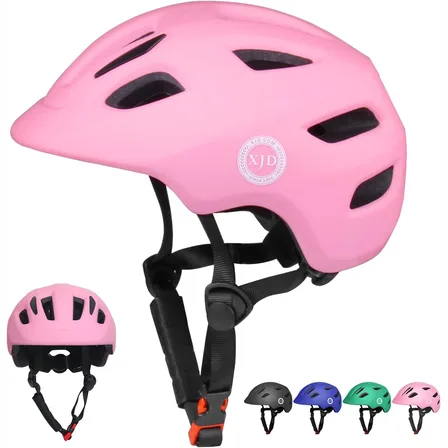
Pink Adjustable Kids Helmet by XJD – Toddler Bike Helmet, XS & S
This Pink XJD Adjustable Kids Helmet is built for toddlers and kids who ride bik…$21.24
-
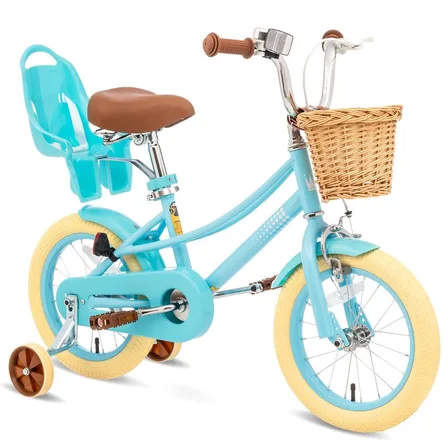
Girls' Training Wheel Bike by XJD, 12–20 Inch Wheels – Blue
This XJD girls' training wheel bike in Blue covers one of the widest fit ranges …$139
$159 -

XJD Kids Bike for Girls – Pink, 12/14/16/20 Inch with Training Wheels
The XJD Kids Bike for Girls in Pink is a training-wheel bike built to carry your…$139
$159