

How to tell if its a girl bike
A “girl bike” is usually identified by its catalog label, colours or accessories—not by a universal technical standard. To choose correctly, measure the child and check fit and control rather than relying on the label.
What actually makes it a girl bike?
There is no single measurement, wheel size or frame feature that proves a bicycle is for girls. Manufacturers and shops may use “girls’ bike” as a product description, often alongside particular colours or accessories. That wording can help you find a preferred appearance, but it does not determine who can ride the bike or whether it fits.
Ask the child whether they like the bike, then treat “girl” as a style or catalog category. Treat wheel size, stand-over clearance, reach and brake access as separate fit questions. A bicycle marketed for girls can fit poorly, while a differently labelled bicycle can fit well.
Measure before comparing labels
Measure the rider’s standing height without shoes. Then measure inseam from the floor to the crotch while the child stands naturally. Use the height ranges below to identify a starting wheel size, but have the child try the actual bicycle whenever possible.
| Wheel size | Starting age | Rider height |
|---|---|---|
| 12 Inch | 3–4 | 34–40 in / 86–102 cm |
| 14 Inch | 3–6 | 37–45 in / 94–114 cm |
| 16 Inch | 4–7 | 40–48 in / 102–122 cm |
| 18 Inch | 5–9 | 43–52 in / 109–132 cm |
| 20 Inch | 7–12 | 48–60 in / 122–152 cm |
| 24 Inch | 10–14 | 54–64 in / 137–163 cm |
| 26 Inch | Youth and adults | Over 60 in / 153 cm |
Overlapping ranges are normal. Prioritise measured height, inseam, reach, brake control and current confidence over age. Do not move up a size merely to leave room for growth.
Perform the fit check
- Check stand-over: with the child straddling the bicycle, confirm that they can stand securely rather than being forced onto their toes or against the frame.
- Check the riding position: seat the child and confirm that the handlebar is reachable without an uncomfortable stretch, locked elbows or loss of steering control.
- Check starting and stopping: the rider should be able to get on, set off, steer and stop without the bicycle overwhelming their present confidence.
- Check brake access: confirm that the child can reach and operate the bicycle’s provided braking controls. Do not assume a particular brake type when comparing these catalog listings.
If any check fails, try another size or design. Adjustments, assembly, compatibility and torque should follow the exact product manual; consult a qualified bicycle mechanic when uncertain.
How the supplied girls’ bikes compare
These three catalog options are relevant because each is explicitly labelled as a girls’ bike and offers listed 12, 14 and 16 Inch choices. They let you compare catalog styling and bike category only after measurements point to one of those sizes.
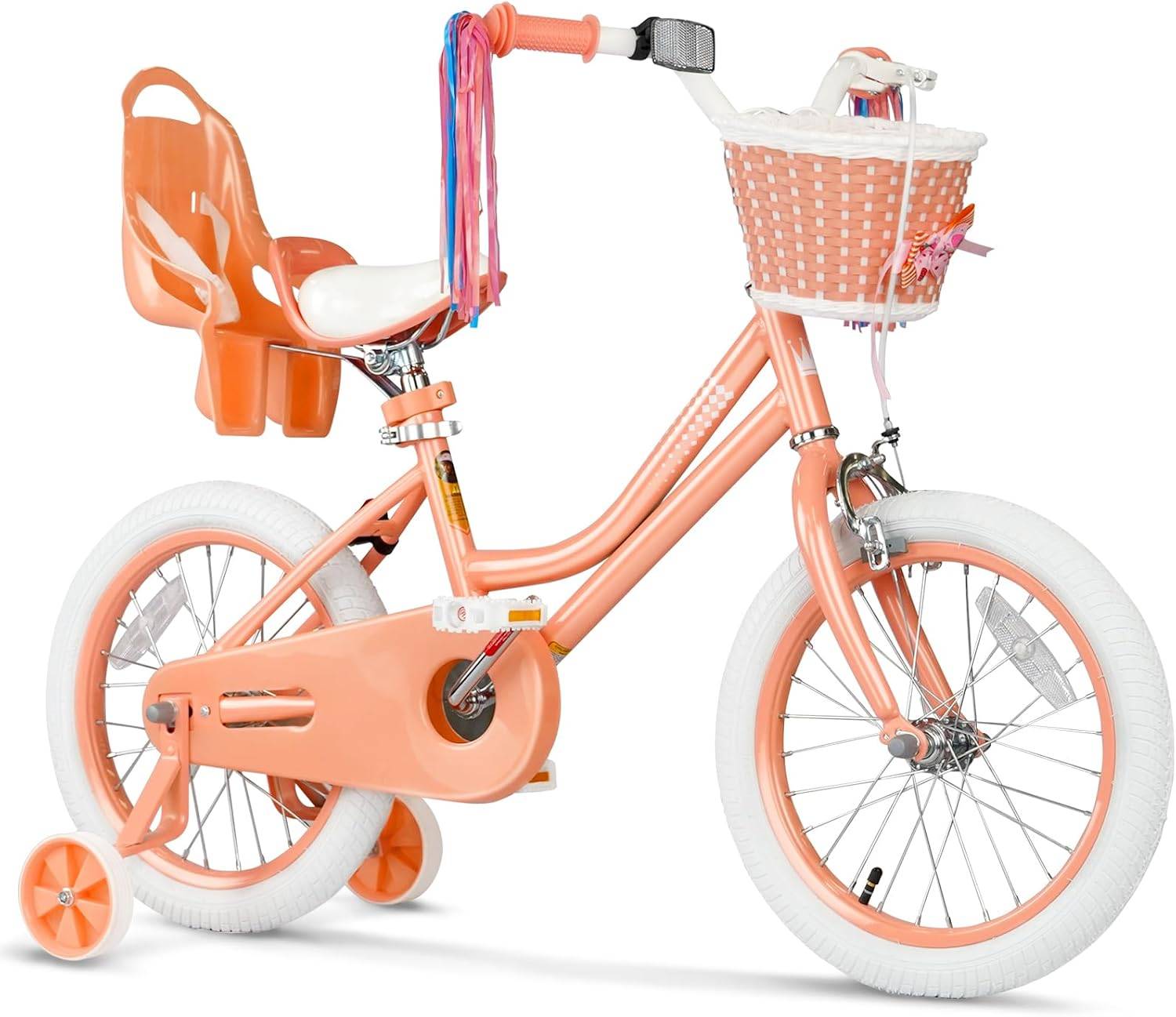 Girls 12/14/16 Inch Kids Bike by XJD with Training Wheels – Peach
A girls-labelled Training Wheel Bike offered with available 12, 14 and 16 Inch SKU labels; relevant when the rider’s measurements and fit check support one of those sizes.
 XJD Light Purple Girls Bike with Basket, Training Wheels, 12/14/16/20 Inch
A girls-labelled Training Wheel Bike with basket wording and available 12, 14 and 16 Inch SKU labels. The exact title mentions 20 Inch, but 20 Inch is not among the supplied available labels.
 XJD Girls BMX Bike 12/14/16 Inch with Training Wheels – Pink Blue
A girls-labelled Kids’ BMX Bike with training wheels in its title and available 12, 14 and 16 Inch SKU labels; useful for comparing the BMX category after determining fit.
Girls 12/14/16 Inch Kids Bike by XJD with Training Wheels – Peach is categorized as a Training Wheel Bike, with available SKU labels of 12 Inch, 14 Inch and 16 Inch.
XJD Light Purple Girls Bike with Basket, Training Wheels, 12/14/16/20 Inch is also categorized as a Training Wheel Bike. Although “20 Inch” appears in its exact catalog title, the supplied available SKU labels are only 12 Inch, 14 Inch and 16 Inch. Verify the selectable size rather than inferring availability from the title.
XJD Girls BMX Bike 12/14/16 Inch with Training Wheels – Pink Blue is categorized as a Kids’ BMX Bike and has available 12 Inch, 14 Inch and 16 Inch SKU labels. Its BMX category distinguishes it from the two Training Wheel Bike listings, but does not replace an individual fit check.
These products are relevant only when the rider’s measurements and hands-on check support a listed size. If the child needs 18, 20, 24 or 26 Inch, these listings are not equal substitutes.
Do not confuse presentation with suitability
Colour, a basket, training wheels and category wording can help the child choose an appearance or format they enjoy. None establishes correct sizing. Likewise, “girls” in a title is not evidence that the reach, stand-over clearance or controls will suit a particular child.
Training wheels may also be relevant to current confidence, but their presence does not justify buying an oversized bicycle. Follow the product manual for assembly, adjustment, maintenance and limits, or ask a qualified bicycle mechanic for help.
Make the final decision
First select a starting wheel size from measured height, then compare inseam, stand-over, reach, brake access and confidence on the actual bike. Add a properly fitting bicycle helmet that sits level and uses its straps according to the helmet manufacturer’s instructions. Choose a girls-labelled model only if the child likes it and it passes those checks; otherwise, choose the bicycle that fits and can be controlled.
Bikes for your next adventure
-

Kids Bike Helmet by XJD for Boys & Girls – Black, Blue, Green, Pink, Purple
The XJD Kids Bike Helmet covers a wide 2-to-8-year age range thanks to two head-…$59.99
-

Kids Bike Helmet by XJD for Girls – Pink
The XJD Kids Bike Helmet in Pink is a lightweight multi-sport helmet for girls r…$59.99
$99 -

XJD Kids Bike for Girls – Pink, 12/14/16/20 Inch with Training Wheels
The XJD Kids Bike for Girls in Pink is a training-wheel bike built to carry your…$139
$159