

Is It Uncomfortable for Girls to Ride Bikes?
No. Bike riding should not be uncomfortable for girls. Discomfort usually signals poor fit, awkward reach, incorrect setup or low confidence—not the rider’s gender.
What to measure before choosing a bike
Measure the rider rather than relying on age or a “girls’ bike” label. Record her height without shoes. For inseam, have her stand straight with her feet slightly apart and measure from the floor to the crotch. These measurements provide a starting point for comparing wheel sizes, but they do not replace trying the actual bicycle.
During a fit check, look at four things: stand-over room, reach to the handlebar, access to the brake controls and overall confidence. She should be able to stand over the bike without the frame pressing uncomfortably into her body. She should not need to stretch, twist her wrists or shift forward simply to steer or operate the brakes.
Compare her measurements with these starting points
Use the measured height first and age only as a secondary clue. Where size ranges overlap, the better choice is the bike she can control comfortably after an individual fit check.
| Wheel size | Starting age | Rider height |
|---|---|---|
| 12 Inch | 3–4 | 34–40 in / 86–102 cm |
| 14 Inch | 3–6 | 37–45 in / 94–114 cm |
| 16 Inch | 4–7 | 40–48 in / 102–122 cm |
| 18 Inch | 5–9 | 43–52 in / 109–132 cm |
| 20 Inch | 7–12 | 48–60 in / 122–152 cm |
| 24 Inch | 10–14 | 54–64 in / 137–163 cm |
| 26 Inch | Youth and adults | Over 60 in / 153 cm |
Do not move up to an oversized bicycle merely to leave room for growth. A larger bike can make mounting, steering and braking harder now. If her height falls near a boundary, compare the relevant sizes in person and prioritize inseam clearance, reach, brake control and current confidence.
How to identify the source of discomfort
Ask where and when discomfort appears. Pressure while standing over the frame points to a size or frame-clearance problem. Strained shoulders, straight locked arms or difficulty turning can indicate excessive reach. Trouble reaching or operating the brakes means the controls are not currently suitable for her hands or position.
Also distinguish discomfort from uncertainty. A correctly sized bike can still feel intimidating to a new rider, but fear should not be answered with a larger bicycle. Use a quiet, level practice area and let her stop before fatigue makes control worse. If discomfort continues, stop riding and have the fit and setup checked rather than asking her to tolerate it.
When the supplied girls’ bike is relevant
The Flower Pink XJD Girls Bike with Doll Seat & Basket is cataloged as a Training Wheel Bike and is offered in 12 Inch, 14 Inch and 16 Inch labels. Those options make it relevant when the rider’s measured height falls within the corresponding starting ranges and a training-wheel format suits her present confidence. The doll seat and basket are catalog features, not evidence of fit or comfort.
These catalog options help answer the title because they allow a parent to compare three nearby wheel-size starting points on one girls’ bike while still checking the individual rider on the exact bicycle.
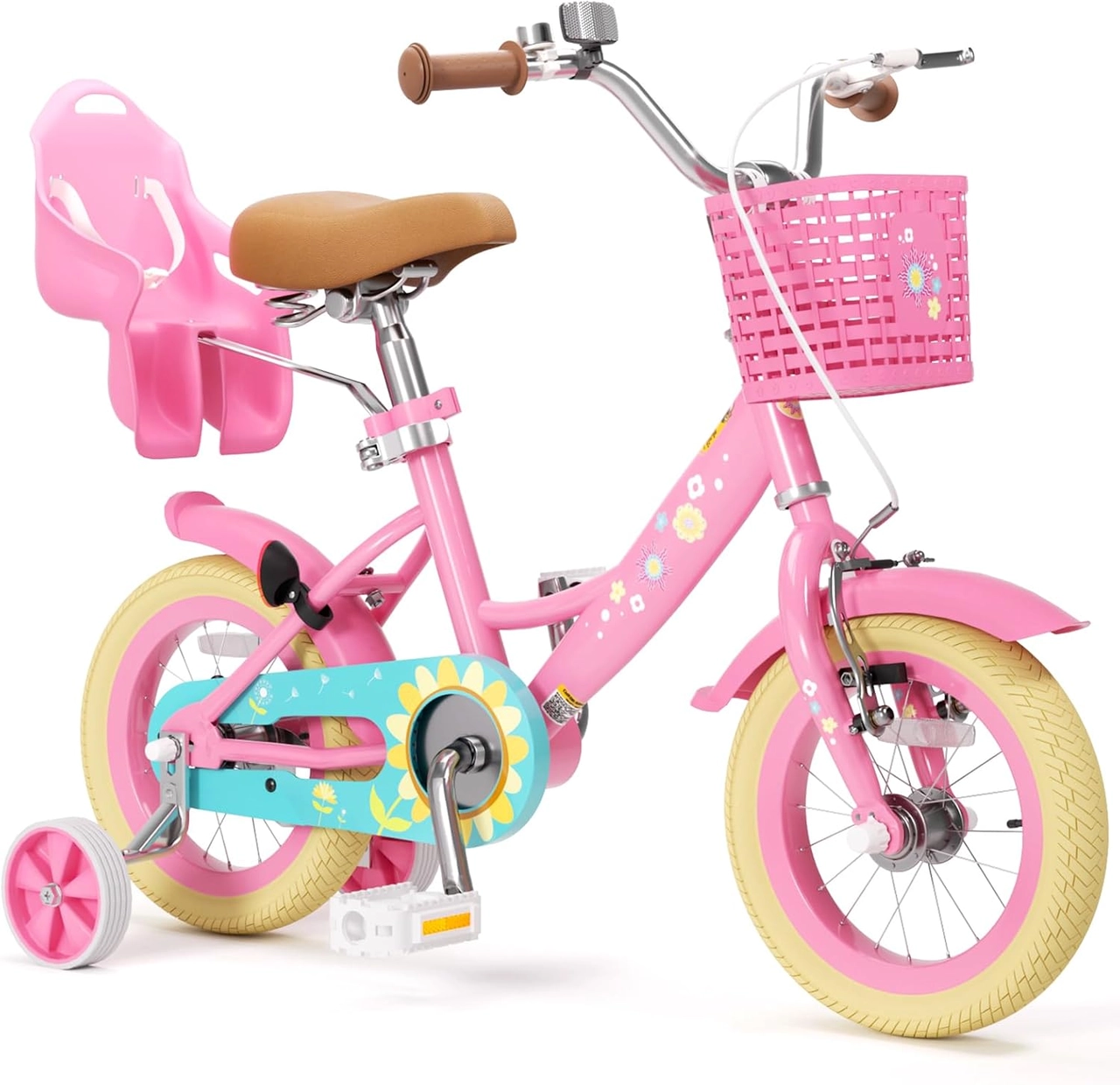
This product is not a substitute when the fit check indicates 18 Inch, 20 Inch, 24 Inch or 26 Inch. Its supplied options stop at 16 Inch; choosing a smaller or larger labeled size does not make it equivalent to the size her measurements and control indicate.
Check setup and protection before riding
Once the likely size is identified, have the child try the assembled bicycle. Confirm that she can mount, stand over, steer and use the brake controls without strain. Do not guess at assembly, adjustment, compatibility, load limits or torque. Follow the exact product manual or ask a qualified bicycle mechanic to inspect and adjust the bike.
A bicycle helmet must fit properly, sit level and have its straps positioned according to the helmet manufacturer’s instructions. A helmet does not correct a poorly fitting bicycle, so check both independently.
Make the decision from control, not color
Choose a bike only if her measured height fits the starting range and the real-world check confirms comfortable stand-over, natural reach, usable brakes and confident control. If any of those fail, compare another size or setup. A girls’ bike should feel manageable to its rider; persistent discomfort is a reason to stop and correct the fit, not part of learning to ride.
Bikes for your next adventure
-

Kids Bike Helmet by XJD for Boys & Girls – Black, Blue, Green, Pink, Purple
The XJD Kids Bike Helmet covers a wide 2-to-8-year age range thanks to two head-…$59.99
-

Kids Bike Helmet by XJD for Girls – Pink
The XJD Kids Bike Helmet in Pink is a lightweight multi-sport helmet for girls r…$59.99
$99 -

XJD Kids Bike for Girls – Pink, 12/14/16/20 Inch with Training Wheels
The XJD Kids Bike for Girls in Pink is a training-wheel bike built to carry your…$139
$159