

Why Do Girls Stop Riding Bikes as They Age?
Girls often stop riding as they age because confidence, bike fit, social belonging and safe opportunities fail to keep pace—not because they lose the ability to ride.
Why interest can fade with age
The change is usually a combination of practical and social barriers. A bike that has become cramped, heavy to control or awkward to mount can make riding feel harder. An oversized replacement can be equally discouraging because the rider may struggle to stand over it, reach the controls or stop confidently.
Social conditions matter too. A girl may ride less when friends choose other activities, cycling feels childish, routes do not feel comfortable, or family rides move at a pace that leaves her behind. Growing self-consciousness can also make an uncomfortable riding position, clothing problem or poorly fitting helmet feel like a reason to quit.
Ask what changed before replacing the bike
A calm, specific conversation is more useful than asking whether she still likes cycling. Ask when riding stopped being enjoyable: after a growth spurt, a difficult fall, a move to busier streets, separation from riding friends, or repeated trouble keeping up.
- Fit: Does mounting, starting, steering or stopping feel awkward?
- Control: Can she comfortably reach and operate the brakes?
- Confidence: Is she uneasy about speed, balance, traffic or riding surfaces?
- Belonging: Does she have companions, destinations and a style of riding she actually enjoys?
- Comfort: Does anything about the bike, helmet or riding position feel distracting or embarrassing?
Her answers identify the next step. A mechanical or fit problem calls for inspection and adjustment; fear calls for low-pressure practice; a social barrier calls for a different route, companion or purpose.
Measure fit instead of shopping by age
Measure her standing height and inseam, then have her try the bicycle. Age is only a starting point. Check that she can stand over the bike appropriately, reach the handlebar without stretching, operate the brakes, start and stop under control, and turn while remaining confident. Do not buy an oversized bicycle merely to allow room for growth.
| Wheel size | XBikes starting point |
|---|---|
| 12 Inch | Ages 3–4; 34–40 in / 86–102 cm |
| 14 Inch | Ages 3–6; 37–45 in / 94–114 cm |
| 16 Inch | Ages 4–7; 40–48 in / 102–122 cm |
| 18 Inch | Ages 5–9; 43–52 in / 109–132 cm |
| 20 Inch | Ages 7–12; 48–60 in / 122–152 cm |
| 24 Inch | Ages 10–14; 54–64 in / 137–163 cm |
| 26 Inch | Youth and adults over 60 in / 153 cm |
Overlapping ranges are a reason to compare bikes in person, not proof that either size fits. Prioritize measured height, inseam, reach, brake control and present confidence. If adjustment, assembly, compatibility, maintenance or torque is uncertain, follow the exact product manual or ask a qualified bicycle mechanic.
Where the supplied girls’ bikes are relevant
The supplied catalog choices help parents compare early riding options: both are training wheel bikes offered in 12 Inch, 14 Inch and 16 Inch sizes. A comfortable, confidence-building start can support continued riding, but styling alone cannot resolve poor fit, limited riding opportunities or concerns about routes.
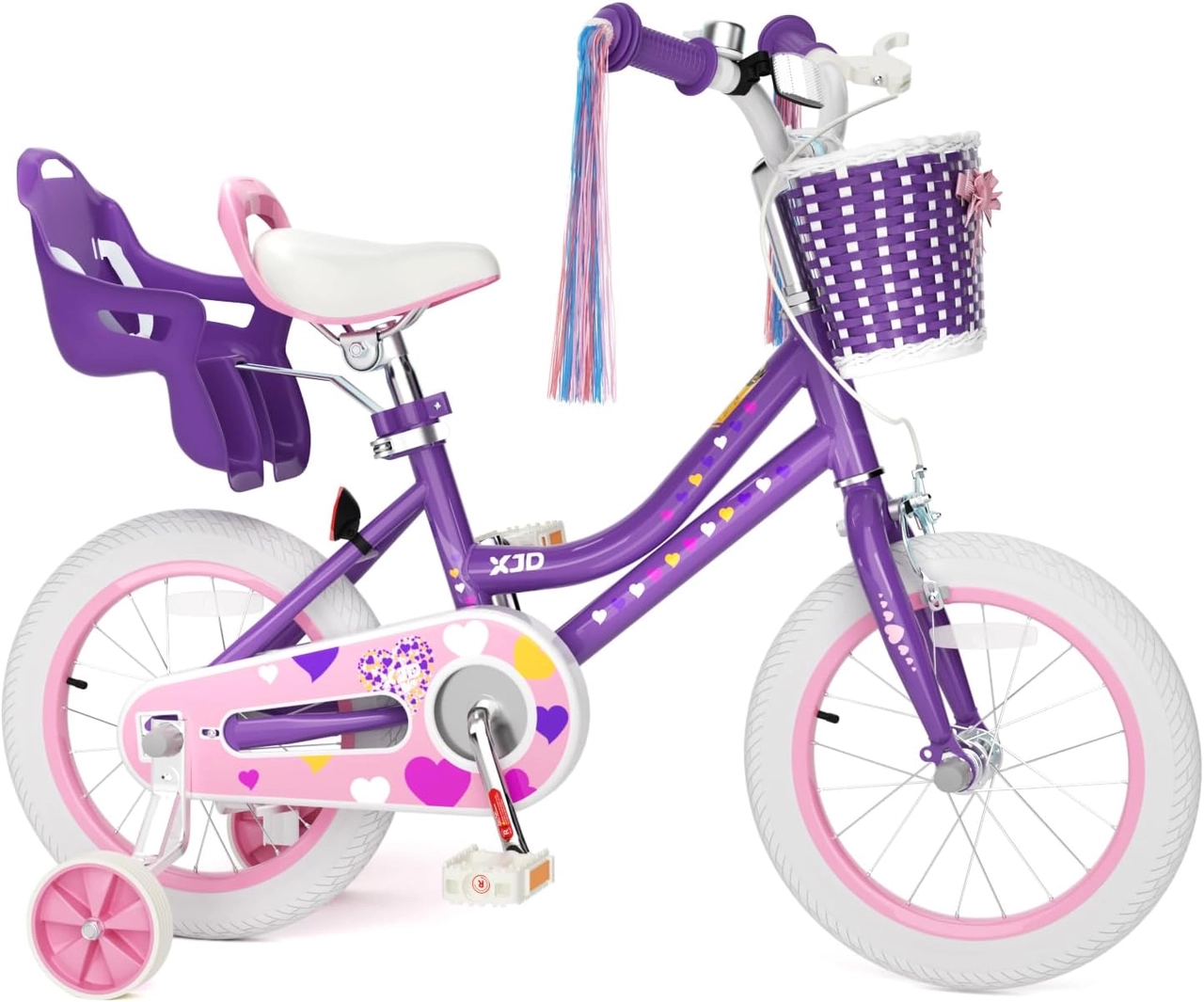 Purple XJD Girls' Bike with Doll Seat & Basket
A training wheel bike offered in 12 Inch, 14 Inch and 16 Inch sizes; relevant for comparing early-fit options when the rider’s measurements and control support one of those sizes.
 Pink Girls' 12/14/16" Bike by XJD – Basket & Doll Seat
A pink training wheel bike with basket and doll seat, offered in 12 Inch, 14 Inch and 16 Inch sizes; consider it only after an individual fit and confidence check.
The Purple XJD Girls' Bike with Doll Seat & Basket is available in 12 Inch, 14 Inch and 16 Inch labels. The Pink Girls' 12/14/16" Bike by XJD – Basket & Doll Seat offers the same listed wheel-size choices. Their supplied differences are the exact catalog titles and color descriptions; no further performance distinction is established by the provided facts.
These products are relevant only when an individual fit check supports one of those sizes and a training wheel bike suits the rider’s current confidence. For an older or taller rider who needs 18, 20, 24 or 26 Inch wheels, they are smaller-size comparison points, not substitutes. Never treat a 12, 14 or 16 Inch model as equal to the size her measurements and control indicate.
Rebuild confidence without making riding a test
Choose a quiet, familiar practice area and let the rider set the pace. Short rides with an appealing destination can reveal more than a pressured skills session. Compare how she starts, stops, turns and reacts when the surface or pace changes. If she remains tense, return to an easier environment rather than interpreting hesitation as lack of interest.
Make the activity socially relevant to her: invite a chosen friend, let her select the route, or connect riding with a destination she values. The goal is not to persuade every girl to love the same kind of cycling; it is to remove avoidable barriers so her decision reflects genuine preference.
Safety and the next decision
Use a bicycle helmet that fits properly, sits level and has straps positioned according to the helmet manufacturer’s instructions. Before a ride, resolve loose, damaged or poorly functioning parts through the product manual or a qualified bicycle mechanic.
Next, measure height and inseam, conduct a real fit and control check, and ask which barrier matters most. Choose a correctly fitting bike and a comfortable riding setting only if she wants to continue. If fit is sound but interest is still absent, respect that answer while leaving cycling available without pressure.
Bikes for your next adventure
-

Kids Bike Helmet by XJD for Boys & Girls – Black, Blue, Green, Pink, Purple
The XJD Kids Bike Helmet covers a wide 2-to-8-year age range thanks to two head-…$59.99
-

Kids Bike Helmet by XJD for Girls – Pink
The XJD Kids Bike Helmet in Pink is a lightweight multi-sport helmet for girls r…$59.99
$99 -

XJD Kids Bike for Girls – Pink, 12/14/16/20 Inch with Training Wheels
The XJD Kids Bike for Girls in Pink is a training-wheel bike built to carry your…$139
$159