

Is there a difference between girls and boys bikes
There is usually no important fit difference between girls’ and boys’ bikes. Choose by the child’s measurements, control and confidence—not the gender label.
What can actually differ?
Manufacturers may use “girls” or “boys” to describe colors, graphics or frame styling. Those labels do not tell you whether a bicycle fits, handles comfortably or matches a child’s ability. Some frame shapes may make mounting easier for a particular rider, but the useful question is whether that individual child can get on, stand over, steer and stop with control.
Compare bicycles of either label using the same criteria: wheel size, stand-over clearance, seated reach to the handlebar, access to the brake controls and ease of starting and stopping. Let the child choose a look they enjoy after the practical fit checks are satisfied.
Measure before comparing labels
Measure the child’s height without shoes, standing straight against a wall. Also measure inseam from the floor to the crotch while the child stands with feet slightly apart. Height provides a wheel-size starting point; inseam helps assess stand-over clearance when the actual bicycle is available.
Then have the child try the bicycle. They should be able to stand over it comfortably, reach the handlebar without an exaggerated stretch and operate the relevant brake controls confidently. Observe whether they can steer, mount and stop without fighting the bike. Current confidence matters: two children with identical measurements may need different setups or sizes.
The American Academy of Pediatrics advises having the child try the bicycle and avoiding an oversized bike bought merely for future growth. A bike that is too large now can make control, stand-over and brake reach more difficult.
Use wheel size only as a starting point
| Wheel size | XBikes age guide | Rider-height guide |
|---|---|---|
| 12 Inch | 3–4 | 34–40 in / 86–102 cm |
| 14 Inch | 3–6 | 37–45 in / 94–114 cm |
| 16 Inch | 4–7 | 40–48 in / 102–122 cm |
| 18 Inch | 5–9 | 43–52 in / 109–132 cm |
| 20 Inch | 7–12 | 48–60 in / 122–152 cm |
| 24 Inch | 10–14 | 54–64 in / 137–163 cm |
| 26 Inch | Youth and adults | Over 60 in / 153 cm |
Overlapping ranges are intentional: a wheel-size label cannot settle the decision by itself. Start with measured height, then use inseam, reach, brake control and confidence to compare the actual bicycles. Age is the least precise clue and should never override a poor fit.
How the supplied training-wheel bike is relevant
The XJD Kids' Training Wheel Bike for Boys & Girls, 12/14/16 Inch – White is listed in the Training Wheel Bikes category and offers catalog size labels of 12 Inch, 14 Inch and 16 Inch. Its “Boys & Girls” wording directly illustrates the main point: a catalog gender label can be inclusive, while the correct size still depends on the rider. These options are useful comparison points for children whose measured height falls near the supplied 12-, 14- or 16-inch starting ranges and who are considering a training-wheel bike.

This product is not relevant merely because a shopper is searching for a girls’ bike. It becomes relevant only when a training-wheel model suits the child’s present learning needs and one of its available sizes passes an individual fit check. If measurements indicate an 18-, 20-, 24- or 26-inch starting point, its listed 12-, 14- and 16-inch options are smaller comparison points, not equal substitutes.
The catalog facts do not specify construction, brake type, load limits, compatibility, assembly details or torque settings. Consult the exact product manual for those matters, or ask a qualified bicycle mechanic to inspect assembly and adjustment.
Make the choice in this order
- Measure height and inseam rather than relying on age or a girls’ or boys’ label.
- Use the XBikes height range to identify a starting wheel size.
- Have the child try the actual bicycle and check stand-over clearance, reach and brake access.
- Watch the child mount, steer and stop; choose for current control rather than room to grow.
- Compare training wheels or other learning formats according to the child’s present confidence, then let color and styling settle otherwise equal choices.
Include a properly fitting bicycle helmet with the decision. The U.S. Consumer Product Safety Commission advises that it sit level and that its straps be used according to the helmet manufacturer’s instructions.
The practical answer for a girls’ bike
Do not seek a special size simply because the bicycle is marketed for girls. Measure the rider, shortlist the matching wheel size, and accept either gender label only if the child can comfortably stand over, reach, steer and brake on that exact bike. If those checks fail, choose a different size or model—even when the color and label seem perfect.
Bikes for your next adventure
-
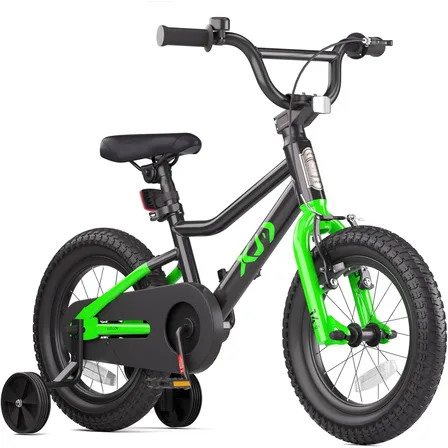
Black XJD Kids' BMX Bicycle with Training Wheels
The XJD Kids' BMX Bicycle with Training Wheels is built for children roughly 3 t…$99.99
$119.99 -
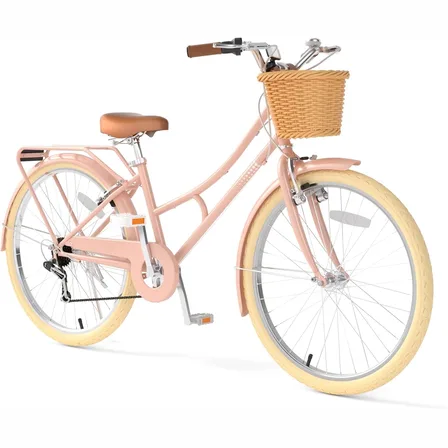
Pink XJD Beach Cruiser Bike, 24"/26", U-Brake
The XJD Pink Beach Cruiser Bike is a single-speed cruiser built for older kids a…$159.99
-

XJD Boys & Girls BMX Bike with Training Wheels, 12/14/16" – Blue
The XJD Boys & Girls BMX Bike in Blue is a first pedal bike for kids roughly age…$99.99
$119.99