

Is there a difference between girl and boy bikes
No—there is no universal fit difference between “girl” and “boy” bikes. Choose by the child’s measurements, control and confidence, not the label.
What the labels actually tell you
“Girls’ bike” and “boys’ bike” may describe color, graphics or styling, but those words do not establish that a bicycle fits a particular child. Some models may also differ in frame shape or components, so compare the actual bicycles rather than assuming every gender-labelled model is built alike.
A lower-looking frame can make getting on and off feel easier, but appearance alone does not prove correct stand-over clearance, reach or control. Either label can be suitable if the individual child can comfortably mount, balance, steer and operate the brakes.
Measure before comparing bikes
Measure the child’s height without shoes. Also measure inseam from the floor to the crotch while the child stands upright with feet slightly apart. Height gives you a wheel-size starting point; inseam helps you assess clearance when the child tries the actual bike.
Use the XBikes ranges below only to narrow the search. Overlapping ranges are intentional: two wheel sizes may both appear plausible, but their frames can still feel different.
| Wheel size | Starting age | Rider height |
|---|---|---|
| 12 Inch | 3–4 | 34–40 in / 86–102 cm |
| 14 Inch | 3–6 | 37–45 in / 94–114 cm |
| 16 Inch | 4–7 | 40–48 in / 102–122 cm |
| 18 Inch | 5–9 | 43–52 in / 109–132 cm |
| 20 Inch | 7–12 | 48–60 in / 122–152 cm |
| 24 Inch | 10–14 | 54–64 in / 137–163 cm |
| 26 Inch | Youth and adults | Over 60 in / 153 cm |
Prioritize measured height, inseam, reach, brake control and current confidence over age. Do not move up merely because a child is near a range boundary.
What to check during the fit test
Have the child try the bicycle. The American Academy of Pediatrics advises against buying an oversized bike for a child to grow into and emphasizes stand-over, control and brake reach. During the trial, check whether the child can:
- stand over the frame with comfortable clearance rather than being pressed against it;
- reach the handlebars without stretching, locking the elbows or losing a stable posture;
- turn the bars while remaining balanced and in control;
- reach and operate the brakes reliably with their normal hand position;
- start, stop and place a foot down with confidence.
If the rider looks cramped on one size but stretched or hesitant on the next, do not solve the problem with a gender label. Compare another frame in an appropriate size and repeat the hands-on check.
How the supplied bikes relate to the question
The catalog itself shows why gender wording should not drive the choice. The XJD Boys & Girls BMX Bike with Training Wheels, 12/14/16" – Blue is categorized as a Kids’ BMX Bike and has 12 Inch, 14 Inch and 16 Inch SKU labels. The XJD Kids' Training Wheel Bike for Boys & Girls, 12/14/16 Inch – White is categorized as a Training Wheel Bike and offers the same three labelled sizes.
These particular options help answer the title because each is explicitly presented for boys and girls, while the meaningful comparison still begins with its listed wheel-size option and the child’s individual fit. They are relevant only when a 12, 14 or 16 Inch starting point matches the measured rider and an actual fit check confirms control.
 XJD Boys & Girls BMX Bike with Training Wheels, 12/14/16" – Blue
A Kids’ BMX Bike catalog option presented for boys and girls, with 12 Inch, 14 Inch and 16 Inch SKU labels for comparison after measuring the rider.
 XJD Kids' Training Wheel Bike for Boys & Girls, 12/14/16 Inch – White
A Training Wheel Bike catalog option presented for boys and girls, available with 12 Inch, 14 Inch and 16 Inch SKU labels; individual fit still determines relevance.
Between these two products, first choose whether the Kids’ BMX Bikes or Training Wheel Bikes catalog category matches what you are seeking; then compare the 12, 14 and 16 Inch options against the child’s height. The supplied facts do not establish geometry, brake type, materials, weight, load limit or compatibility, so consult the exact product manual or a qualified bicycle mechanic for those details.
Do not overlook confidence and setup
Training wheels appearing in both exact product titles may make these models relevant to a child using that setup, but their presence does not replace correct sizing. A nervous rider may need a manageable bike even when age suggests a larger one, while a confident rider still should not use a bike that compromises stand-over, reach or braking control.
Follow the exact product manual for assembly, adjustments, maintenance and any torque or load limits. If the instructions are unclear or the bike cannot be adjusted to give the child reliable control, use a qualified bicycle mechanic rather than improvising.
Make the decision
Ignore “girl” or “boy” as a sizing rule. Record the child’s height and inseam, identify the matching wheel-size starting point, and have the child compare stand-over, reach, steering and brake operation on the actual bike. Buy only when those checks work at the child’s present confidence level—not because the styling matches a gender or a larger size promises more growing room.
Before riding, add a properly fitting bicycle helmet. The U.S. Consumer Product Safety Commission advises that it sit level and that its straps be used according to the helmet manufacturer’s instructions.
Bikes for your next adventure
-
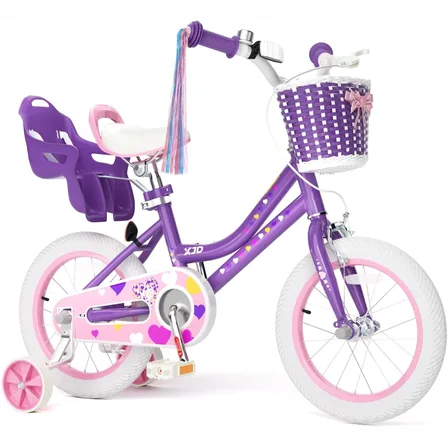
XJD Light Purple Girls Bike with Basket, Training Wheels, 12/14/16/20 Inch
The XJD Girls Bike with Basket in Light Purple is a single-speed training-wheel …$99.99
$119.99 -
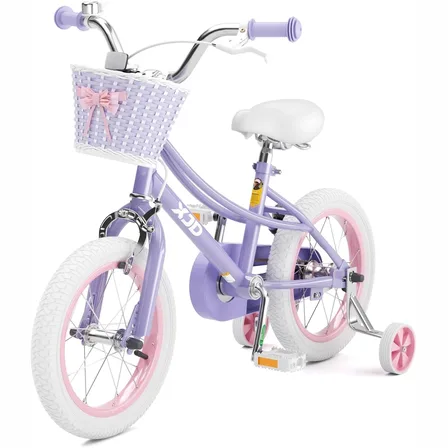
Girls' Training Wheel Bike by XJD with Basket – Purple
If you're shopping for a first bike for a girl roughly 3 to 12 years old (91–152…$75.99
-
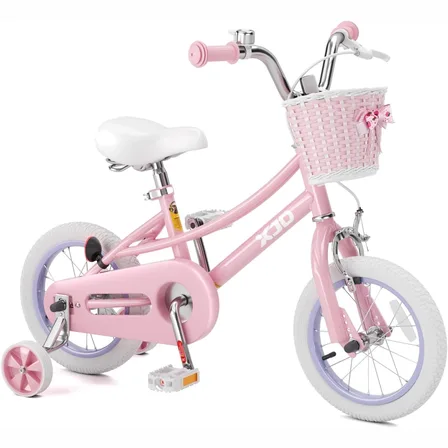
Pink 12/14/16/20" XJD Girls Bike with Training Wheels & Basket
The Pink XJD Girls Bike with Training Wheels & Basket is a first-bike pick f…$65.99
$75.99