

What is the difference between girl and boy bikes
Girl and boy bikes usually differ in styling, color, or marketing—not in the fit a child actually needs. Choose by measured height, inseam, reach, brake control, and confidence rather than by the gender label.
What actually makes a bike suitable?
A “girl” or “boy” label does not determine wheel size or whether a child can control a bicycle. Some models may have different colors, graphics, accessories, or frame shapes, but those details should come after fit and handling.
The practical comparison is simple: can the rider stand over the bike comfortably, reach the handlebars without stretching, operate the brakes reliably, and start, steer, stop, and dismount with control? Have the child try the bicycle whenever possible. Do not choose an oversized bike merely to allow room for growth.
Measure before comparing labels
Measure the child’s height without shoes. Also measure inseam from the floor to the crotch while the child stands upright. Height identifies a useful wheel-size starting point; inseam helps you check clearance when the child stands over the bicycle.
During a fit check, compare these points:
- Stand-over: The child should be able to straddle the bicycle and manage it without being trapped by the frame.
- Reach: Hands should reach the handlebars naturally, without an extreme stretch or cramped posture.
- Brake control: The rider must be able to reach and operate the bicycle’s brakes confidently.
- Handling: Ask the child to demonstrate controlled starting, steering, stopping, and getting off.
- Confidence: A technically plausible size is not suitable if the rider feels unable to control it.
Use wheel size only as a starting point
| Wheel size | Starting age | Rider height |
|---|---|---|
| 12 Inch | 3–4 | 34–40 in / 86–102 cm |
| 14 Inch | 3–6 | 37–45 in / 94–114 cm |
| 16 Inch | 4–7 | 40–48 in / 102–122 cm |
| 18 Inch | 5–9 | 43–52 in / 109–132 cm |
| 20 Inch | 7–12 | 48–60 in / 122–152 cm |
| 24 Inch | 10–14 | 54–64 in / 137–163 cm |
| 26 Inch | Youth and adults | Over 60 in / 153 cm |
Overlapping ranges are normal. Prioritize measured height, inseam, reach, brake control, and present confidence over age alone. Two children of the same age—and of any gender—may need different sizes or setups.
How the supplied boys-and-girls models compare
The catalog options make the distinction especially clear because both are explicitly presented for boys and girls. The XJD Boys & Girls BMX Bike with Training Wheels, 12/14/16" – Blue is categorized as a Kids’ BMX Bike and has 12 Inch, 14 Inch, and 16 Inch SKU labels. The XJD Kids' Training Wheel Bike for Boys & Girls, 12/14/16 Inch – White is categorized as a Training Wheel Bike and offers the same three labeled sizes.
These particular options help answer the title because neither restricts suitability to girls or boys; the useful catalog comparison is category, color stated in the title, and available wheel-size label. They are relevant only when a 12, 14, or 16 Inch starting point matches the rider and an individual fit check confirms control.
 XJD Boys & Girls BMX Bike with Training Wheels, 12/14/16" – Blue
A boys-and-girls Kids’ BMX Bike offered with 12 Inch, 14 Inch, and 16 Inch SKU labels; relevant when one of those size starting points matches the rider and a fit check confirms control.
 XJD Kids' Training Wheel Bike for Boys & Girls, 12/14/16 Inch – White
A boys-and-girls Training Wheel Bike offered with 12 Inch, 14 Inch, and 16 Inch SKU labels; useful for comparing available size labels without treating gender wording as evidence of fit.
Do not infer frame dimensions, brake type, weight, materials, load limits, compatibility, or other construction details from these titles. Compare those points only in the exact product information and manual. Follow the exact manual for assembly and maintenance, or use a qualified bicycle mechanic.
Training wheels do not replace correct fit
Both supplied titles mention training wheels, but that feature does not make an oversized or poorly controlled bicycle appropriate. A child still needs manageable stand-over clearance, a comfortable reach, accessible brakes, and enough confidence to steer and stop.
Whether training wheels suit the rider depends on current riding ability and the instructions for the exact model. Confirm installation, adjustment, compatibility, and removal procedures in the product manual rather than assuming the same process applies to every bicycle.
Make the final girl-versus-boy decision
- Ignore the gender label at first and measure height and inseam.
- Use the XBikes table to identify a starting wheel size, not a guaranteed fit.
- Have the child try the bicycle and check stand-over, reach, brake operation, steering, stopping, and confidence.
- Among bikes that fit, let the child choose the styling or category they prefer.
Finish by fitting a bicycle helmet properly: it should sit level, and its straps should be used according to the helmet manufacturer’s instructions. The right “girl” or “boy” bike is therefore the correctly sized bike the child can control—not the one whose label matches their gender.
Bikes for your next adventure
-
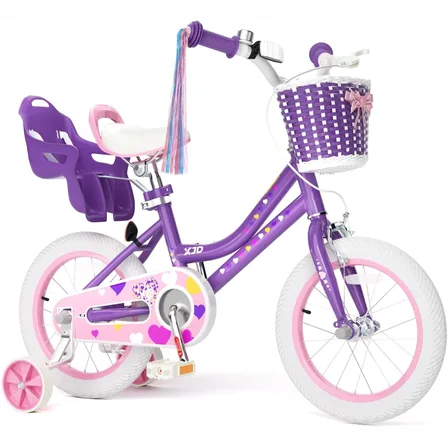
XJD Light Purple Girls Bike with Basket, Training Wheels, 12/14/16/20 Inch
The XJD Girls Bike with Basket in Light Purple is a single-speed training-wheel …$99.99
$119.99 -
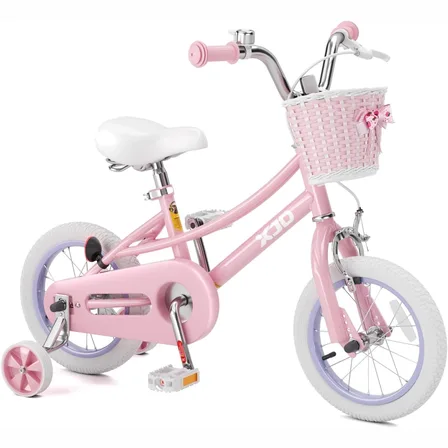
Pink 12/14/16/20" XJD Girls Bike with Training Wheels & Basket
The Pink XJD Girls Bike with Training Wheels & Basket is a first-bike pick f…$65.99
$75.99 -
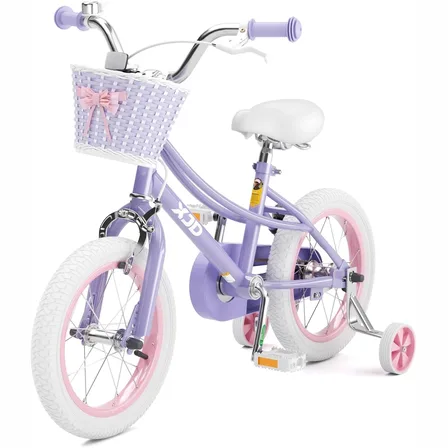
Girls' Training Wheel Bike by XJD with Basket – Purple
If you're shopping for a first bike for a girl roughly 3 to 12 years old (91–152…$75.99