

What's up with people thinking sporters are girls bikes
People call sporters “girls’ bikes” because they confuse frame styling, colors, or accessories with rider gender. Fit and control—not labels—decide whether a bike suits a child.
Why the label sticks
“Sporters” is not a useful fit category here. People may use the word for sporty-looking bikes, step-through frames, or simply bicycles whose colors and accessories they associate with girls. Those associations are social conventions, not evidence that the bicycle works differently for one gender.
A child does not need to defend liking a particular shape, color, basket, or doll seat. The practical question is whether the bike fits the rider and supports confident control. Treat “girls’ bike” as a style or catalog description, then evaluate the actual size in front of you.
Measure the rider before comparing bikes
Measure the child’s current height and inseam while they wear the shoes they normally ride in. Height gives you a wheel-size starting point; inseam helps you assess stand-over room when the child tries the bicycle. Do not choose by age alone or buy an oversized bike merely to allow growth.
| Wheel size | XBikes starting age | Rider height |
|---|---|---|
| 12 Inch | 3–4 | 34–40 in / 86–102 cm |
| 14 Inch | 3–6 | 37–45 in / 94–114 cm |
| 16 Inch | 4–7 | 40–48 in / 102–122 cm |
| 18 Inch | 5–9 | 43–52 in / 109–132 cm |
| 20 Inch | 7–12 | 48–60 in / 122–152 cm |
| 24 Inch | 10–14 | 54–64 in / 137–163 cm |
| 26 Inch | Youth and adults | Over 60 in / 153 cm |
Overlapping ranges are intentional: two children of the same height may have different proportions, reach, coordination, and confidence. Use the table to narrow the options, never to replace an individual fit check.
What to check during the try-on
Have the child try the exact bicycle rather than relying on a gender label or wheel number. A useful check covers four points:
- Stand-over: the child should be able to straddle the bike appropriately without the frame obstructing a comfortable, controlled stance.
- Reach: the child should reach the handlebar without excessive stretching or an awkward posture.
- Brake control: if the bicycle has hand controls, confirm the child can reach and operate them reliably.
- Confidence: ask the child to start, steer, stop, and get off under close supervision. Hesitation caused by excessive size matters.
If the child cannot control the bicycle comfortably, a preferred color or “sporty” appearance does not rescue the fit. Compare another size or model. For assembly, adjustment, compatibility, load limits, maintenance, or torque details, follow the exact product manual or consult a qualified bicycle mechanic.
How the supplied girls’ bikes fit this question
The catalog offers two concrete examples of how a “girls’ bike” label describes presentation and accessories rather than proving rider suitability. Flower Pink XJD Girls Bike with Doll Seat & Basket and Purple XJD Girls' Bike with Doll Seat & Basket are both categorized as Training Wheel Bikes and offered in 12 Inch, 14 Inch, and 16 Inch labels. They help you compare color and named accessories only after measurements point toward one of those sizes.
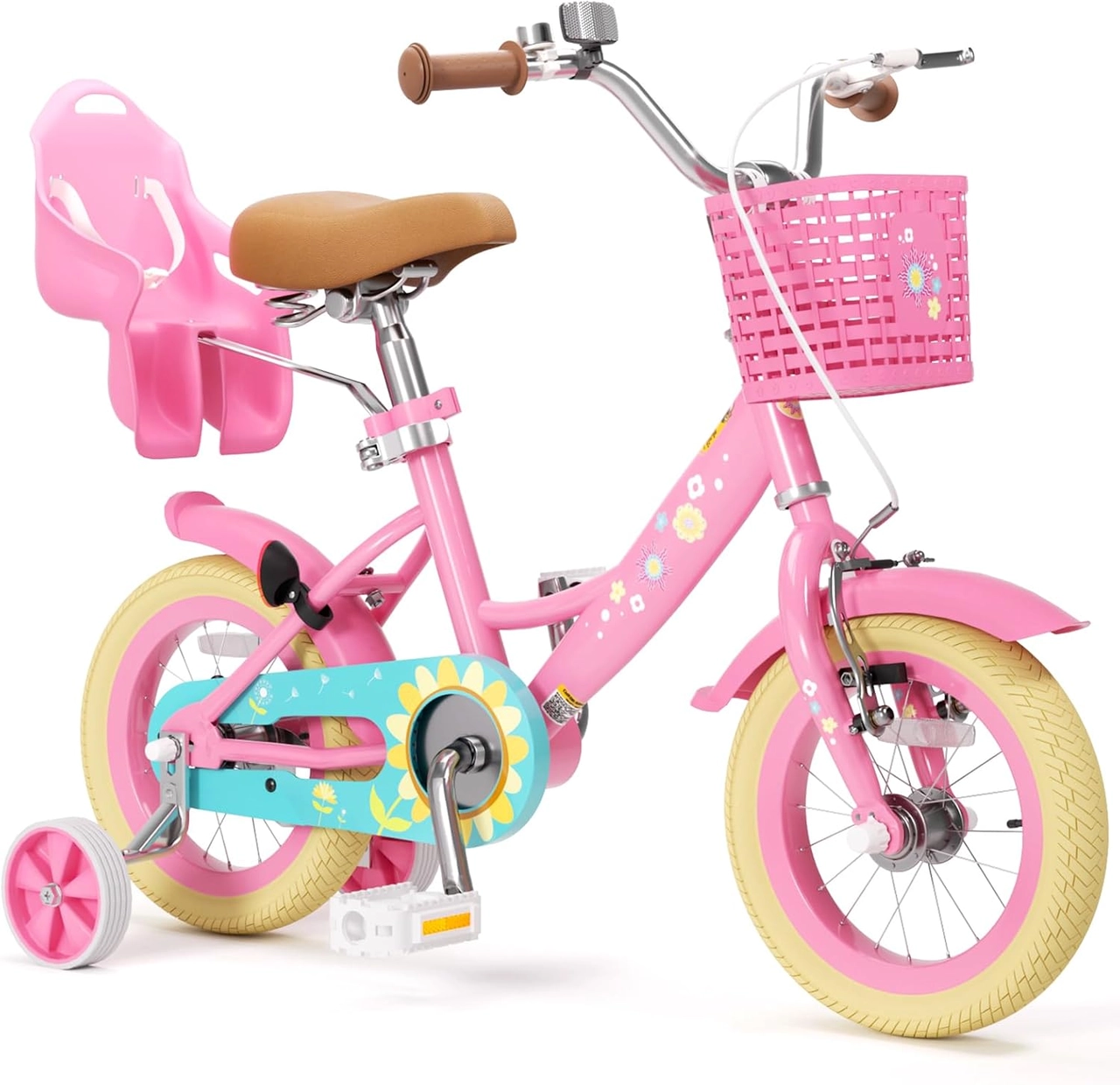 Flower Pink XJD Girls Bike with Doll Seat & Basket
A Training Wheel Bike offered in 12 Inch, 14 Inch, and 16 Inch labels. Its supplied catalog details—flower pink finish, doll seat, and basket—make it relevant to the styling-versus-fit distinction.
 Purple XJD Girls' Bike with Doll Seat & Basket
A purple Training Wheel Bike with a doll seat and basket, offered in 12 Inch, 14 Inch, and 16 Inch labels. Consider it only when the rider’s measurements and individual fit check support one of those sizes.
Between these two products, the supplied differences are the exact color wording and product title; both list a doll seat, basket, the same category, and the same three wheel-size options. No supplied fact establishes a difference in weight, material, brakes, geometry, certification, or performance, so do not infer one.
These products are relevant only if the rider’s measurements, reach, brake control, and confidence support a 12 Inch, 14 Inch, or 16 Inch option after a real fit check. If measurements suggest 18 Inch or larger, neither product is a substitute; use it only as a smaller-size comparison point and continue looking for the indicated size.
Separate identity from the purchase decision
Let the child choose among styles they enjoy, but keep the adult decision anchored to control. A boy can ride a pink or purple bicycle; a girl can ride a bike marketed as sporty; any child can reject either. The label does not change the fit.
Also include a bicycle helmet in the fitting process. It must fit properly, sit level, and use its straps according to the helmet manufacturer’s instructions. A helmet cannot correct an oversized or poorly controlled bicycle.
What to do next
- Record the rider’s height and inseam.
- Use the XBikes table to identify a starting wheel size.
- Have the child try the exact bike and check stand-over, reach, braking, and confidence.
- Compare the two supplied products only if 12, 14, or 16 Inch remains appropriate.
- Choose the style the child likes among the bikes that genuinely fit.
So when someone calls sporters “girls’ bikes,” treat that as an opinion about styling—not a sizing rule. Measure first, verify control on the exact bicycle, and let the rider’s fit and preference settle the question.
Bikes for your next adventure
-

Kids Bike Helmet by XJD for Boys & Girls – Black, Blue, Green, Pink, Purple
The XJD Kids Bike Helmet covers a wide 2-to-8-year age range thanks to two head-…$59.99
-

Kids Bike Helmet by XJD for Girls – Pink
The XJD Kids Bike Helmet in Pink is a lightweight multi-sport helmet for girls r…$59.99
$99 -

XJD Kids Bike for Girls – Pink, 12/14/16/20 Inch with Training Wheels
The XJD Kids Bike for Girls in Pink is a training-wheel bike built to carry your…$139
$159