

What's the difference between girl and boy bikes
Girl and boy bikes are usually separated by color, graphics or marketing—not by a fit rule. Choose by the child’s measurements, control and confidence.
What is the actual difference?
A “girls’ bike” or “boys’ bike” label does not tell you whether the bicycle fits a particular child. Some models may have different frame shapes, accessories or styling, but those details must be checked on the individual bicycles rather than assumed from the gender label.
For a useful comparison, look at wheel size, stand-over clearance, riding position, reach to the handlebar and access to the brake controls. Then let the child choose the appearance they like. A girl can ride a bike marketed to boys, and a boy can ride one marketed to girls, provided the bicycle fits and the rider can control it.
Measure before comparing bikes
Measure the child’s height without shoes. Also measure inseam from the floor to the crotch while the child stands upright. These measurements give you a starting point, but the child still needs to try the bicycle.
During the fit check, confirm that the child can:
- Stand over the bicycle with practical clearance rather than being pressed against the frame.
- Reach the handlebar without stretching or becoming cramped.
- Operate the applicable brake controls comfortably and reliably.
- Start, steer, stop and get off while remaining in control.
- Place their feet as required for their current skill and confidence.
Do not buy an oversized bicycle solely to leave room for growth. A bike that is difficult to mount, steer or stop is not made suitable by a “girl” or “boy” label.
Use wheel size only as a starting point
| Wheel size | Starting age | Rider height |
|---|---|---|
| 12 Inch | 3–4 | 34–40 in / 86–102 cm |
| 14 Inch | 3–6 | 37–45 in / 94–114 cm |
| 16 Inch | 4–7 | 40–48 in / 102–122 cm |
| 18 Inch | 5–9 | 43–52 in / 109–132 cm |
| 20 Inch | 7–12 | 48–60 in / 122–152 cm |
| 24 Inch | 10–14 | 54–64 in / 137–163 cm |
| 26 Inch | Youth and adults | Over 60 in / 153 cm |
Where ranges overlap, do not decide from age alone. Prioritize measured height and inseam, then compare stand-over clearance, reach, brake control and the child’s present confidence on each bicycle.
How the supplied bike helps with the comparison
The XJD Boys & Girls BMX Bike with Training Wheels, 12/14/16" – Blue is relevant because its title includes both boys and girls, while its available size labels are 12 Inch, 14 Inch and 16 Inch. It provides concrete wheel-size options to compare without treating gender as the sizing method.

Start by matching the child’s measured height to those three ranges: 12 Inch for 34–40 in / 86–102 cm, 14 Inch for 37–45 in / 94–114 cm, or 16 Inch for 40–48 in / 102–122 cm. These are starting points, not a guarantee of fit.
This product is relevant only if one of those wheel sizes suits the rider after an individual fit check. It is not a substitute when the child needs an 18-, 20-, 24- or 26-inch bicycle. “Boys & Girls” in the exact title describes the catalog positioning; it does not prove fit for every child.
Compare the features that affect the decision
Once you have a likely wheel size, place the candidate bikes side by side and ignore the gender category temporarily. Check whether the child can stand over each frame, settle into a comfortable riding position, turn the handlebar without interference and operate the brakes. A preferred color or graphic can break a tie only after both choices fit and feel manageable.
Do not infer unspecified details such as brake type, frame material, bicycle weight, load limit or component compatibility from a product name. For assembly, adjustment, maintenance, torque values and operating limits, follow the exact product manual or ask a qualified bicycle mechanic.
Complete the fit and helmet check
Have the child try the bicycle in a controlled area with adult supervision. Watch for strained reaching, difficulty starting, uncertain steering or inability to stop predictably. If any of those appear, reassess the size and setup rather than expecting the rider to grow into it.
A bicycle helmet should fit properly, sit level and have its straps used according to the helmet manufacturer’s instructions. A correctly sized bike and a properly fitted helmet address different needs; neither replaces the other.
Make the girl-bike versus boy-bike decision
Measure height and inseam, identify the likely wheel size, and have the child test stand-over, reach, braking and control. If two bikes pass those checks, choose according to the child’s style preference—not the gender label. If the XJD 12-, 14- or 16-inch option does not match the rider’s measurements and abilities, move to the correctly sized bicycle instead.
Bikes for your next adventure
-
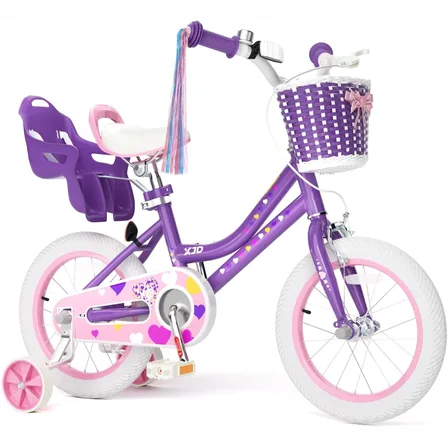
XJD Light Purple Girls Bike with Basket, Training Wheels, 12/14/16/20 Inch
The XJD Girls Bike with Basket in Light Purple is a single-speed training-wheel …$99.99
$119.99 -
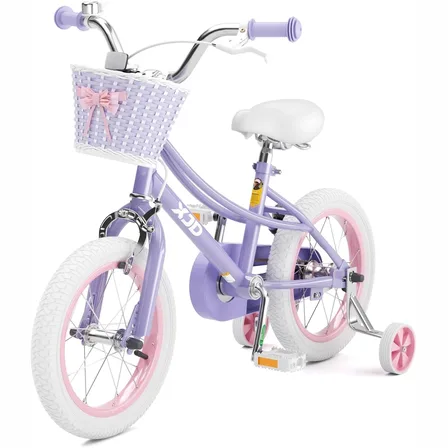
Girls' Training Wheel Bike by XJD with Basket – Purple
If you're shopping for a first bike for a girl roughly 3 to 12 years old (91–152…$75.99
-
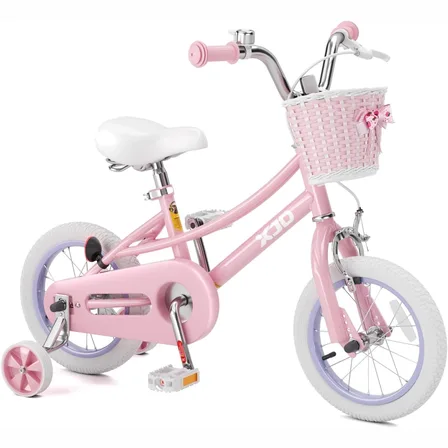
Pink 12/14/16/20" XJD Girls Bike with Training Wheels & Basket
The Pink XJD Girls Bike with Training Wheels & Basket is a first-bike pick f…$65.99
$75.99