

What's the difference between a girls and boys bike
Girls’ and boys’ bikes usually differ in styling or frame presentation, not in the fit a child needs. Choose by body measurements, control and confidence—not the gender label.
What the label actually means
A bike marketed to girls may use different colours, graphics or styling from one marketed to boys. Those labels do not establish that its geometry, controls or wheel size will fit a particular child. Unless the product information gives measurable differences, do not assume that a “girls’” frame is smaller, easier to ride or built differently.
The practical answer is therefore simple: either bike can be appropriate for any child when the rider fits it, can operate it comfortably and likes its appearance. Compare the bicycles themselves rather than treating the label as a sizing rule.
Measure the rider before comparing bikes
Start with the child’s current height and inseam. Height provides a wheel-size starting point; inseam helps you assess clearance when the child stands over the bicycle. Then have the child try the actual bike whenever possible.
During that check, look beyond whether the child can merely sit on the saddle. The rider should be able to stand over the bike with usable clearance, reach the handlebar without an awkward stretch, steer while staying balanced, and operate the brakes with confident hand control. Current riding confidence matters too: a technically possible size can still feel unmanageable to a hesitant beginner.
Do not buy an oversized bicycle simply to allow room for growth. Poor reach, difficult starts or limited brake control are immediate problems, while future growth is only an estimate.
Use wheel size as a starting point
| Wheel size | Starting age | Rider height |
|---|---|---|
| 12 Inch | 3–4 | 34–40 in / 86–102 cm |
| 14 Inch | 3–6 | 37–45 in / 94–114 cm |
| 16 Inch | 4–7 | 40–48 in / 102–122 cm |
| 18 Inch | 5–9 | 43–52 in / 109–132 cm |
| 20 Inch | 7–12 | 48–60 in / 122–152 cm |
| 24 Inch | 10–14 | 54–64 in / 137–163 cm |
| 26 Inch | Youth and adults | Over 60 in / 153 cm |
Overlapping ranges are normal. Use measured height before age, and treat the table as a shortlist rather than proof of fit. Inseam, reach, brake control and confidence decide whether a candidate within that shortlist actually works.
How to compare a “girls’” and “boys’” bike
- Ignore the category label first. Note each candidate’s wheel size and any documented dimensions or adjustments.
- Try each bike under the same conditions. Compare stand-over clearance, seated reach, steering control and the child’s ability to use the brakes.
- Watch the rider begin and stop. The child should not need to overreach, twist or lose control to manage ordinary riding movements.
- Ask which bike feels comfortable. Colour and presentation can matter to the child, but preference should come after acceptable fit and control.
If two bikes fit equally well, the child’s style preference can settle the choice. If only one fits, its gendered marketing should not disqualify it.
Where the supplied XBikes options are relevant
The catalog includes two explicitly boys-and-girls models, which helps demonstrate that the useful comparison is wheel size and bike category rather than gender. The XJD Kids' Training Wheel Bike for Boys & Girls, 12/14/16 Inch – White is categorized as a training wheel bike and has 12 Inch, 14 Inch and 16 Inch labels. The XJD Boys & Girls BMX Bike with Training Wheels, 12/14/16" – Blue is categorized as a kids’ BMX bike and has the same three wheel-size labels.
These particular options are relevant when the rider’s measured height points toward 12, 14 or 16 Inch candidates and a training-wheel model is being considered. They do not establish fit on their titles alone, and the categories are not interchangeable proof that the bicycles have identical construction or riding characteristics.
 XJD Kids' Training Wheel Bike for Boys & Girls, 12/14/16 Inch – White
A boys-and-girls training wheel bike offered with 12 Inch, 14 Inch and 16 Inch labels; relevant for comparing those starting sizes after measuring the rider and checking individual fit.
 XJD Boys & Girls BMX Bike with Training Wheels, 12/14/16" – Blue
A boys-and-girls kids’ BMX bike with training wheels, offered in 12 Inch, 14 Inch and 16 Inch labels; useful as a category and size comparison, not proof of fit.
They are not relevant substitutes when the rider needs an 18, 20, 24 or 26 Inch bicycle after measurement and a hands-on fit check. For assembly, maintenance, load limits, compatibility or torque, follow the exact product manual or use a qualified bicycle mechanic.
Make the decision at the bike
Measure height and inseam now, shortlist the matching wheel sizes, and have the child compare stand-over clearance, reach, brake operation and confidence on each candidate. Use “girls’” or “boys’” only as a description of presentation; choose the bike the child can control comfortably today. Add a properly fitting bicycle helmet that sits level, with straps adjusted according to its manufacturer’s instructions.
Bikes for your next adventure
-

Black XJD Toddler Bike Helmet, Adjustable – Kids' Protective Helmet
The XJD Toddler Bike Helmet in black is an adjustable protective helmet for kids…$20.39
-

Light Pink XJD Girls' Bicycle with Basket & Training Wheels
The Light Pink XJD Girls' Bicycle with Basket & Training Wheels is a retro-style…$109.99
$129.99 -
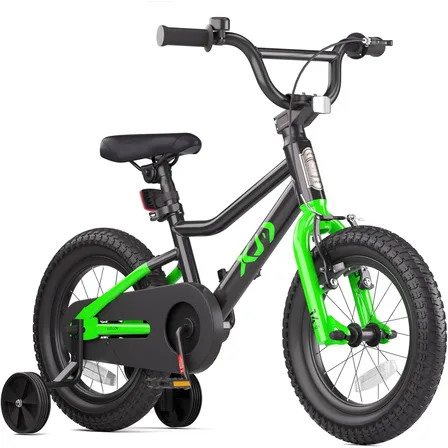
Black XJD Kids' BMX Bicycle with Training Wheels
The XJD Kids' BMX Bicycle with Training Wheels is built for children roughly 3 t…$99.99
$119.99