

What's the difference between a girl bike and boy bike
The main difference between a girl bike and boy bike is usually styling or frame labeling—not a different fit rule. Choose by the child’s measurements, control and confidence, regardless of gender.
What actually differs
Manufacturers may use “girls’” and “boys’” to describe colors, graphics, accessories or frame appearance. Those labels do not tell you whether a bicycle fits a particular child. Two bikes carrying different gender labels may function similarly, while two bikes with the same label may have noticeably different proportions.
Do not assume that a girls’ bike must have a lower frame or that a boys’ bike must have a higher one. Look at the actual bicycle. The useful comparison is wheel size, stand-over clearance, saddle adjustment, reach to the handlebar and the child’s ability to operate the brakes.
Measure before comparing labels
Measure the child’s height without shoes. Then measure inseam from the floor to the crotch while the child stands upright with feet slightly apart. Use height to find a starting wheel size, then have the child try the bicycle.
During that trial, check whether the child can stand over the frame comfortably, get on and off without struggling, reach the handlebar without stretching, steer while looking ahead and operate each brake control reliably. A bike intended “for growth” can be too large to control now, so do not move up merely because the child is near a birthday.
Wheel size starting points
| Wheel size | Starting age | Rider height |
|---|---|---|
| 12 Inch | 3–4 | 34–40 in / 86–102 cm |
| 14 Inch | 3–6 | 37–45 in / 94–114 cm |
| 16 Inch | 4–7 | 40–48 in / 102–122 cm |
| 18 Inch | 5–9 | 43–52 in / 109–132 cm |
| 20 Inch | 7–12 | 48–60 in / 122–152 cm |
| 24 Inch | 10–14 | 54–64 in / 137–163 cm |
| 26 Inch | Youth and adults | Over 60 in / 153 cm |
These ranges are starting points, not proof of fit. Where sizes overlap, prioritize measured height, inseam, reach, brake control and current riding confidence over age. Compare both candidate sizes in person when possible rather than automatically selecting the larger one.
How the supplied bikes help with the comparison
The two catalog options make the title’s point clearly because both are explicitly offered for boys and girls. The XJD Boys & Girls BMX Bike with Training Wheels, 12/14/16" – Blue is categorized as a Kids’ BMX Bike and has 12 Inch, 14 Inch and 16 Inch SKU labels. The XJD Kids' Training Wheel Bike for Boys & Girls, 12/14/16 Inch – White is categorized as a Training Wheel Bike and offers the same three labeled sizes. They let you compare category, appearance and listed wheel size without treating gender as the sizing method.
 XJD Boys & Girls BMX Bike with Training Wheels, 12/14/16" – Blue
A boys-and-girls Kids’ BMX Bike offered with 12 Inch, 14 Inch and 16 Inch SKU labels, making it relevant for comparing listed size and category without using gender as the fit rule.
 XJD Kids' Training Wheel Bike for Boys & Girls, 12/14/16 Inch – White
A boys-and-girls Training Wheel Bike offered with 12 Inch, 14 Inch and 16 Inch SKU labels. Use its listed sizes as starting points, followed by an individual fit check.
Neither title establishes fit for an individual child, and the words “boys” and “girls” are catalog wording rather than evidence that one child needs a particular geometry. Start with the relevant 12, 14 or 16 Inch height range, then verify the fit on the exact bicycle. If the rider needs 18, 20, 24 or 26 Inch, these products are smaller-size comparison points only, not substitutes.
What to compare on the actual bikes
- Stand-over: Ask the child to straddle the bicycle with both feet on the ground. They should be able to balance and move away from the frame comfortably.
- Reach and posture: Check that the child can hold the handlebar and turn it without locking the arms, leaning excessively or losing a stable seated position.
- Brake control: Confirm that the child can reach and operate the fitted brake controls while maintaining steering control.
- Mounting and starting: Have the child get on, set off, stop and dismount in a controlled area. Current confidence matters alongside physical dimensions.
For assembly, adjustment procedures, maintenance, load limits, compatibility and torque requirements, follow the manual for the exact product or ask a qualified bicycle mechanic. Details should not be transferred from a similarly named or similarly sized bicycle.
Helmet fit is a separate check
A bike that fits does not make an incorrectly fitted helmet suitable. Use a bicycle helmet that fits the child properly, sits level and has its straps arranged according to the helmet manufacturer’s instructions. Recheck it whenever clothing, hairstyle or adjustment changes affect the fit.
The decision to make
Treat “girl bike” and “boy bike” as shopping labels, then remove gender from the fit decision. Measure height and inseam, shortlist the corresponding wheel size, and let the child try each candidate for stand-over, reach, brake operation and confident control. Choose the bicycle that fits now—not the label, preferred color alone or an oversized option intended for later.
Bikes for your next adventure
-
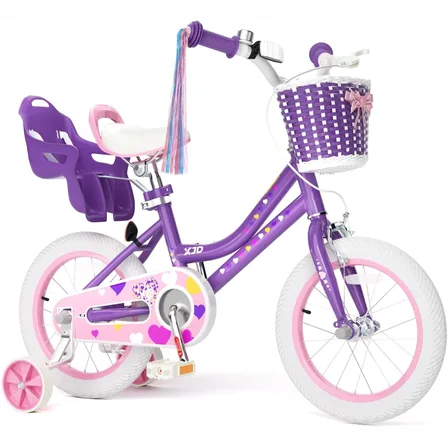
XJD Light Purple Girls Bike with Basket, Training Wheels, 12/14/16/20 Inch
The XJD Girls Bike with Basket in Light Purple is a single-speed training-wheel …$99.99
$119.99 -
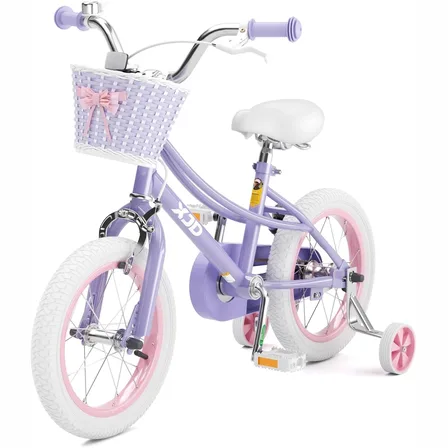
Girls' Training Wheel Bike by XJD with Basket – Purple
If you're shopping for a first bike for a girl roughly 3 to 12 years old (91–152…$75.99
-
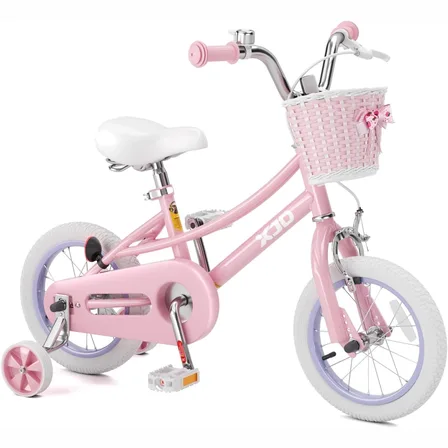
Pink 12/14/16/20" XJD Girls Bike with Training Wheels & Basket
The Pink XJD Girls Bike with Training Wheels & Basket is a first-bike pick f…$65.99
$75.99