

What's the difference between a boys bike and girls bike
The practical difference between a boys bike and a girls bike is usually the label, styling or frame presentation—not a separate rule for fit. Choose by the child’s measured body size, reach, control and confidence.
What actually matters more than the label
A bike marked for boys or girls may use different colours, graphics, accessories or frame shapes. Those details can affect preference and convenience, but the category name does not tell you whether a particular child can ride the bike comfortably.
Compare the bikes as individual models. Check wheel size, stand-over position, handlebar reach, brake reach and how easily the rider can start, steer and stop. A lower-looking frame may make mounting easier, but do not assume that every girls bike is lower or that every boys bike has the same geometry. Have the child try the actual bicycle.
Measure the rider before comparing bikes
Start with current height and inseam, measured in ordinary clothes and without shoes. Height identifies a sensible wheel-size range; inseam helps you judge the real stand-over position. Because frame dimensions vary even at the same wheel size, measurements narrow the search rather than guarantee a fit.
- Measure the child’s full standing height.
- Measure inseam from the floor to the crotch.
- Compare height with the XBikes starting points below.
- Have the child straddle and sit on the specific bike.
- Confirm that the child can reach the handlebars and brake controls without stretching or losing a stable riding position.
| Wheel size | Age starting point | Rider-height starting point |
|---|---|---|
| 12 Inch | Ages 3–4 | 34–40 in / 86–102 cm |
| 14 Inch | Ages 3–6 | 37–45 in / 94–114 cm |
| 16 Inch | Ages 4–7 | 40–48 in / 102–122 cm |
| 18 Inch | Ages 5–9 | 43–52 in / 109–132 cm |
| 20 Inch | Ages 7–12 | 48–60 in / 122–152 cm |
| 24 Inch | Ages 10–14 | 54–64 in / 137–163 cm |
| 26 Inch | Youth and adults | Over 60 in / 153 cm |
Age is only a starting point. If age and measured height suggest different sizes, prioritize measured height, inseam, reach, brake control and current confidence. Do not buy an oversized bike simply to leave room for growth; a child who cannot comfortably control it needs a better-fitting option now.
How to conduct the same fit check for any child
Ignore the boys or girls wording during the physical check. With the bicycle upright, ask the child to straddle it and assess whether the frame allows a comfortable stand-over position. Then check the seated riding posture: the handlebars should not require an awkward stretch, and the child should be able to operate the brake controls reliably.
Let the child demonstrate starting, steering, slowing and stopping in a controlled area. Confidence matters, but it does not override fit. A hesitant rider may benefit from a setup appropriate to their present skill level, while an experienced rider still needs suitable reach and control. If two differently labelled bikes both fit, preference can decide between them.
Where the supplied training-wheel bike is relevant
The catalog option, XJD Kids' Training Wheel Bike for Boys & Girls, 12/14/16 Inch – White, is explicitly presented for boys and girls. Its available 12 Inch, 14 Inch and 16 Inch labels make it useful for comparing three nearby starting ranges without treating gender as a sizing rule. It is relevant when a training-wheel bike is wanted and the rider’s measurements point to one of those sizes.

Those three size labels are not interchangeable. Based on the XBikes starting points, compare 12 Inch with 34–40 in / 86–102 cm, 14 Inch with 37–45 in / 94–114 cm, and 16 Inch with 40–48 in / 102–122 cm, then verify the individual fit. The title’s “Boys & Girls” wording describes the catalog positioning; it is not separate fit evidence.
This product is not the relevant catalog match when the rider needs an 18, 20, 24 or 26 Inch bike, when training wheels are not wanted, or when the child cannot comfortably stand over, reach and control the selected version. A smaller available label is not a substitute for a required larger wheel size, and a larger one should not be chosen merely for future growth.
What to compare before deciding
- Fit: Confirm stand-over, seated reach and access to the brake controls on the exact bike.
- Control: Make sure the child can start, steer, slow and stop without struggling.
- Confidence: Choose a setup suited to how the child rides today.
- Preference: Let colour, graphics or a boys/girls label decide only after both options fit properly.
- Instructions: Follow the exact product manual for assembly, maintenance, load limits, compatibility and torque, or use a qualified bicycle mechanic.
Complete the choice with a properly fitting bicycle helmet that sits level and uses its straps according to the helmet manufacturer’s instructions. The final decision is simple: measure the child, test the actual bicycle, and choose the boys- or girls-labelled option only if its real fit and controls suit that rider now.
Bikes for your next adventure
-

Black XJD Toddler Bike Helmet, Adjustable – Kids' Protective Helmet
The XJD Toddler Bike Helmet in black is an adjustable protective helmet for kids…$20.39
-

Light Pink XJD Girls' Bicycle with Basket & Training Wheels
The Light Pink XJD Girls' Bicycle with Basket & Training Wheels is a retro-style…$109.99
$129.99 -
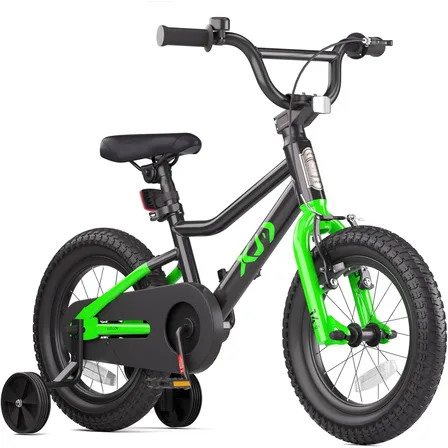
Black XJD Kids' BMX Bicycle with Training Wheels
The XJD Kids' BMX Bicycle with Training Wheels is built for children roughly 3 t…$99.99
$119.99