

What size bike does an 11 year old girl need
Most 11-year-old girls need a 20-inch or 24-inch bike: start with measured height, then confirm inseam clearance, reach, brake control and confidence on the actual bicycle.
Choose between 20 and 24 inches by height
Age narrows the search, but it does not determine fit. Under the XBikes starting points, a 20-inch bike covers rider heights of 48–60 in (122–152 cm), while a 24-inch bike covers 54–64 in (137–163 cm). The ranges overlap, so an 11-year-old between 54 and 60 in (137–152 cm) might fit either size. That overlap is where an individual fit check matters most.
| Measured rider height | Starting wheel size | What to do next |
|---|---|---|
| 48–53 in (122–136 cm) | 20 Inch | Try a 20-inch bike and check clearance and controls. |
| 54–60 in (137–152 cm) | 20 or 24 Inch | Compare both; choose by actual control, not room to grow. |
| 61–64 in (155–163 cm) | 24 Inch | Try a 24-inch bike and verify reach and brake operation. |
| Over 60 in (153 cm) | 26 Inch is also a starting point | Compare the complete fit carefully because wheel size alone is insufficient. |
The 24-inch height band begins at 54 in (137 cm), so do not move a shorter rider to that size merely because she is 11. Likewise, a taller 11-year-old should not be held to a 20-inch bike solely because its age starting point extends through age 12.
Measure her before comparing bikes
- Measure standing height: Have her stand barefoot, upright and against a wall. Record the result in inches or centimetres and compare it with the table.
- Measure inseam: With feet slightly apart, measure from the floor to the crotch. Use this measurement to assess stand-over clearance on the particular frame; wheel diameter cannot predict frame clearance by itself.
- Note current confidence: Record whether she starts, stops, turns and balances independently. A rider who is still developing control may fit differently in practice from a confident rider of the same height.
Frame shapes and adjustment ranges can differ even when two bicycles use the same wheel size. Measurements therefore identify which bikes to try; they do not replace the trial.
Perform the fit check on the actual bike
Have the child try the bicycle rather than ordering an oversized model for future growth. With the bike upright, check that she can stand over it with usable clearance instead of being pressed against the frame. Seated, she should reach the handlebar without an extreme stretch, awkward shoulder position or loss of steering control.
Ask her to operate each brake control repeatedly while maintaining a secure grip. She should be able to start, steer, turn and stop in control. Also watch whether she can place a foot down predictably when stopping. If she looks tense, cannot reach a control, or must shift her body excessively to steer, that particular bike does not fit now—even if its wheel size matches the chart.
How the supplied XBikes options help
The catalog provides relevant 20-, 24- and 26-inch comparison points. Pink 12/14/16/20" XJD Girls Bike with Training Wheels & Basket includes a 20 Inch SKU, alongside 12 Inch, 14 Inch and 16 Inch labels. For this question, only its 20 Inch option falls within the usual 11-year-old starting range; the smaller labels correspond to younger and shorter starting ranges in the supplied standard.
26-Inch XJD Beach Cruiser Bike for Girls – Purple, V-Brake has Mint Green and Pink options labeled 20 Inch, 24 Inch and 26 Inch, plus Purple / 26 Inch. Its 20- and 24-inch options let a rider in the overlapping height band compare adjacent starting sizes. Its 26-inch options are relevant only when her measured height and real-world fit support that larger starting point.
These particular catalog options help because they provide the likely 20- and 24-inch sizes, plus 26-inch options for riders over 60 in (153 cm), while still requiring a hands-on comparison.
 Pink 12/14/16/20" XJD Girls Bike with Training Wheels & Basket
The 20 Inch SKU is relevant to many 11-year-old riders after a height and hands-on fit check; the supplied 12, 14 and 16 Inch options use younger and shorter starting ranges.
 26-Inch XJD Beach Cruiser Bike for Girls – Purple, V-Brake
Its supplied 20, 24 and 26 Inch options provide useful comparison points for an 11-year-old, with the appropriate starting size determined by measured height and confirmed control on the actual bike.
Reject a size that limits control
- Do not buy a larger bike simply to leave growing room.
- Do not choose from age, color or a catalog title before checking measured height.
- Reject any bike she cannot comfortably stand over, steer or stop.
- Reject a setup whose brake controls she cannot reach and operate while holding the handlebar securely.
- For assembly, adjustment, compatibility, maintenance or torque details, follow the exact product manual or use a qualified bicycle mechanic.
Complete the decision
Measure her height and inseam today. If she is 48–53 in (122–136 cm), begin with 20 inches; at 54–60 in (137–152 cm), try both 20 and 24 inches; at 61–64 in (155–163 cm), begin with 24 inches. If she is over 60 in (153 cm), include 26 inches in the comparison. Choose only after she demonstrates comfortable clearance, reach, steering and braking on that exact bike. Finish by fitting a bicycle helmet so it sits level, fits properly and has its straps used according to the helmet manufacturer’s instructions.
Bikes for your next adventure
-
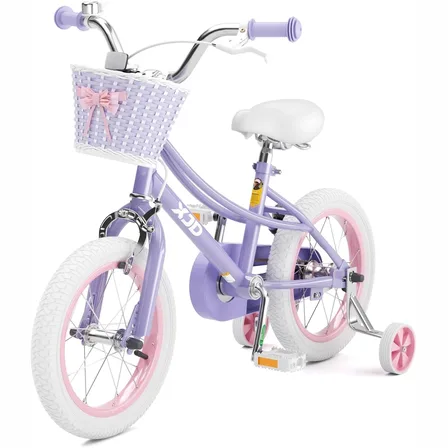
Girls' Training Wheel Bike by XJD with Basket – Purple
If you're shopping for a first bike for a girl roughly 3 to 12 years old (91–152…$75.99
-
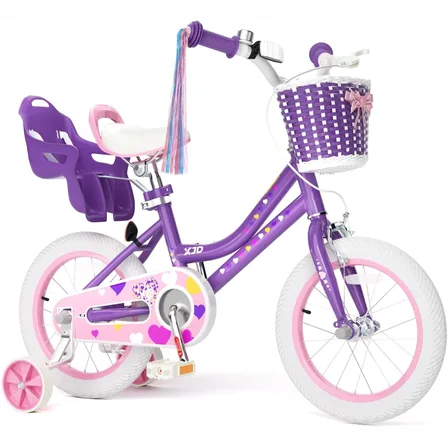
XJD Light Purple Girls Bike with Basket, Training Wheels, 12/14/16/20 Inch
The XJD Girls Bike with Basket in Light Purple is a single-speed training-wheel …$99.99
$119.99 -
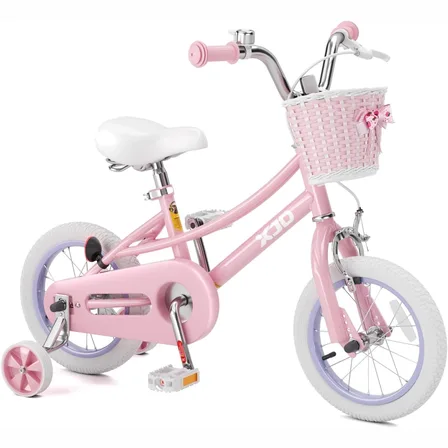
Pink 12/14/16/20" XJD Girls Bike with Training Wheels & Basket
The Pink XJD Girls Bike with Training Wheels & Basket is a first-bike pick f…$65.99
$75.99