

What size bike does an 8 year old girl need
Most 8-year-old girls should start by trying a 20-inch bike, especially at 48–60 in (122–152 cm) tall. Choose by measured fit, not age alone.
Start with height, then confirm the fit
Under the XBikes starting points, a 20-inch wheel suits ages 7–12 and rider heights of 48–60 in (122–152 cm). That makes it the usual first comparison for an 8-year-old girl. A child near either edge of that height band may need to compare an adjacent wheel size.
An 18-inch bike is the starting point for heights of 43–52 in (109–132 cm) and ages 5–9. A 24-inch bike begins at 54–64 in (137–163 cm) and ages 10–14. These ranges overlap because wheel diameter alone cannot determine whether the frame, controls and riding position fit a particular child.
| Wheel size | XBikes age starting point | XBikes height starting point |
|---|---|---|
| 18 Inch | 5–9 | 43–52 in / 109–132 cm |
| 20 Inch | 7–12 | 48–60 in / 122–152 cm |
| 24 Inch | 10–14 | 54–64 in / 137–163 cm |
Measure your child before comparing bikes
Measure her height without shoes, standing straight against a wall. Then measure her inseam from the floor to the crotch while she stands in socks with her feet naturally spaced. Record both measurements rather than estimating from clothing size or age.
Use height to select the first wheel-size range. Use the inseam during an actual stand-over check: she should be able to straddle the bicycle comfortably rather than being forced onto tiptoes or against the frame. Frame shapes differ, so an inseam measurement does not establish fit until it is compared with the specific bicycle.
What to check during a test ride
Have your child try the exact bike. The American Academy of Pediatrics advises against buying an oversized bicycle merely for future growth and emphasizes stand-over clearance, control and brake reach. During the fit check, confirm that she can:
- Mount, start and stop without needing an adult to hold the bicycle.
- Stand over the frame comfortably and put her feet down when stopping.
- Reach the handlebar without an awkward stretch or cramped posture.
- Turn the handlebar while keeping stable control of the bicycle.
- Reach and operate the available brake controls confidently with her hands in a normal riding position.
Watch her confidence as well as her posture. If she freezes, struggles to steer, cannot stop predictably or has difficulty reaching the controls, the bike is not a good current fit even if her height falls inside its starting range.
When the supplied XBikes option is relevant
The Light Pink XJD Girls' Bicycle with Basket & Training Wheels is listed as a Training Wheel Bike with 12 Inch, 14 Inch, 16 Inch and 20 Inch SKU labels. For a typical 8-year-old within the 20-inch height range, its 20 Inch option is the relevant catalog comparison. The smaller labels do not become equivalent alternatives simply because they belong to the same product.
This catalog option helps answer the size question because it includes a 20 Inch label matching the usual starting point for ages 7–12 and heights of 48–60 in (122–152 cm), while also showing smaller labeled options for comparison. A hands-on fit check remains necessary.

The training-wheel configuration may be relevant if the rider currently uses that type of bicycle. Do not select it solely from age or appearance. If your child needs an 18-inch or 24-inch fit after measurement and testing, this supplied product has no listed SKU in that exact size and should not be treated as a substitute.
How to decide between 18, 20 and 24 inches
Begin with 20 inches when your 8-year-old measures 48–60 in (122–152 cm). Compare an 18-inch bicycle if she is below 48 in, falls within the 18-inch height band, or cannot comfortably control the 20-inch bike. Consider a 24-inch comparison only when she is at least 54 in (137 cm) and can pass every stand-over, reach, braking and confidence check.
Do not move up merely because she may grow soon. A bicycle that is difficult to mount, steer or stop now is oversized now. Conversely, do not keep her on a smaller bicycle solely because it feels familiar if her posture is cramped or control is compromised. The deciding evidence is her present fit on the exact model.
Complete the safety and setup check
Use a properly fitting bicycle helmet every ride. The U.S. Consumer Product Safety Commission says the helmet should sit level and its straps should be used according to the manufacturer's instructions. A helmet does not correct a poorly fitting bicycle.
Before riding, follow the exact product manual for assembly, adjustments, maintenance, load limits, compatibility and any torque requirements. When instructions are missing or the setup is uncertain, use a qualified bicycle mechanic rather than guessing.
For your 8-year-old, measure height and inseam today, try a 20-inch bike first if she is 48–60 in tall, and choose it only if she can stand over, reach, steer and brake with confident control.
Bikes for your next adventure
-
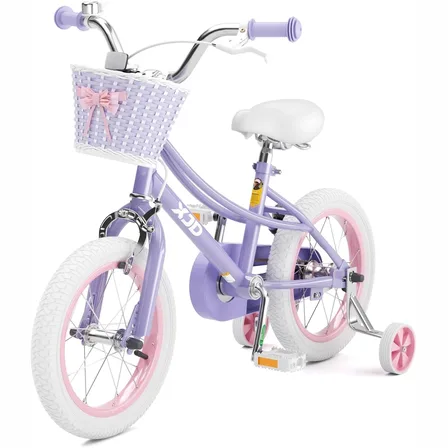
Girls' Training Wheel Bike by XJD with Basket – Purple
If you're shopping for a first bike for a girl roughly 3 to 12 years old (91–152…$75.99
-
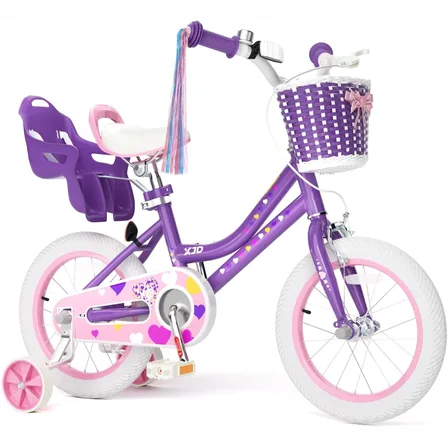
XJD Light Purple Girls Bike with Basket, Training Wheels, 12/14/16/20 Inch
The XJD Girls Bike with Basket in Light Purple is a single-speed training-wheel …$99.99
$119.99 -

Pink 12/14/16/20" XJD Girls Bike with Training Wheels & Basket
The Pink XJD Girls Bike with Training Wheels & Basket is a first-bike pick f…$65.99
$75.99