

What size bike for 5 year old girl
For most 5-year-old girls, start by comparing 14-inch and 16-inch bikes. Measure her height first, then confirm inseam, stand-over clearance, reach, braking and control on the actual bicycle.
Choose the starting wheel size by measured height
Age narrows the search, but it does not establish fit. Under the XBikes starting points, a 14-inch bike covers ages 3–6 and heights of 37–45 inches (94–114 cm). A 16-inch bike covers ages 4–7 and heights of 40–48 inches (102–122 cm). Both can therefore be relevant at age five.
| Wheel size | XBikes age starting point | Rider-height starting point |
|---|---|---|
| 12 Inch | Ages 3–4 | 34–40 in / 86–102 cm |
| 14 Inch | Ages 3–6 | 37–45 in / 94–114 cm |
| 16 Inch | Ages 4–7 | 40–48 in / 102–122 cm |
| 18 Inch | Ages 5–9 | 43–52 in / 109–132 cm |
A shorter five-year-old may still need a 12-inch bike, while a taller child may be ready to compare an 18-inch model. Where height bands overlap, choose by the individual fit check rather than automatically selecting the larger wheel.
Measure before comparing bikes
Measure her standing height without shoes, with her back straight against a wall. Then measure inseam from the floor to the crotch while she stands naturally. Record both measurements rather than relying on clothing size or an estimate from her age.
Use height to identify likely wheel sizes. Use inseam to assess how the frame sits beneath her when she straddles it. Bicycle geometry varies, so wheel diameter alone cannot prove that a particular frame will fit.
Check the actual bicycle
Have her try the bike whenever possible. The American Academy of Pediatrics guidance supports checking the child on the bicycle and avoiding an oversized model bought solely for future growth.
- Stand-over: She should be able to straddle the bicycle with appropriate clearance rather than being pressed against the frame.
- Reach: She should reach the handlebars without stretching, twisting or losing a comfortable riding posture.
- Brake control: She must be able to reach and operate the fitted controls confidently. Control design can differ between models.
- Overall control: She should be able to start, steer, stop and support the bicycle without the size making it unwieldy.
- Confidence: If she becomes tense or cannot manage the bike predictably, reconsider the fit even when her height falls inside the starting range.
Do not move up a size merely because she is close to the upper end of a height band. A bike that fits now is more useful than one she must grow into.
How the supplied girls’ bikes help with the comparison
The supplied catalog choices all offer 12 Inch, 14 Inch and 16 Inch SKU labels, so they provide relevant comparison options for many five-year-old riders. They do not include an available 18 Inch SKU label; if her measurements and fit check point to 18 inches, treat these products as nearest-size comparison points, not substitutes for an 18-inch bike.
 XJD Light Purple Girls Bike with Basket, Training Wheels, 12/14/16/20 Inch
A Training Wheel Bike with available 12 Inch, 14 Inch and 16 Inch SKU labels, making it relevant for comparing likely sizes after measuring the rider and checking fit.
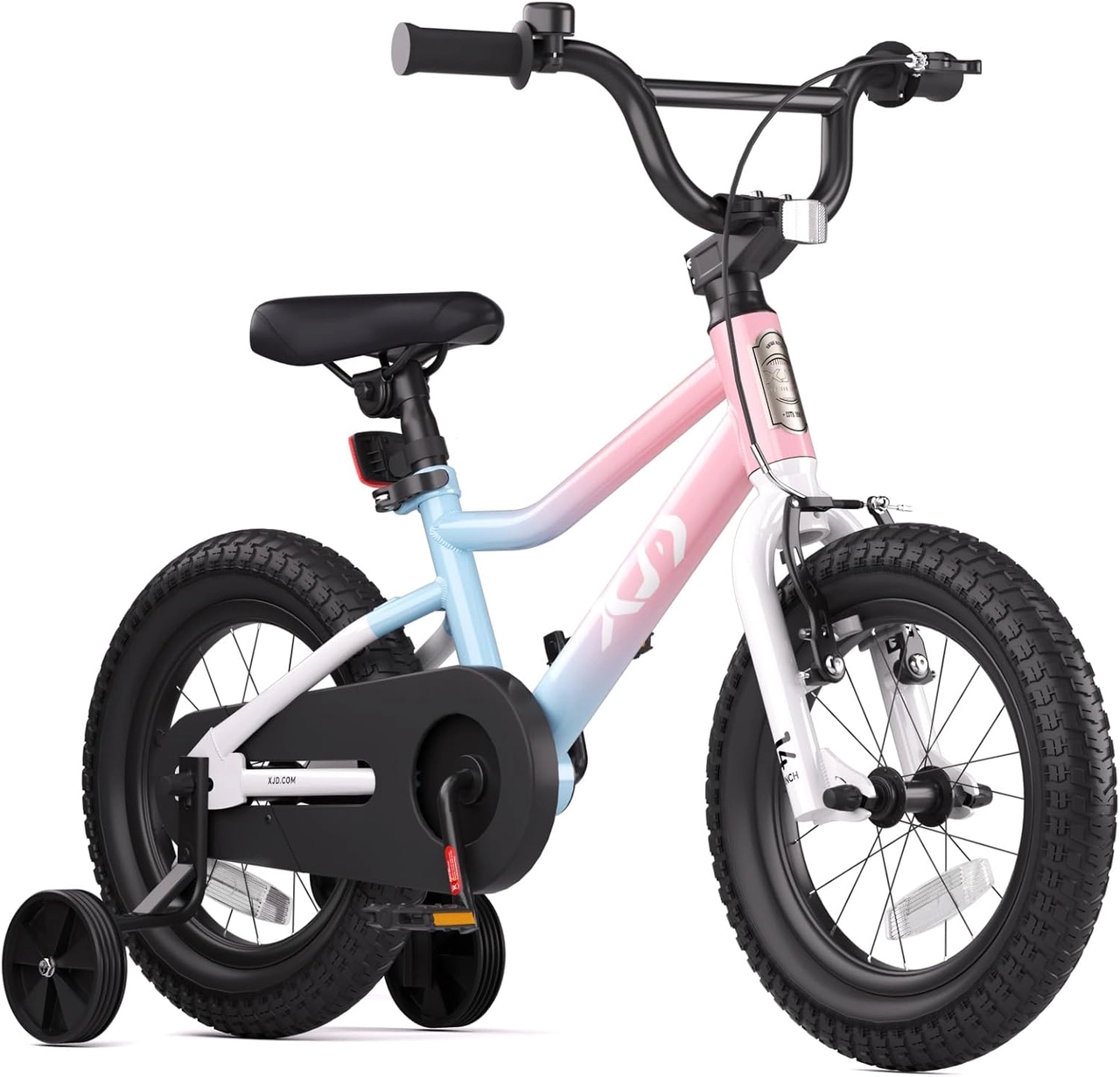 XJD Girls BMX Bike 12/14/16 Inch with Training Wheels – Pink Blue
A Kids' BMX Bike with training wheels and available 12 Inch, 14 Inch and 16 Inch labels. Its 14- and 16-inch options cover common starting comparisons for many five-year-olds.
 XJD Boys & Girls BMX Bike with Training Wheels, 12/14/16" – Blue
A Kids' BMX Bike with training wheels and available 12 Inch, 14 Inch and 16 Inch labels. Consider only the size supported by the child's measurements and hands-on control check.
Compare the three catalog options
The XJD Light Purple Girls Bike with Basket, Training Wheels, 12/14/16/20 Inch is categorized as a Training Wheel Bike. Although its title mentions four sizes, the supplied available SKU labels are 12 Inch, 14 Inch and 16 Inch. Use only an available label that matches her measured range and successful fit check.
The XJD Girls BMX Bike 12/14/16 Inch with Training Wheels – Pink Blue is categorized as a Kids' BMX Bike and has available 12 Inch, 14 Inch and 16 Inch SKU labels. Its size choices let you compare the two most common starting candidates for a five-year-old—14 and 16 inches—plus 12 inches for a shorter rider.
The XJD Boys & Girls BMX Bike with Training Wheels, 12/14/16" – Blue is also categorized as a Kids' BMX Bike, with available 12 Inch, 14 Inch and 16 Inch SKU labels. The catalog title's “Boys & Girls” wording describes the product; fit should still be decided from her measurements and control of the bicycle.
These facts do not establish weight, frame geometry, brake type, assembly details or compatibility. Check the exact product manual for those matters, and use a qualified bicycle mechanic when assembly or adjustment is uncertain.
Make the final size decision
- Measure her standing height and inseam.
- Start with 14 inches at 37–45 inches (94–114 cm) or 16 inches at 40–48 inches (102–122 cm).
- If her height points outside those bands, compare the relevant 12-inch or 18-inch starting point instead.
- Have her straddle and control the exact bike, checking reach and brake operation.
- Select the size she can handle now; do not size up solely for growth.
Complete the setup with a properly fitting bicycle helmet. It should sit level and its straps should be used according to the helmet manufacturer's instructions. For this five-year-old rider, buy only after her measurements and hands-on check agree on the size.
Bikes for your next adventure
-

Pink Girls' 12/14/16" Bike by XJD – Basket & Doll Seat
The XJD Pink Girls' Bike with Basket & Doll Seat is made for riders 71–122 cm ta…$75.99
$99.99 -

Light Purple XJD Toddler Bike Helmet, Adjustable, Size XS (46–51 cm)
This Light Purple XJD toddler bike helmet is made for the smallest riders — the …$20.39
-

Black XJD Toddler Bike Helmet, Adjustable – Kids' Protective Helmet
The XJD Toddler Bike Helmet in black is an adjustable protective helmet for kids…$20.39