

What size bike for a six year old girl
Most six-year-old girls should start by trying a 16-inch bike, but height and fit decide the size. Measure her height and inseam, then check control in person.
Use her height before her age
Six years old falls within more than one XBikes starting range, so age cannot select the bike by itself. Compare her measured standing height with these wheel-size starting points:
| Wheel size | XBikes age starting point | Rider-height starting point |
|---|---|---|
| 14 Inch | Ages 3–6 | 37–45 in / 94–114 cm |
| 16 Inch | Ages 4–7 | 40–48 in / 102–122 cm |
| 18 Inch | Ages 5–9 | 43–52 in / 109–132 cm |
| 20 Inch | Ages 7–12 | 48–60 in / 122–152 cm |
For many six-year-olds, 16 inches is the sensible first size to test. A shorter child may fit a 14-inch bike, while a taller child may need to compare 16 and 18 inches. A 20-inch bike is generally a later starting point unless her measured height and individual fit support it.
These ranges overlap intentionally. They narrow the search, but they do not replace trying the bicycle.
Measure height and inseam accurately
Have her stand without shoes against a wall, looking straight ahead. Keep her heels on the floor and mark the top of her head with a level book. Measure from the floor to that mark.
For inseam, have her stand naturally with her feet slightly apart. Place a firm book between her legs and raise it gently to simulate the position of a bicycle saddle. Measure from the floor to the book's upper edge. Record both measurements in inches or centimetres.
Height identifies likely wheel sizes. Inseam helps you judge whether she can stand over the bike comfortably and get on and off without struggling. Do not choose a larger frame merely because she may grow into it.
Check the bike with the rider on it
Once height suggests a size, have her try the exact bicycle. A useful fit check answers all of these questions:
- Can she stand over the bicycle without the frame pressing into her?
- Can she mount, start, stop and dismount without needing an adult to hold the bike?
- Can she reach the handlebars without stretching, locking her elbows or leaning too far forward?
- Can she steer through a gentle turn while remaining balanced and looking ahead?
- Can her hands reach and operate the available brake controls confidently?
- Does the bike feel manageable at her current skill level rather than intimidating?
If she meets the height range but cannot control the bike, try a smaller or differently proportioned model. If she looks cramped or cannot use a comfortable riding position, compare the next appropriate size. Reach, brake control and confidence can rule out a size even when the height chart includes her.
How the supplied girls' bikes compare
The Flower Pink XJD Girls Bike with Doll Seat & Basket and the Purple XJD Girls' Bike with Doll Seat & Basket are both catalogued as Training Wheel Bikes. Each is offered with 12-inch, 14-inch and 16-inch SKU labels, making them useful comparisons when a six-year-old's measurements point to 14 or 16 inches. Their supplied catalog facts differ by title and colour wording, not by listed size availability.
These particular catalog options help answer the sizing question because both let a parent compare the two smaller sizes most relevant to a shorter or average-height six-year-old. Neither supplied product offers an 18-inch or 20-inch SKU, so they are not substitutes if the fit check shows that she needs either larger wheel size.
 Flower Pink XJD Girls Bike with Doll Seat & Basket
A Training Wheel Bike offered in 12 Inch, 14 Inch and 16 Inch labels. Its 14- and 16-inch options are relevant comparison points when the rider's measured height and individual fit support those sizes.
 Purple XJD Girls' Bike with Doll Seat & Basket
A Training Wheel Bike available with 12 Inch, 14 Inch and 16 Inch labels. Compare its 14- or 16-inch option only after checking the child's height, inseam, reach, brake control and confidence.
The 12-inch versions use an XBikes starting range of ages 3–4 and 34–40 in / 86–102 cm. That usually makes 12 inches too small for a six-year-old, but measured height and an actual fit check remain decisive. Do not infer brake type, construction, weight, availability or other specifications from the names. Consult the exact product manual or a qualified bicycle mechanic for assembly, maintenance, compatibility, load limits and torque information.
Finish the decision safely
Start with the size indicated by measured height: usually 16 inches, with 14 inches worth checking for a child under 40 in / 102 cm and 18 inches worth comparing from 43 in / 109 cm upward. Where ranges overlap, test both relevant sizes and choose the one she can control now—not the larger one intended for future growth.
Complete the test with a properly fitting bicycle helmet. It should sit level and its straps should be adjusted according to the helmet manufacturer's instructions. Then watch her start, steer, brake and stop in a controlled area.
For a six-year-old girl, buy only after her height, inseam, stand-over clearance, reach, brake use and confidence all agree: try 16 inches first, move to 14 or 18 inches only when her measurements and real-world control support that decision.
Bikes for your next adventure
-
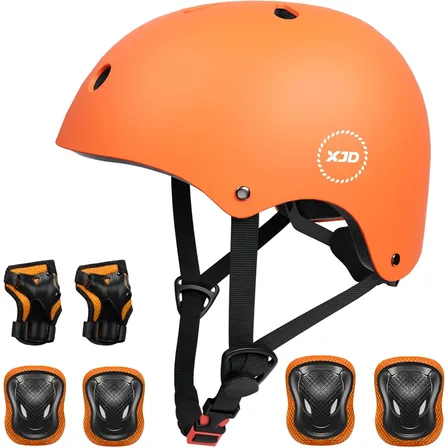
Orange Kids Helmet & Pad Set by XJD – Sizes S & M
The Orange XJD Kids Helmet & Pad Set is built for children around 3 to 8 years o…$24.64
-
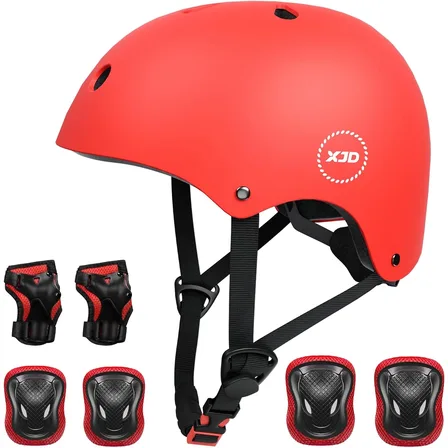
Red XJD Helmet & Protective Gear Set for Kids, Medium
If your child rides a bike, scooter, or skateboard, this red XJD helmet and prot…$25.49
$29.99 -

Kids Bike Helmet by XJD for Boys & Girls – Black, Blue, Green, Pink, Purple
The XJD Kids Bike Helmet covers a wide 2-to-8-year age range thanks to two head-…$59.99