

What size bike for a six-year-old girl
For a six-year-old girl, compare 14-, 16- and 18-inch bikes first, then choose by her measured height and an individual fit check—not age alone.
Start with her height, not her birthday
Measure her standing height without shoes, with her back straight against a wall. At age six, the XBikes starting ranges overlap: a 14-inch bike covers 37–45 in (94–114 cm), a 16-inch bike covers 40–48 in (102–122 cm), and an 18-inch bike covers 43–52 in (109–132 cm).
This overlap is useful. It means two wheel sizes may look plausible on paper, but it does not mean they fit identically. Confidence, body proportions and the bicycle’s exact geometry can make one easier to control than another.
| Wheel size | XBikes age starting point | Rider-height starting point |
|---|---|---|
| 14 Inch | Ages 3–6 | 37–45 in / 94–114 cm |
| 16 Inch | Ages 4–7 | 40–48 in / 102–122 cm |
| 18 Inch | Ages 5–9 | 43–52 in / 109–132 cm |
| 20 Inch | Ages 7–12 | 48–60 in / 122–152 cm |
A 20-inch bike can enter the comparison when she is at least 48 in (122 cm), but age six falls outside its age starting point. Treat the height range only as a reason to arrange a careful try-out, not proof that the bike fits.
Measure inseam and check stand-over clearance
Measure her inseam without shoes: have her stand naturally, place a book firmly upward between her legs to represent a saddle, and measure from the floor to the top edge of the book. Keep this measurement available when checking the bicycle manufacturer’s exact sizing information.
Next, have her straddle the bicycle while standing over its frame. She needs comfortable clearance rather than contact with the frame. Because the supplied sizing standard does not give a universal clearance number, do not invent one or rely on wheel size alone. Follow the exact product manual or ask a qualified bicycle mechanic to assess the fit.
Have her try both overlapping sizes
When her height falls in two ranges, try both sizes. She should be able to mount and dismount without struggling, hold the grips comfortably, steer without stretching, and remain composed while starting and stopping. Her knees and arms should not appear cramped, but neither should she need to overreach.
Check brake control on the exact bicycle. She must be able to reach and operate its controls confidently while maintaining her grip. Do not assume that a listed wheel size guarantees suitable reach. If she cannot control the larger option comfortably, choose the smaller properly fitting bicycle; do not buy an oversized bike merely to allow room for growth.
How the supplied girls’ bikes fit this comparison
The three catalog options provide 14- and 16-inch comparison points, the two sizes most likely to begin the decision for many six-year-olds under the supplied ranges. Purple XJD Girls' Bike with Doll Seat & Basket and Pink Girls' 12/14/16" Bike by XJD – Basket & Doll Seat are offered in 12-, 14- and 16-inch labels. Pink 12/14/16/20" XJD Girls Bike with Training Wheels & Basket adds a 20-inch label.
These particular catalog options help because a parent can compare available 14- and 16-inch versions after measuring the rider, while the third also provides a 20-inch reference for a taller child who reaches that height range.
 Purple XJD Girls' Bike with Doll Seat & Basket
Available in 12-, 14- and 16-inch labels, this product provides relevant 14- and 16-inch comparison options after the six-year-old rider’s height and individual fit are checked.
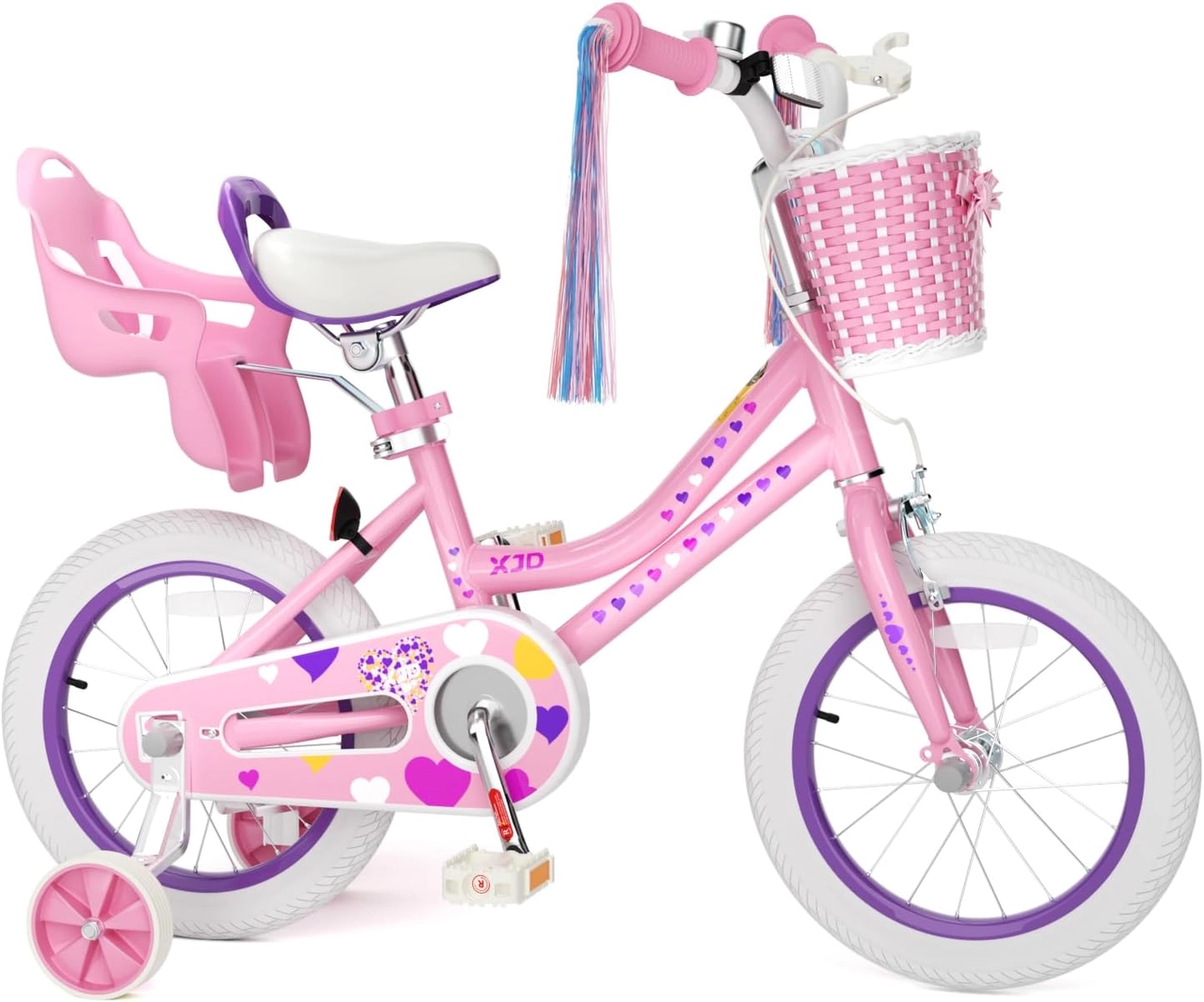 Pink Girls' 12/14/16" Bike by XJD – Basket & Doll Seat
Its supplied 12-, 14- and 16-inch labels make the 14- and 16-inch versions relevant comparison points for a measured six-year-old; wheel size alone does not confirm fit.
 Pink 12/14/16/20" XJD Girls Bike with Training Wheels & Basket
Offered in 12-, 14-, 16- and 20-inch labels, this product supports comparison across several ranges, including a 20-inch reference for a rider at least 48 inches tall, subject to a fit check.
None of these products is supplied with an 18-inch option. If her measurement and hands-on fit point to 18 inches, the displayed products are nearest-size comparison points, not substitutes; a 16- or 20-inch bicycle is not equivalent to an 18-inch one. The 12-inch versions use a starting range of ages 3–4 and 34–40 in (86–102 cm), so they are generally outside the age starting point for a six-year-old, although measured fit still takes priority.
Make the final fit and safety check
- Record her standing height and inseam.
- Use height to shortlist the applicable wheel sizes.
- Have her straddle and ride each plausible bicycle in a suitable supervised setting.
- Compare reach, steering, mounting, stopping, brake operation and current confidence.
- Reject any bicycle that is oversized, awkward to control or difficult to stop.
Use a bicycle helmet that fits properly, sits level and has its straps adjusted according to the helmet manufacturer’s instructions. For assembly, maintenance, compatibility, load limits or torque settings, follow the exact bicycle manual or use a qualified bicycle mechanic.
For this six-year-old rider, measure first, try the overlapping 14-, 16- or 18-inch candidates, and buy only the size she can control comfortably today.
Bikes for your next adventure
-
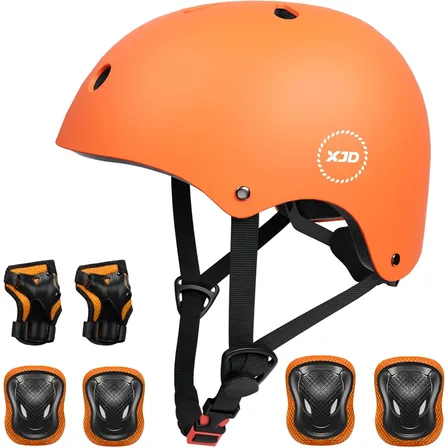
Orange Kids Helmet & Pad Set by XJD – Sizes S & M
The Orange XJD Kids Helmet & Pad Set is built for children around 3 to 8 years o…$24.64
-
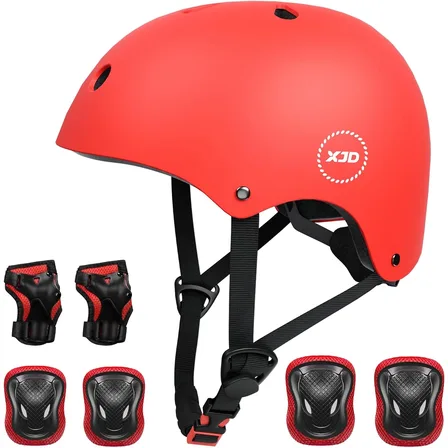
Red XJD Helmet & Protective Gear Set for Kids, Medium
If your child rides a bike, scooter, or skateboard, this red XJD helmet and prot…$25.49
$29.99 -

Kids Bike Helmet by XJD for Boys & Girls – Black, Blue, Green, Pink, Purple
The XJD Kids Bike Helmet covers a wide 2-to-8-year age range thanks to two head-…$59.99