

What size bike for an 8yr old girl
For most 8-year-old girls, start by comparing 18-inch and 20-inch bikes. Measure her height first: 18-inch suits 43–52 in (109–132 cm), while 20-inch suits 48–60 in (122–152 cm). Where those ranges overlap, choose only after checking stand-over, reach, braking and confidence on the actual bike.
Measure before choosing a wheel size
Age provides a starting point, but it cannot confirm fit. Measure your child without shoes, standing straight against a wall, from the floor to the top of her head. Then measure her inseam from the floor to the crotch while she stands naturally with her feet slightly apart.
Compare her measured height with the XBikes starting points:
| Wheel size | Starting age range | Rider height | Relevance at age 8 |
|---|---|---|---|
| 16 Inch | 4–7 | 40–48 in / 102–122 cm | Usually below the age starting point; consider only if her measured size and individual fit support it. |
| 18 Inch | 5–9 | 43–52 in / 109–132 cm | A likely comparison for a shorter 8-year-old. |
| 20 Inch | 7–12 | 48–60 in / 122–152 cm | A common starting point for this age when height and control agree. |
| 24 Inch | 10–14 | 54–64 in / 137–163 cm | Do not select from height alone; it may be too large despite an overlapping height range. |
The inseam does not translate automatically into a wheel size because bicycle frames differ. Use it during the physical stand-over check rather than inventing a universal clearance number.
Decide between 18 and 20 inches
If she is under 48 in (122 cm), begin with an 18-inch bike under this standard. From 48 to 52 in (122–132 cm), both 18-inch and 20-inch height ranges apply, so neither size wins on the chart alone. Have her try both and favor the one she can control comfortably now.
Above 52 in (132 cm), the 18-inch starting range no longer applies; compare a 20-inch bike first. A tall child approaching 54 in (137 cm) may also enter the 24-inch height range, but the 24-inch age starting point is 10–14. That makes an individual fit and control check especially important for an 8-year-old.
Do not buy an oversized bicycle merely to leave growing room. A bike that is difficult to mount, steer or stop is not made suitable by the expectation that she will grow into it.
Run a practical fit check
Have her wear the shoes she will ride in and try the bicycle in a controlled area with adult supervision. Check that she can:
- Stand over the frame securely rather than being forced onto tiptoes or against the frame.
- Sit in a stable riding position and reach the handlebar without an uncomfortable stretch.
- Turn the handlebar while remaining balanced and in control.
- Reach and operate the brakes confidently with her hands in their normal riding position.
- Start, stop and put a foot down without panic or a sudden loss of balance.
If she cannot complete these checks, reject that particular bike or setup even when her age and height appear within the chart. Ask a qualified bicycle mechanic about adjustments, and follow the exact product manual for assembly, maintenance, compatibility, load limits and torque requirements.
How the supplied XBikes options compare
The supplied catalog does not include an 18-inch option, so its products cannot substitute for an 18-inch bike when that is the size her measurements and test ride indicate. They are useful because both catalogs provide 20-inch comparison points, while their other listed sizes help show when a model falls outside the likely range.
The Pink 12/14/16/20" XJD Girls Bike with Training Wheels & Basket has 12-, 14-, 16- and 20-inch SKU labels. For a typical age-eight comparison, examine the 20-inch version only if she measures 48–60 in (122–152 cm) and passes the individual fit check. Its 12- and 14-inch choices use much smaller starting ranges; the 16-inch choice starts at ages 4–7 and heights 40–48 in (102–122 cm).
The 26-Inch XJD Beach Cruiser Bike for Girls – Purple, V-Brake lists 20-, 24- and 26-inch available SKU labels across its supplied color combinations. The 20-inch choices are relevant to the 48–60 in (122–152 cm) comparison. A 24-inch choice should not be assumed suitable merely because a tall 8-year-old reaches 54 in (137 cm), and 26 inches is the starting point only for youth and adults over 60 in (153 cm). Treat the age wording in any product name as a catalog label, not fit evidence.
These particular catalog options let you compare an age-eight candidate at 20 inches with clearly smaller and larger listed alternatives before confirming fit in person.
 Pink 12/14/16/20" XJD Girls Bike with Training Wheels & Basket
Offers 12-, 14-, 16- and 20-inch SKU labels. Its 20-inch version is relevant when the rider measures 48–60 inches and passes an individual fit check; it does not provide the chart’s 18-inch option.
 26-Inch XJD Beach Cruiser Bike for Girls – Purple, V-Brake
Lists 20-, 24- and 26-inch SKU labels across supplied colors. The 20-inch choices are the most relevant comparison for many 8-year-olds; 24 and 26 inches require their own height and control checks.
Make the final choice
- Measure her standing height and inseam.
- Use 18 inches at 43–52 in and 20 inches at 48–60 in as starting points.
- In the overlap, try both sizes rather than choosing by age or appearance.
- Reject any bike she cannot stand over, steer, reach or brake comfortably.
- Fit a bicycle helmet so it sits level and secure its straps according to the helmet manufacturer’s instructions.
For an 8-year-old girl, proceed with a 20-inch catalog option only when she is at least 48 in (122 cm) and demonstrates comfortable control; otherwise, seek an actual 18-inch bike and verify its fit rather than substituting a larger size.
Bikes for your next adventure
-

XJD Girls Bike for Kids Ages 3-8, 12/14/16 Inch with Training Wheels – Purple
The XJD Girls Bike in Purple is a training-wheel bicycle for kids ages 3 to 8, f…$149
$169 -
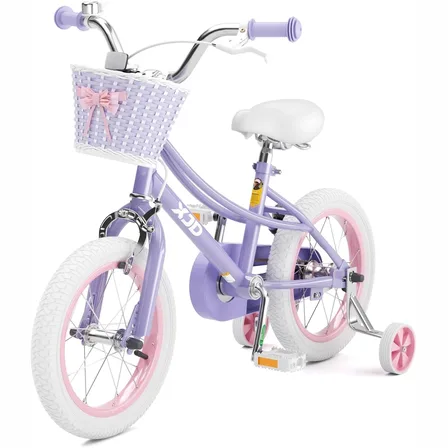
Girls' Training Wheel Bike by XJD with Basket – Purple
If you're shopping for a first bike for a girl roughly 3 to 12 years old (91–152…$75.99
-

Blue XJD Girls Bike with Training Wheels – 12/14/16 Inch
If you're shopping for a first pedal bike for a daughter roughly 3 to 8 years ol…$149
$169