

What size bike for girl 4 feet tall
For a girl who is exactly 4 feet tall (48 inches/122 cm), compare 16-, 18-, and 20-inch bikes, then choose only after an individual fit check.
Why three wheel sizes deserve a fit check
At 48 inches, the rider sits where several XBikes starting ranges overlap. A 16-inch bike covers heights of 40–48 inches (102–122 cm), an 18-inch bike covers 43–52 inches (109–132 cm), and a 20-inch bike covers 48–60 inches (122–152 cm). That makes 48 inches the upper edge of the 16-inch range and the lower edge of the 20-inch range, while also falling inside the 18-inch range.
These figures identify sensible bikes to try; they do not determine the purchase by themselves. Body proportions, reach, brake control, and current riding confidence can make one size clearly easier to handle than another.
| Wheel size | XBikes rider-height range | What 48 inches means |
|---|---|---|
| 16 Inch | 40–48 in / 102–122 cm | At the upper edge |
| 18 Inch | 43–52 in / 109–132 cm | Inside the range |
| 20 Inch | 48–60 in / 122–152 cm | At the lower edge |
Measure height and inseam before shopping
Measure the child without shoes, standing straight against a wall with feet flat. Record the floor-to-top-of-head height rather than relying on an old measurement or an age estimate. Four feet should read 48 inches or about 122 cm.
Next, measure inseam. Have the child stand with feet slightly apart, place a firm book upright between the legs to represent the saddle area, and measure from the floor to the top edge of the book. Keep this number available when checking the bicycle’s stand-over space and saddle adjustment according to the exact product manual.
Age is secondary. The XBikes starting points list 16-inch bikes for ages 4–7, 18-inch bikes for ages 5–9, and 20-inch bikes for ages 7–12, but measured fit and control take priority over those broad age bands.
What the child should do during the fit check
Have her try the actual bicycle. The American Academy of Pediatrics guidance emphasizes trying the bike, checking stand-over and control, and avoiding an oversized bicycle bought merely for future growth.
- Stand over it: confirm that she can stand over the frame securely and comfortably. Use the manufacturer’s fitting instructions for the specific bicycle rather than assuming a universal clearance.
- Check the reach: with a normal riding posture, she should reach the handlebar without stretching, locking her arms, or losing stable control.
- Check the brakes: she must be able to reach and operate the supplied brake controls confidently. Brake type is model-specific, so verify it on the bicycle and in its manual.
- Start, steer, and stop: in a controlled area, confirm that she can begin riding, turn accurately, stop when asked, and put a foot down without panic.
If the 20-inch bicycle makes any of these actions difficult, its height range does not make it a suitable choice today. If the 16-inch bicycle feels cramped or limits comfortable control, compare the 18- and 20-inch options rather than choosing by the label alone.
How the supplied girls’ bikes help with comparison
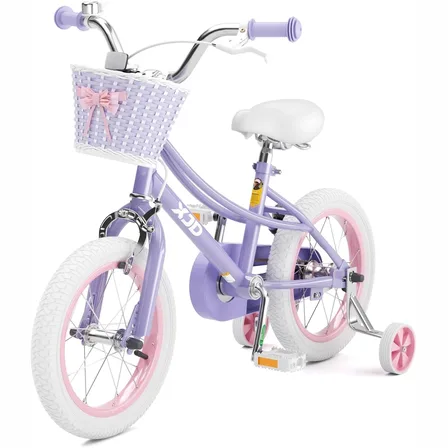
The supplied catalog provides useful training-wheel-bike comparison points around this height. Girls' Training Wheel Bike by XJD with Basket – Purple is offered in 14 Inch, 16 Inch, and 20 Inch labels, so its 16- and 20-inch versions bracket the key boundary at 48 inches. Flower Pink XJD Girls Bike with Doll Seat & Basket is offered in 12 Inch, 14 Inch, and 16 Inch labels, making its 16-inch version relevant to the smaller of the likely choices. Neither supplied product has an 18 Inch label, so these products cannot substitute for an 18-inch bike if that size gives the child the correct fit.
 Girls' Training Wheel Bike by XJD with Basket – Purple
Available in 14 Inch, 16 Inch, and 20 Inch labels. Its 16- and 20-inch versions provide relevant comparison points for a 48-inch rider, but each requires an individual fit check.
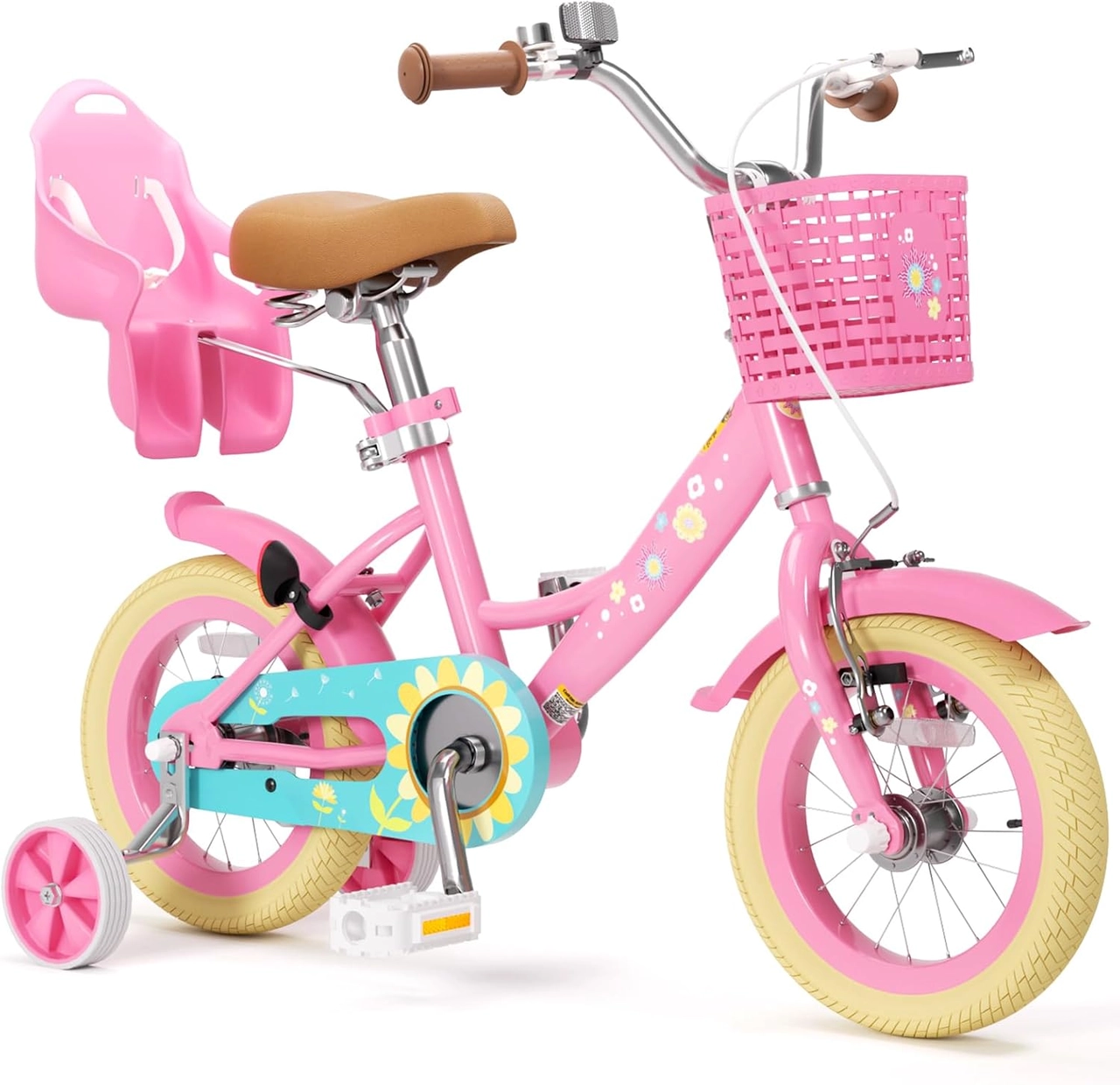 Flower Pink XJD Girls Bike with Doll Seat & Basket
Available in 12 Inch, 14 Inch, and 16 Inch labels. The 16-inch version is relevant at the upper edge of its XBikes height range; this product does not offer an 18- or 20-inch label.
These are training-wheel-bike options, so they are relevant when that format matches the rider’s present needs. Their baskets, and the doll seat named on the pink model, should not influence the size decision. Compare fit and control first. Availability, assembly, maintenance, load limits, component compatibility, and adjustment procedures must be checked in the exact product manual or with a qualified bicycle mechanic.
Do not size up only for growth
A child at 48 inches may technically enter the 20-inch starting range, but that does not automatically make a 20-inch bicycle the right purchase. Choosing a bike she cannot comfortably straddle, reach, steer, or stop trades present control for hoped-for future use. Growth room is reasonable only after the bike fits now.
Likewise, do not automatically select 16 inches because it seems less intimidating. At the top of that height range, the rider’s proportions and posture may point toward an 18- or 20-inch bike. A side-by-side trial resolves this more reliably than age, appearance, or wheel size alone.
Finish with the safety essentials
Use a bicycle helmet that fits properly, sits level, and has straps adjusted according to the helmet manufacturer’s instructions, consistent with U.S. Consumer Product Safety Commission guidance. Recheck the helmet whenever its adjustment changes.
For a 4-foot-tall girl, begin by trying 16-, 18-, and 20-inch bikes. Record her height and inseam, compare stand-over, reach, brake operation, starting, steering, and stopping, then select the size she can control comfortably today—not the largest size she may eventually grow into.
Bikes for your next adventure
-

Pink 12/14/16/20" XJD Girls Bike with Training Wheels & Basket
The Pink XJD Girls Bike with Training Wheels & Basket is a first-bike pick f…$65.99
$75.99 -
Girls' Training Wheel Bike by XJD with Basket – Purple
If you're shopping for a first bike for a girl roughly 3 to 12 years old (91–152…$75.99
-
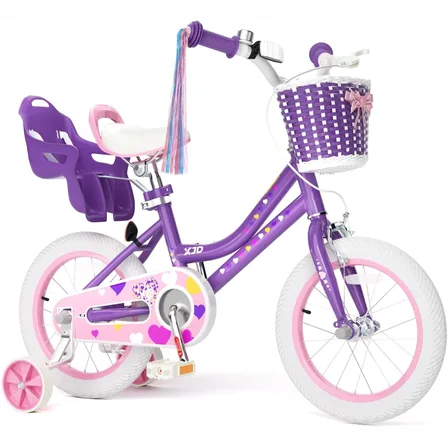
XJD Light Purple Girls Bike with Basket, Training Wheels, 12/14/16/20 Inch
The XJD Girls Bike with Basket in Light Purple is a single-speed training-wheel …$99.99
$119.99