

What size bike for girl age 7
For most 7-year-old girls, start by comparing 16-, 18- and 20-inch bikes—but choose by measured height and an in-person fit, not age alone.
Which wheel size should you check first?
Measure your child’s standing height without shoes, then use the XBikes starting points below. At age 7, several size ranges overlap, so age cannot identify the correct bike by itself.
| Wheel size | XBikes age starting point | Rider-height starting point |
|---|---|---|
| 16 Inch | Ages 4–7 | 40–48 in / 102–122 cm |
| 18 Inch | Ages 5–9 | 43–52 in / 109–132 cm |
| 20 Inch | Ages 7–12 | 48–60 in / 122–152 cm |
A girl shorter than 48 inches may begin with the 16- or 18-inch comparison, depending on where her measured height falls. At 48 inches, all three published height ranges meet, making a physical fit check especially important. Above 48 inches, compare 18 and 20 inches until the rider exceeds the 18-inch starting range at 52 inches. These are starting points, not guarantees of fit.
Measure height and inseam before shopping
Record standing height first. For inseam, have the child stand upright in socks with feet slightly apart. Place a firm, level object between the legs to represent the saddle contact point, then measure from its top edge straight down to the floor.
Use height to identify likely wheel sizes, then take both measurements to the product’s size information or exact manual. The supplied standard does not provide a universal inseam-to-frame formula, and two bicycles with the same wheel label can fit differently. Do not infer fit from wheel size alone.
What a proper try-on should confirm
Have the child try the actual bicycle whenever possible. The American Academy of Pediatrics advises against buying an oversized bike merely to allow room for growth. During the fit check, confirm that she can:
- Stand over the bicycle with comfortable clearance rather than being pressed against it.
- Mount, start, steer and stop without struggling to control the bike.
- Reach the handlebars without an exaggerated stretch or cramped posture.
- Reach and operate the brakes reliably with her hands in a normal riding position.
- Put a foot down and recover balance in a way that matches her present confidence.
If a larger candidate makes starting, turning or braking harder, reject it even when its published age range includes 7. If two sizes appear possible, compare control and confidence on both instead of automatically choosing the larger one.
How the supplied girls’ bikes are relevant
The three catalog options are all Training Wheel Bikes offered in 12 Inch, 14 Inch and 16 Inch labels. Their 16-inch versions are relevant comparison points for a 7-year-old whose height falls within 40–48 inches / 102–122 cm and who passes the individual fit check. The 12- and 14-inch versions use smaller starting ranges and should not be selected simply because the products have a girls’ design.
These particular catalog options help answer the question because each provides a 16-inch choice at the lower end of the age-7 comparison, while their exact titles identify basket and doll-seat features. They do not provide 18- or 20-inch options.
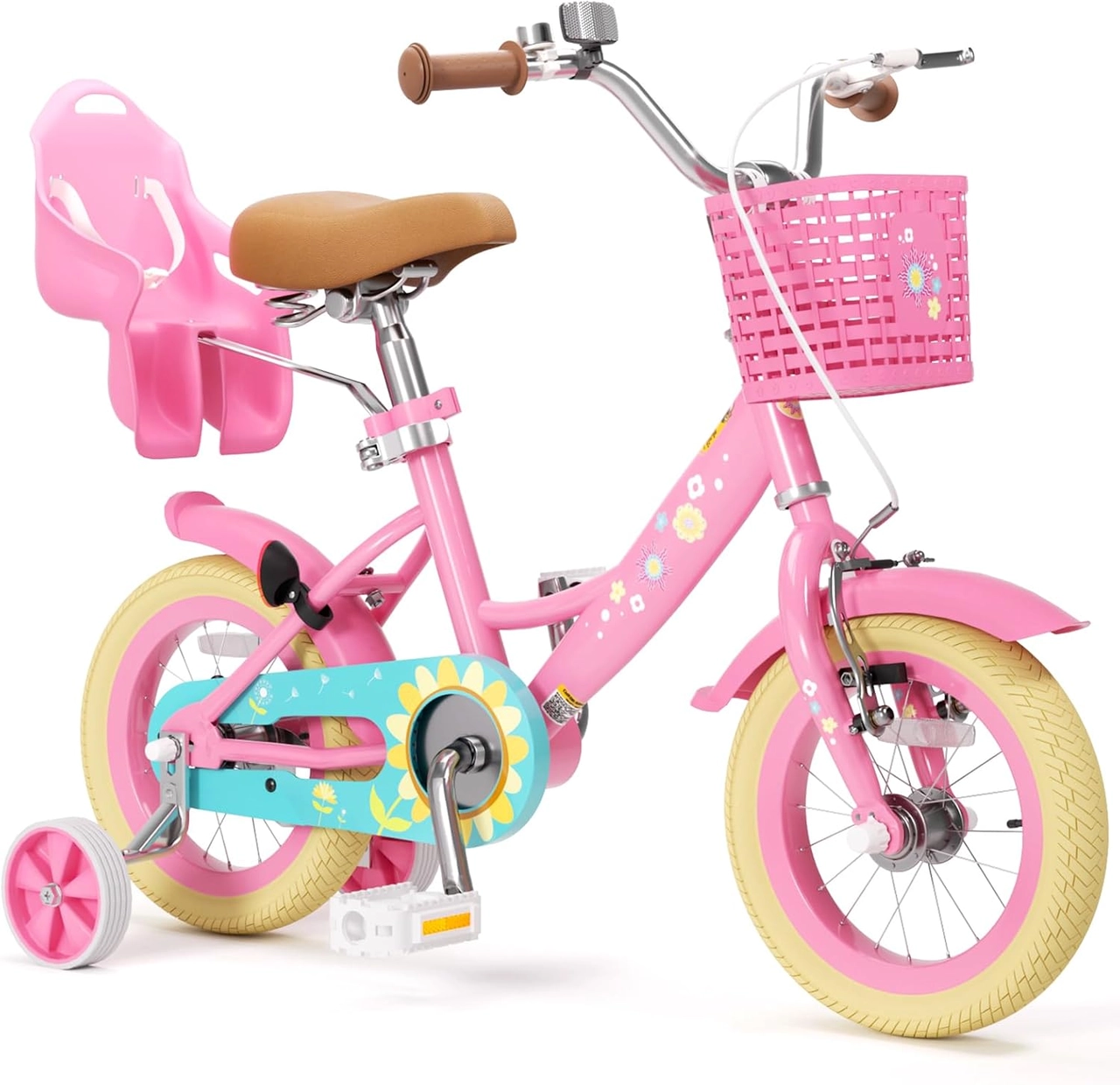 Flower Pink XJD Girls Bike with Doll Seat & Basket
A 12-, 14- or 16-inch Training Wheel Bike. Its 16-inch option is relevant only when the rider is 40–48 inches tall and passes an individual fit check.
 Purple XJD Girls' Bike with Doll Seat & Basket
This purple Training Wheel Bike comes in 12-, 14- and 16-inch labels. For a 7-year-old, the 16-inch version is a comparison option when measurements and riding control support it.
 Pink Girls' 12/14/16" Bike by XJD – Basket & Doll Seat
Available in 12-, 14- and 16-inch labels, this Training Wheel Bike provides a 16-inch comparison for appropriately measured riders; it is not a substitute when an 18- or 20-inch fit is needed.
What differs in the catalog
Flower Pink XJD Girls Bike with Doll Seat & Basket is available in 12 Inch, 14 Inch and 16 Inch labels. Purple XJD Girls' Bike with Doll Seat & Basket offers the same three wheel-size labels in purple. Pink Girls' 12/14/16" Bike by XJD – Basket & Doll Seat also lists 12-, 14- and 16-inch choices.
Because all three stop at 16 inches, they are relevant only when the rider’s measurements and try-on support that size. If she needs an 18- or 20-inch bike, these products are nearest-size comparison points, not substitutes; another wheel size is not equivalent. Use the exact product manual or a qualified bicycle mechanic for assembly, maintenance, compatibility, load limits or torque details not supplied here.
Do the final safety and confidence check
Fit a bicycle helmet for every ride. U.S. Consumer Product Safety Commission guidance says the helmet should fit properly, sit level and have its straps used according to the helmet manufacturer’s instructions.
Then test the likely size in a controlled setting appropriate for the child. Recheck stand-over clearance, reach, brake operation, steering and her ability to stop and place a foot down. Training wheels, where used, do not make an otherwise oversized bicycle fit correctly.
Your next decision
- Measure her standing height and inseam.
- Compare her height with the 16-, 18- and 20-inch starting ranges.
- Try the resulting candidate size or sizes and reject any bike she cannot comfortably control or brake.
- Consider the supplied 16-inch products only if both measurement and try-on support 16 inches; otherwise continue with the correctly fitting 18- or 20-inch size.
Bikes for your next adventure
-

Pink 12/14/16/20" XJD Girls Bike with Training Wheels & Basket
The Pink XJD Girls Bike with Training Wheels & Basket is a first-bike pick f…$65.99
$75.99 -
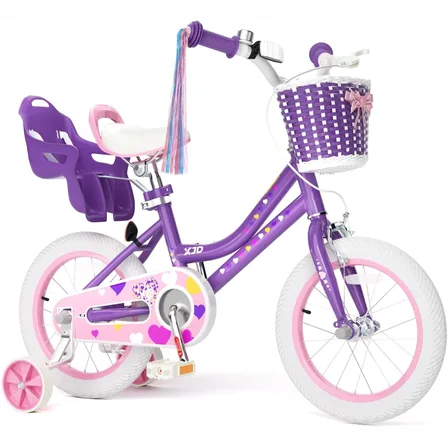
XJD Light Purple Girls Bike with Basket, Training Wheels, 12/14/16/20 Inch
The XJD Girls Bike with Basket in Light Purple is a single-speed training-wheel …$99.99
$119.99 -
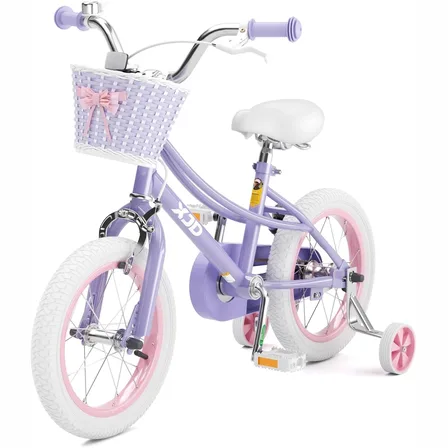
Girls' Training Wheel Bike by XJD with Basket – Purple
If you're shopping for a first bike for a girl roughly 3 to 12 years old (91–152…$75.99