

What size bike for girl age 8
For most 8-year-old girls, start by comparing an 18-inch and 20-inch bike, then choose by measured height and an in-person fit check—not age alone.
Use height to choose the first wheel size
Measure the child without shoes, standing straight against a wall. Compare that number with the XBikes starting points below. These ranges narrow the search, but they do not prove that a particular frame will fit.
| Wheel size | XBikes age starting point | Rider height | Relevance at age 8 |
|---|---|---|---|
| 16 Inch | Ages 4–7 | 40–48 in / 102–122 cm | Consider only when her measured height and actual fit support it. |
| 18 Inch | Ages 5–9 | 43–52 in / 109–132 cm | A common starting comparison for a shorter 8-year-old. |
| 20 Inch | Ages 7–12 | 48–60 in / 122–152 cm | A common starting comparison for many 8-year-olds. |
| 24 Inch | Ages 10–14 | 54–64 in / 137–163 cm | Worth comparing only for a taller rider who can control it comfortably. |
If she is 43–47 inches tall, begin with 18 inches. At 48–52 inches, the published ranges overlap, so compare both 18- and 20-inch bikes in person. At 53–60 inches, begin with 20 inches; from 54 inches, a 24-inch comparison may also be reasonable. Height outside these bands should be matched against the full XBikes standard rather than forced into an age-based choice.
Measure inseam as well as total height
Have her stand in socks with her feet naturally spaced. Place a firm, thin book between her legs and raise it gently to simulate the saddle contact point. Measure vertically from the floor to the top edge of the book. Keep this measurement available when checking the bicycle or its exact manual.
Wheel diameter alone does not determine stand-over clearance or saddle position; frames with the same wheel label can differ. With the bicycle upright, she should be able to straddle it without the frame obstructing a comfortable stance. Follow the product manual for permitted saddle and handlebar adjustments, or ask a qualified bicycle mechanic if the setup is unclear.
Do a five-part fit check
The American Academy of Pediatrics advises having the child try the bicycle and avoiding an oversized bike bought merely for future growth. During the trial, check:
- Stand-over: she can stand over the frame comfortably and stabilize the bike.
- Starting and stopping: she can get moving and stop without struggling against the bike's size.
- Reach: she can hold the handlebar without stretching, locking her elbows or losing a balanced posture.
- Brake control: she can reach and operate the fitted controls reliably with her hands in their normal riding position.
- Turning: she can steer both ways at low speed while remaining composed and in control.
If she cannot complete these checks, reject that fit even when her age and height appear inside a published range. Current confidence matters too: a nervous or developing rider may handle a different frame more successfully than a confident rider of identical height.
How the supplied catalog option helps
The XJD Kids Bike for Girls – Pink, 12/14/16/20 Inch with Training Wheels is offered in 12-, 14-, 16- and 20-inch SKU labels. For an 8-year-old, its 20-inch option is the principal comparison when she measures 48–60 inches. Its 16-inch option is relevant only if her measured height, reach and control genuinely support that smaller size. The 12- and 14-inch options correspond to substantially smaller XBikes starting ranges and should not be selected simply because the product is presented for children.
This catalog choice helps because it provides multiple labeled sizes, including the age-8 starting point of 20 inches. It does not include an 18-inch SKU, so an 18-inch bike remains a distinct size to compare elsewhere when her height points there; the listed 16- or 20-inch versions are not equivalent substitutes.

Do not size up for growth
A larger bicycle may last longer on paper, but that does not compensate for poor stand-over, excessive reach or weak brake control today. If she falls in an overlapping height range, choose the bike on which she demonstrates better control rather than automatically choosing the larger wheel.
Training wheels also do not correct an oversized frame. Treat them as a feature named for the supplied product, not evidence that any listed size fits this rider. For assembly, adjustment limits, compatibility, maintenance, load limits and torque requirements, use the exact product manual or a qualified bicycle mechanic.
Make the final age-8 decision
Measure her height and inseam first. Start with 18 inches at 43–47 inches tall, compare 18 and 20 inches at 48–52 inches, and start with 20 inches at 53–60 inches. Then have her straddle, reach, brake, start, stop and turn on the actual bicycle. Choose only the size she can control now, and finish by fitting a bicycle helmet level on her head with its straps adjusted according to the helmet manufacturer's instructions.
Bikes for your next adventure
-
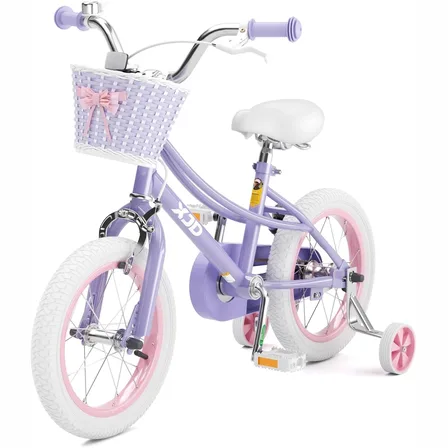
Girls' Training Wheel Bike by XJD with Basket – Purple
If you're shopping for a first bike for a girl roughly 3 to 12 years old (91–152…$75.99
-
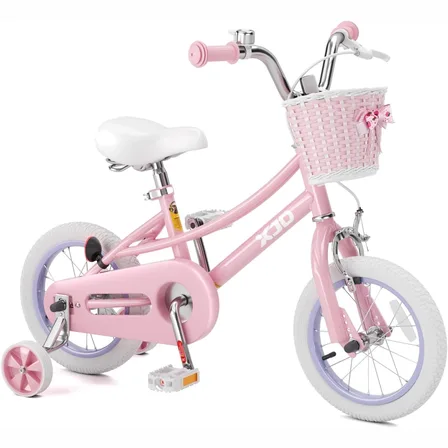
Pink 12/14/16/20" XJD Girls Bike with Training Wheels & Basket
The Pink XJD Girls Bike with Training Wheels & Basket is a first-bike pick f…$65.99
$75.99 -
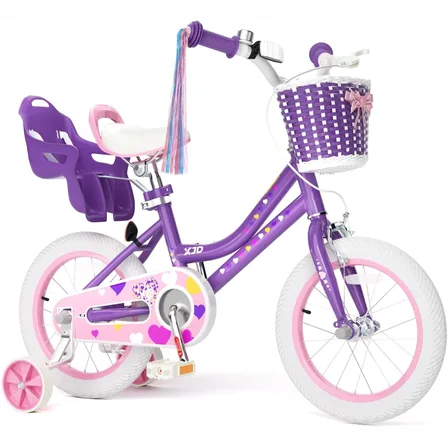
XJD Light Purple Girls Bike with Basket, Training Wheels, 12/14/16/20 Inch
The XJD Girls Bike with Basket in Light Purple is a single-speed training-wheel …$99.99
$119.99