

What size bike for girl age 9
For most 9-year-old girls, start with a 20-inch bike, then confirm it fits her measured height, inseam, reach, brake control and confidence.
The short answer by height
Age nine falls within two XBikes starting ranges: an 18-inch bike covers ages 5–9 and heights 43–52 inches (109–132 cm), while a 20-inch bike covers ages 7–12 and heights 48–60 inches (122–152 cm). The overlap means age alone cannot settle the choice.
If she is 48–52 inches tall, compare both 18-inch and 20-inch bikes in person. Below 48 inches, begin with 18 inches. From 53–60 inches, begin with 20 inches. A rider who is at least 54 inches tall can also compare a 24-inch bike, whose starting range is ages 10–14 and 54–64 inches (137–163 cm), but only if she can comfortably control it. Over 60 inches (153 cm), 26-inch youth and adult bikes become a starting point.
| Measured height | Wheel size to check first |
|---|---|
| 43–47 in / 109–121 cm | 18 Inch |
| 48–52 in / 122–132 cm | Compare 18 Inch and 20 Inch |
| 53–60 in / 135–152 cm | 20 Inch |
| 54–64 in / 137–163 cm | 24 Inch may also merit a fit check |
| Over 60 in / 153 cm | 26 Inch starting point |
These ranges narrow the search; they do not prove that every frame with the same wheel size will fit identically.
Measure her before comparing bikes
Measure height without shoes, with her standing straight against a wall. For inseam, have her stand with feet slightly apart and measure from the floor to the top of the inside leg. Record both measurements rather than estimating from clothing size or age.
Wheel-size charts use overall height, but inseam helps reveal whether she has enough clearance over the frame and can mount and stop without struggling. Reach also varies among bicycle designs, so measurements should lead to an actual fit check rather than an online size decision by themselves.
What to check when she tries the bike
- Stand-over: Ask her to straddle the bicycle with both feet on the ground. She should have usable clearance and should not be forced onto tiptoes by the frame.
- Starting and stopping: She should be able to get on, begin riding and put a foot down without the bicycle feeling unwieldy.
- Reach: With hands in the riding position, she should not need to stretch excessively or lock her arms to steer.
- Brake control: She must be able to reach and operate the fitted brakes reliably while maintaining steering control.
- Confidence: Watch for controlled turns and stops. A technically possible fit is still unsuitable if the size makes her hesitant or unstable.
The American Academy of Pediatrics advises having a child try the bicycle and avoiding an oversized bike bought merely for future growth. Choose the size she can control now.
How the supplied XBikes options relate
The catalog provides useful comparison points around the likely sizes. XJD Light Purple Girls Bike with Basket, Training Wheels, 12/14/16/20 Inch is listed under Training Wheel Bikes, with available 12 Inch, 14 Inch and 16 Inch SKU labels. Those available sizes sit below the usual starting point for most nine-year-olds, although a 16-inch version may provide a useful smaller-size comparison when fit or confidence makes larger bicycles difficult.
XJD Pink Beach Cruiser for Girls – Rear Rack & V-Brake is listed under Beach Cruiser Bikes and has 20 Inch, 24 Inch and 26 Inch SKU labels. Those sizes let a parent compare the principal 20-inch starting point with larger 24-inch and 26-inch options when measured height supports doing so. The product name itself does not establish fit.
These particular catalog options help answer the question because they show available sizes below, at and above the common 20-inch starting point, making the required individual fit comparison clearer.
 XJD Light Purple Girls Bike with Basket, Training Wheels, 12/14/16/20 Inch
Available in 12 Inch, 14 Inch and 16 Inch SKU labels, this training-wheel bike is mainly a smaller-size comparison; it does not provide the relevant 18-inch option.
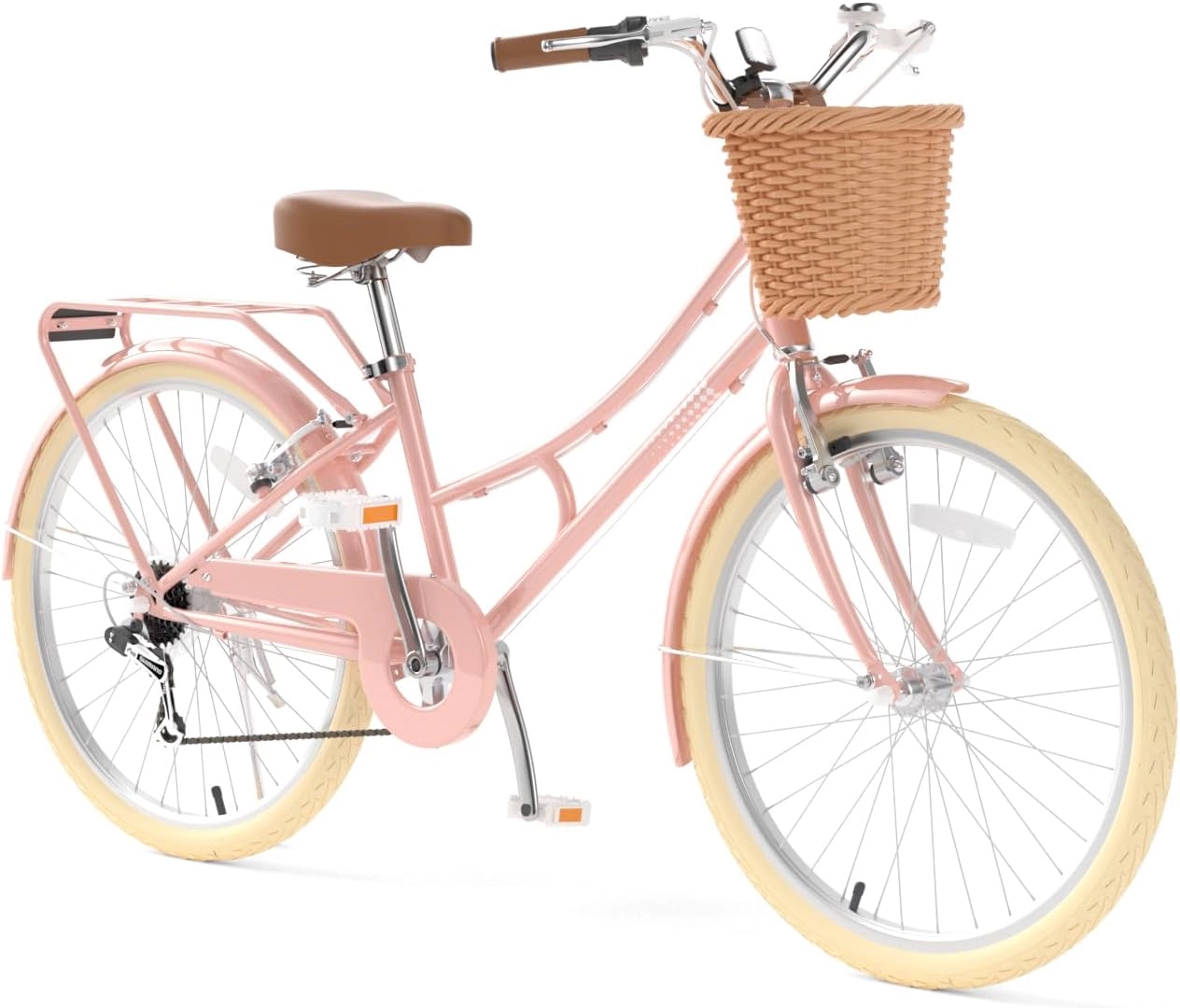 XJD Pink Beach Cruiser for Girls – Rear Rack & V-Brake
Its 20 Inch, 24 Inch and 26 Inch SKU labels cover the main starting size and larger comparison points, but measured fit and control must determine relevance.
When these products are not relevant
Neither supplied product has an available 18 Inch SKU label. If her measurements and trial point to an 18-inch bike, these products are nearest-size comparison points, not substitutes; a 16-inch, 20-inch or other wheel size is not equivalent to 18 inches.
The training-wheel model is also unlikely to be the relevant available-size choice when she fits the stated 18-inch, 20-inch or larger ranges, unless an individual trial shows that its available 16-inch size suits her current dimensions and control. Conversely, do not move to the beach cruiser’s 24-inch or 26-inch label solely for growing room. For assembly, maintenance, compatibility, torque or load limits, follow the exact product manual or consult a qualified bicycle mechanic.
Make the final size decision
Begin with 20 inches for a typical nine-year-old, but use 18 inches when her height and control point smaller, and compare 24 inches only when she is at least 54 inches tall and manages it comfortably. After selecting the bicycle, fit a bicycle helmet so it sits level and its straps follow the manufacturer’s instructions. The right decision is the size she can stand over, reach, steer, brake and stop confidently today—not the size she may eventually grow into.
Bikes for your next adventure
-
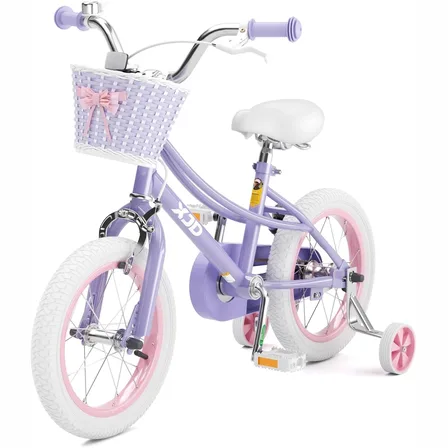
Girls' Training Wheel Bike by XJD with Basket – Purple
If you're shopping for a first bike for a girl roughly 3 to 12 years old (91–152…$75.99
-
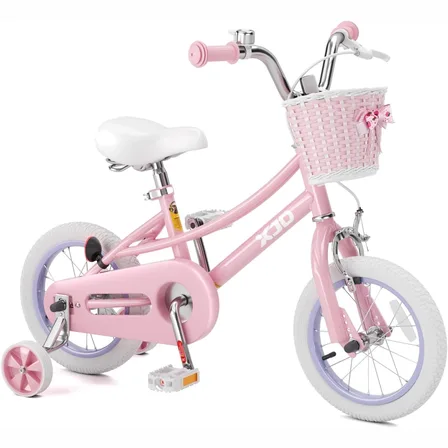
Pink 12/14/16/20" XJD Girls Bike with Training Wheels & Basket
The Pink XJD Girls Bike with Training Wheels & Basket is a first-bike pick f…$65.99
$75.99 -
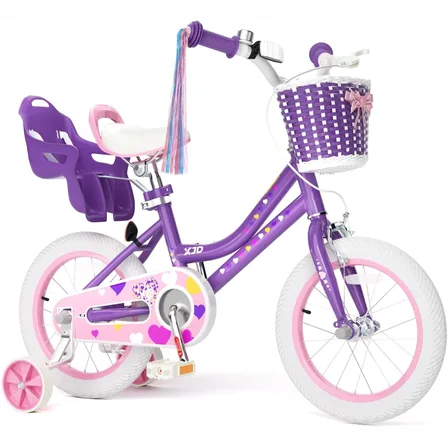
XJD Light Purple Girls Bike with Basket, Training Wheels, 12/14/16/20 Inch
The XJD Girls Bike with Basket in Light Purple is a single-speed training-wheel …$99.99
$119.99