

What size bike would an 8 year old girl ride
Most 8-year-old girls should start by trying a 20-inch bike, especially if they are 48–60 in (122–152 cm) tall. Measure her height and inseam, then confirm stand-over clearance, reach, brake control and confidence before choosing.
Choose by height, not by age alone
At age 8, the XBikes starting points overlap because children of the same age can differ considerably in size and ability. A 20-inch wheel bike is the usual starting point for ages 7–12 and heights of 48–60 in (122–152 cm), but it is not automatically the correct fit.
| Wheel size | XBikes age starting point | XBikes height starting point | Relevance at age 8 |
|---|---|---|---|
| 18 Inch | Ages 5–9 | 43–52 in / 109–132 cm | Worth trying for a shorter rider |
| 20 Inch | Ages 7–12 | 48–60 in / 122–152 cm | The main starting point |
| 24 Inch | Ages 10–14 | 54–64 in / 137–163 cm | May suit a taller rider, but only after a fit check |
The overlapping ranges are comparison points, not instructions to size up. Do not buy a bicycle that is too large simply to leave growing room. The child should try the actual bike and be able to control it now.
What to measure before shopping
Measure her standing height without shoes, with her back straight against a wall. Then measure her inseam from the floor to the crotch while she stands naturally. Record both measurements and bring them when comparing bicycles.
Height identifies a sensible wheel-size range. Inseam helps assess whether she can stand over the frame comfortably. Frame shapes vary even when wheel labels match, so neither age nor wheel diameter tells you everything about fit.
What to check on the actual bicycle
Have her try each candidate rather than judging it only from a size label. Check these points with the bicycle adjusted according to its exact manual:
- Stand-over: She should be able to straddle the bicycle securely without the frame preventing a stable stance.
- Reach: She should reach the handlebars without stretching, locking her elbows or leaning awkwardly.
- Brake control: She must be able to reach and operate the controls confidently. Do not assume a control can be adjusted beyond what the manual permits.
- Starting and stopping: She should be able to set off, steer, slow down and stop without the bicycle feeling unwieldy.
- Confidence: A technically plausible size is still unsuitable if she appears tense or cannot control it consistently.
If the fit is uncertain, use a qualified bicycle mechanic. For assembly, adjustment, maintenance, compatibility, load limits and torque requirements, follow the exact product manual rather than relying on a general procedure.
How the supplied girls’ bikes relate
The supplied catalog options help because both include a 20 Inch SKU, the main XBikes starting point for many 8-year-olds. They also offer smaller sizes for comparison when measured height or present confidence indicates that 20 Inch may be too large.
 Girls' Training Wheel Bike by XJD, 12–20 Inch Wheels – Blue
Its available 20 Inch SKU is the main comparison for many 8-year-olds measuring 48–60 in (122–152 cm); smaller 12, 14 and 16 Inch SKUs are also listed, but every size requires an individual fit check.
 XJD Girls' Bike with Training Wheels, 12/14/16/20 Inch – Purple
This Training Wheel Bike includes 12, 14, 16 and 20 Inch SKU labels. The 20 Inch option is relevant to the usual age-eight starting point when height, reach, braking and confidence also support the fit.
Girls' Training Wheel Bike by XJD, 12–20 Inch Wheels – Blue is listed in the Training Wheel Bikes category and has 12 Inch, 14 Inch, 16 Inch and 20 Inch SKU labels. For this question, its 20 Inch version is the relevant starting comparison when the rider measures 48–60 in (122–152 cm).
XJD Girls' Bike with Training Wheels, 12/14/16/20 Inch – Purple is also a Training Wheel Bike with 12 Inch, 14 Inch, 16 Inch and 20 Inch SKU labels. Fit cannot be inferred from its title; compare the selected size with the child’s measurements and actual control.
Neither supplied product offers an 18 Inch or 24 Inch SKU. If her measurements point toward either of those sizes, these products are not equal substitutes: their available sizes can serve only as comparison points. Look for the indicated wheel size elsewhere and require the same individual fit check.
Decide whether training wheels are relevant
Both supplied products are cataloged as Training Wheel Bikes, so they are most relevant when that format matches the child’s current riding confidence. Wheel size and learning support are separate decisions: the presence of training wheels does not make an oversized frame suitable, and a child who already balances and rides confidently may need a different type of bicycle.
Confirm any setup, removal or compatibility details in the exact product manual or with a qualified bicycle mechanic. Do not assume that parts or adjustments work identically across models.
Complete the fit and helmet check
Begin with 20 Inch if she is 48–60 in (122–152 cm), but compare 18 Inch if she is shorter and consider 24 Inch only if her height and real-world fit support it. Let her straddle, reach, brake, start and stop on the exact bicycle.
Before riding, use a bicycle helmet that fits properly, sits level and has its straps fastened according to the helmet manufacturer’s instructions. The final decision is simple: choose the size she can control comfortably today, not the larger size you hope she will grow into.
Bikes for your next adventure
-
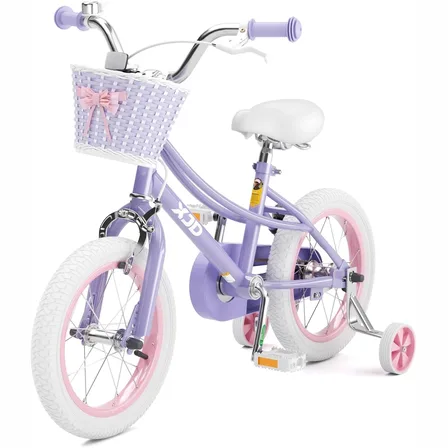
Girls' Training Wheel Bike by XJD with Basket – Purple
If you're shopping for a first bike for a girl roughly 3 to 12 years old (91–152…$75.99
-
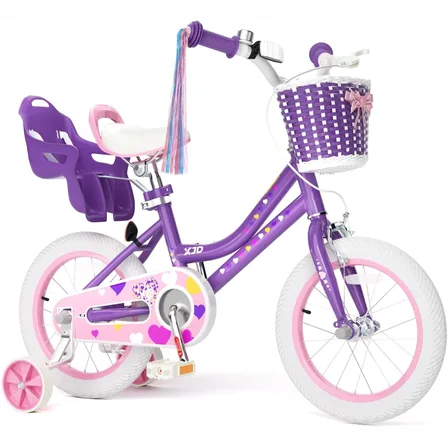
XJD Light Purple Girls Bike with Basket, Training Wheels, 12/14/16/20 Inch
The XJD Girls Bike with Basket in Light Purple is a single-speed training-wheel …$99.99
$119.99 -

Pink 12/14/16/20" XJD Girls Bike with Training Wheels & Basket
The Pink XJD Girls Bike with Training Wheels & Basket is a first-bike pick f…$65.99
$75.99