

What size bikes do most 9 year old girls need
Most 9-year-old girls need a 20-inch bike, especially at 48–60 in (122–152 cm) tall. Measure her height and inseam, then check fit in person.
Start with 20 inches, then verify the fit
Under the XBikes sizing starting points, a 20-inch bicycle covers ages 7–12 and rider heights of 48–60 in (122–152 cm). That makes it the usual starting point for a 9-year-old girl—not an automatic answer for every child.
Height is more useful than age alone. A shorter 9-year-old measuring 43–52 in (109–132 cm) may need to compare an 18-inch bike, while a taller rider approaching 54 in (137 cm) may also be near the lower end of the 24-inch range. Those ranges overlap because body proportions, reach and confidence differ.
| Wheel size | XBikes age starting point | Rider height | Relevance at age 9 |
|---|---|---|---|
| 18 Inch | Ages 5–9 | 43–52 in / 109–132 cm | Compare for a shorter rider |
| 20 Inch | Ages 7–12 | 48–60 in / 122–152 cm | Most likely starting point |
| 24 Inch | Ages 10–14 | 54–64 in / 137–163 cm | Compare for a taller rider; do not size up only for growth |
Measure before comparing bikes
Measure her standing height without shoes, with her back straight against a wall. For inseam, have her stand with feet slightly apart and measure from the floor to the crotch. Record both measurements in inches or centimetres.
Wheel size narrows the search, but inseam cannot be matched responsibly without the bicycle’s actual stand-over and adjustment dimensions. Compare the measurements with the exact model information in its manual, and have her try the bicycle whenever possible.
What a successful in-person check looks like
Ask her to stand over the bicycle and confirm that she has comfortable clearance rather than contact with the frame. Seated, she should be able to reach the handlebars without stretching, turning awkwardly or locking her arms.
She must also be able to operate the brakes confidently with her hands in their normal riding position. Watch her start, steer, stop and get off under close supervision in a traffic-free area. A size is unsuitable if she looks cramped, cannot control the brakes, struggles to balance because of the fit, or must overreach.
Do not choose an oversized bicycle simply to leave room for growth. If both 20- and 24-inch models appear plausible from height alone, her stand-over clearance, reach, brake control and present confidence should decide—not the larger number.
How the supplied girls’ bikes relate
The supplied catalog includes three training-wheel bike listings that can help you compare 20-inch and smaller options. The first two list a 20-inch SKU, the most common starting point for a 9-year-old; the third currently supplies only smaller SKU labels. They are relevant only after an individual fit check, and the catalog facts do not establish whether training wheels suit her current ability.
 XJD Girls' Bike with Training Wheels, 12/14/16/20 Inch – Purple
Offers a 20-inch SKU—the usual starting comparison for a 9-year-old measuring 48–60 inches tall—alongside 12-, 14- and 16-inch labels. Confirm individual fit and whether training wheels suit her ability.
 XJD Kids Bike for Girls – Pink, 12/14/16/20 Inch with Training Wheels
Its supplied SKU labels include 20 Inch as well as 12, 14 and 16 Inch. Compare the 20-inch option when the rider falls within the corresponding height range, subject to a hands-on fit check.
 XJD Light Purple Girls Bike with Basket, Training Wheels, 12/14/16/20 Inch
Although the exact catalog title mentions 20 Inch, the supplied available SKU labels are 12, 14 and 16 Inch. These are smaller comparison points and should not replace the size indicated by the rider’s measurements.
Compare the three catalog options accurately
- XJD Girls' Bike with Training Wheels, 12/14/16/20 Inch – Purple lists 12-, 14-, 16- and 20-inch SKU labels. For a typical 9-year-old in the 20-inch height range, compare only its 20-inch option first.
- XJD Kids Bike for Girls – Pink, 12/14/16/20 Inch with Training Wheels also lists 12-, 14-, 16- and 20-inch SKU labels. Its 20-inch option is the relevant starting comparison when her measured height is 48–60 in (122–152 cm).
- XJD Light Purple Girls Bike with Basket, Training Wheels, 12/14/16/20 Inch has an exact catalog title mentioning four sizes, but the supplied available SKU labels are only 12, 14 and 16 Inch. Those are smaller comparison points, not substitutes for an 18-, 20- or 24-inch need.
None of these supplied products offers an available 18- or 24-inch SKU label. If her measurements and trial indicate either size, do not treat a supplied 16- or 20-inch option as equivalent.
Do these checks before she rides
- Confirm the chosen wheel-size range against her measured height.
- Check stand-over clearance, seated reach, steering and brake operation on the exact bicycle.
- Choose for current control and confidence rather than anticipated growth.
- Use a bicycle helmet that fits properly, sits level and has straps adjusted according to its manufacturer’s instructions.
- Follow the exact product manual for assembly, maintenance, compatibility, load limits and torque. If anything is unclear, use a qualified bicycle mechanic.
For most 9-year-old girls, begin with a 20-inch test ride; move to an 18- or 24-inch comparison only when measured height and real-world control show that 20 inches does not fit.
Bikes for your next adventure
-
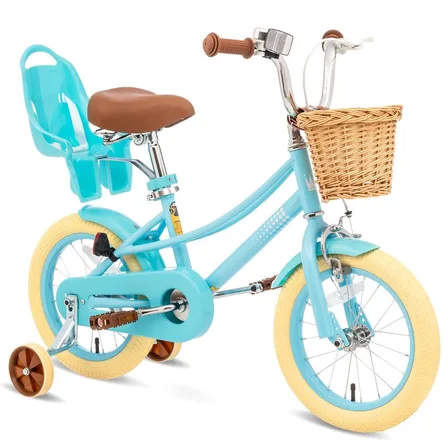
Girls' Training Wheel Bike by XJD, 12–20 Inch Wheels – Blue
This XJD girls' training wheel bike in Blue covers one of the widest fit ranges …$139
$159 -

XJD Boys & Girls BMX Bike with Training Wheels, 12/14/16" – Blue
The XJD Boys & Girls BMX Bike in Blue is a first pedal bike for kids roughly age…$99.99
$119.99 -
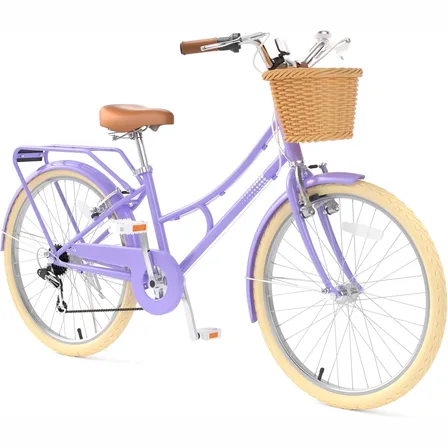
24-Inch Purple XJD Beach Cruiser Bike with U-Brake
The XJD 24-Inch Purple Beach Cruiser is built for girls and young women roughly …$159.99