

Why are girl bike frames different
Girl bike frames are often different because a lower or sloping top tube can make mounting and stopping easier. Fit and control matter more than gender.
What the frame difference actually means
Many bikes marketed for girls use a step-through or lower-top-tube frame, while many bikes marketed for boys use a higher or straighter top tube. This difference comes largely from traditional clothing conventions and product styling, not from a rule that girls need a fundamentally different bicycle.
A lower top tube can give any child more clearance when getting on, stepping off or stopping unexpectedly. A higher top tube may create a different frame shape, but the label alone does not tell you whether the bicycle fits. Either design can work if the rider can stand over it comfortably, reach the controls and handle the bike with confidence.
Measure the rider before comparing frames
Start with the child’s current height and inseam, measured in the shoes they normally wear for riding. For inseam, have the child stand straight with feet slightly apart and measure from the floor to the crotch. Use that measurement to assess clearance over the frame rather than relying on a “girls’” label.
Then have the child try the actual bicycle. Check whether the rider can:
- stand over the frame without the top tube pressing into the body;
- get on and off without leaning or twisting excessively;
- sit in a balanced position without stretching for the handlebar;
- turn the handlebar while remaining stable;
- reach and operate the brakes comfortably, if hand controls are fitted;
- start, stop and place a foot down with current confidence.
Do not choose an oversized frame simply to leave room for growth. A child who cannot control the bicycle now does not gain a useful fit from extra future capacity.
Use wheel size as a starting point
Wheel size narrows the search, but it does not determine frame clearance, reach or control by itself. XBikes uses these starting points:
| Wheel size | Age guide | Rider height |
|---|---|---|
| 12 Inch | 3–4 | 34–40 in / 86–102 cm |
| 14 Inch | 3–6 | 37–45 in / 94–114 cm |
| 16 Inch | 4–7 | 40–48 in / 102–122 cm |
| 18 Inch | 5–9 | 43–52 in / 109–132 cm |
| 20 Inch | 7–12 | 48–60 in / 122–152 cm |
| 24 Inch | 10–14 | 54–64 in / 137–163 cm |
| 26 Inch | Youth and adults | Over 60 in / 153 cm |
Because the ranges overlap, prioritize measured height, inseam, reach, brake control and confidence over age. Two children of the same age may need different sizes or frame shapes.
How to compare two frames in person
Place the candidate bikes side by side and ignore their gender labels at first. Compare top-tube clearance, the effort needed to mount, the distance to the handlebar and how naturally the child can reach the controls. If one frame is lower, ask whether that difference meaningfully improves the child’s movement and confidence.
Next, let the rider make controlled starts, stops and turns in a suitable traffic-free area. A decorative style the child likes can encourage riding, but appearance should follow fit. Reject a frame if the rider must overreach, cannot stop predictably or struggles to dismount, even when its suggested age or wheel-size range seems suitable.
Where the supplied girls’ bikes are relevant
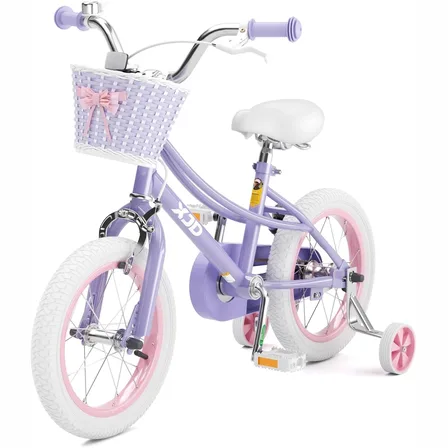
The supplied options are useful because they show that bikes sold as girls’ models span several wheel sizes rather than sharing one universal frame fit. The Girls' Training Wheel Bike by XJD with Basket – Purple has 14 Inch, 16 Inch and 20 Inch SKU labels. The Flower Pink XJD Girls Bike with Doll Seat & Basket has 12 Inch, 14 Inch and 16 Inch SKU labels. Both are categorized as Training Wheel Bikes.
These particular catalog options help answer the title by separating styling and category from sizing: compare only the available wheel-size label that matches the rider’s measurements, then confirm the individual frame fit.
 Girls' Training Wheel Bike by XJD with Basket – Purple
A Training Wheel Bikes option with 14 Inch, 16 Inch and 20 Inch SKU labels. It is relevant for comparing listed sizes after measuring the rider and confirming frame clearance, reach and control.
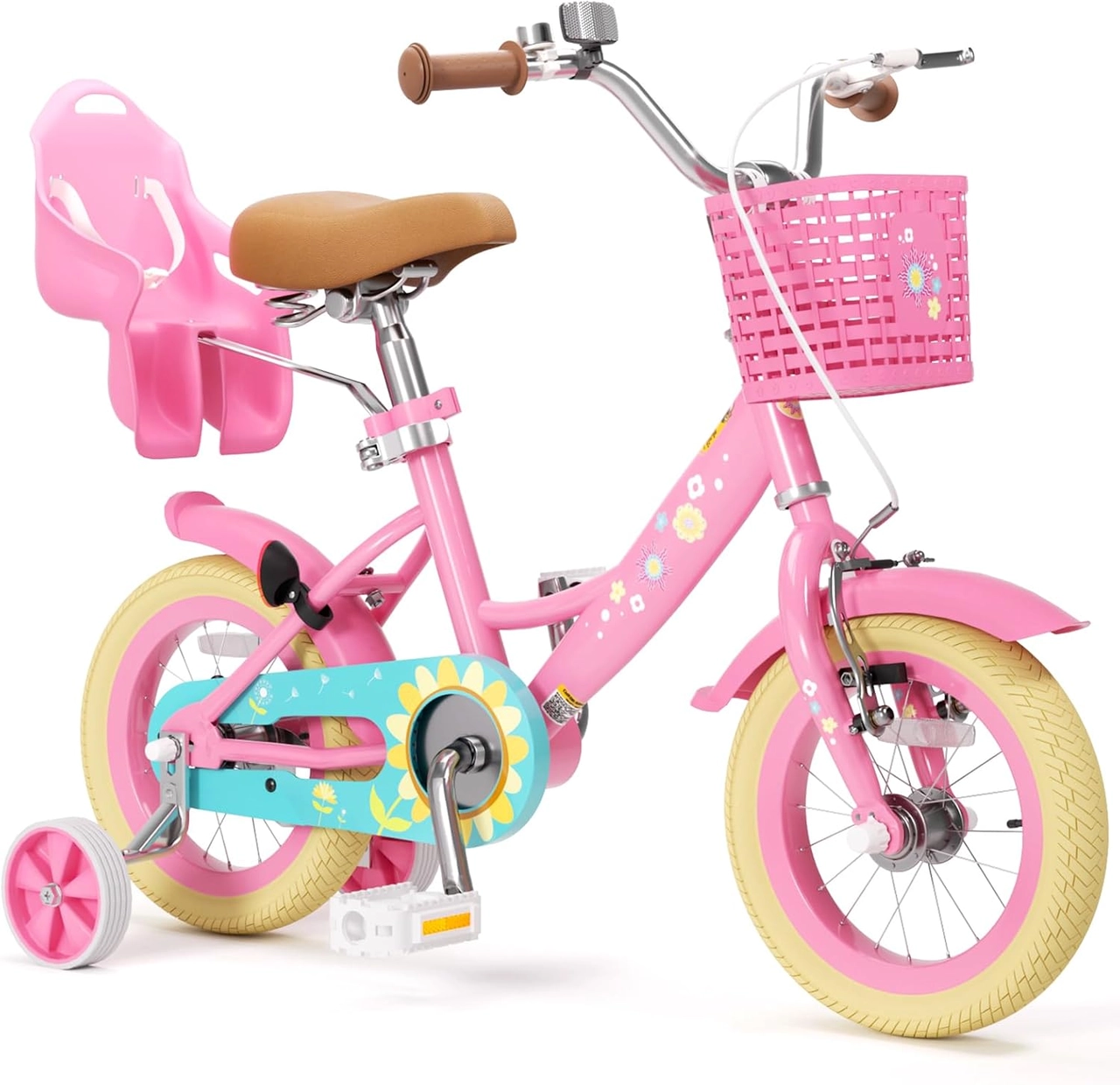 Flower Pink XJD Girls Bike with Doll Seat & Basket
A Training Wheel Bikes option offered with 12 Inch, 14 Inch and 16 Inch SKU labels. Use it as a size-specific comparison only when the rider’s measurements and an individual fit check support that choice.
They are relevant when a training-wheel bike is wanted and one of their listed sizes matches the rider’s starting range. They are not evidence that every girl needs a lower frame, and they should not be chosen from color, accessories or age alone. No 18 Inch, 24 Inch or 26 Inch option is supplied here; for those sizes, these products are nearest-size comparison points only, not substitutes.
Check setup and riding readiness
Before riding, follow the exact product manual for assembly, adjustment, maintenance, compatibility, load limits and torque requirements. If anything is unclear or controls cannot be adjusted to the child, use a qualified bicycle mechanic rather than improvising a procedure.
A bicycle helmet should fit properly, sit level and have its straps adjusted according to the helmet manufacturer’s instructions. The helmet does not correct a poorly fitting frame, so assess both independently.
Make the frame decision
Choose the frame the child can stand over, mount, steer, brake and stop with comfortably today. Treat “girl bike” as a description of marketing or styling; let measured fit and demonstrated control decide whether its different frame shape is genuinely useful.
Bikes for your next adventure
-
Girls' Training Wheel Bike by XJD with Basket – Purple
If you're shopping for a first bike for a girl roughly 3 to 12 years old (91–152…$75.99
-
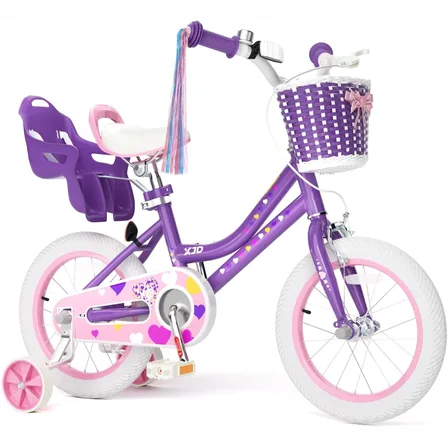
XJD Light Purple Girls Bike with Basket, Training Wheels, 12/14/16/20 Inch
The XJD Girls Bike with Basket in Light Purple is a single-speed training-wheel …$99.99
$119.99 -

Pink 12/14/16/20" XJD Girls Bike with Training Wheels & Basket
The Pink XJD Girls Bike with Training Wheels & Basket is a first-bike pick f…$65.99
$75.99