

Why are there girl and boy bikes
Girl and boy bikes exist mainly because brands use different styling and marketing. The label does not determine who can ride a bike; fit, control and confidence do.
What “girl” and “boy” usually mean
These labels often organize choices by colors, graphics or themes that manufacturers expect different children to prefer. Some bicycle ranges may also differ in frame shape, contact points or included accessories, but the gender word alone does not tell you which of those details are present.
A child does not need a bike carrying a particular gender label. Compare the actual bicycle, let the rider try it and choose the option that fits properly and appeals to them. Avoid assuming that a “girl” bike will fit every girl or that a “boy” bike will fit every boy.
Measure the child before comparing labels
Measure the rider’s height without shoes, then measure the inseam from the floor to the crotch. Height provides a wheel-size starting point; inseam helps assess clearance when the child stands over the bicycle. Age is only a rough guide.
| Wheel size | Starting age | Rider height |
|---|---|---|
| 12 Inch | 3–4 | 34–40 in / 86–102 cm |
| 14 Inch | 3–6 | 37–45 in / 94–114 cm |
| 16 Inch | 4–7 | 40–48 in / 102–122 cm |
| 18 Inch | 5–9 | 43–52 in / 109–132 cm |
| 20 Inch | 7–12 | 48–60 in / 122–152 cm |
| 24 Inch | 10–14 | 54–64 in / 137–163 cm |
| 26 Inch | Youth and adults | Over 60 in / 153 cm |
Overlapping ranges are deliberate: two wheel sizes can be plausible starting points for the same height. That does not make them equivalent. The individual fit check decides which one gives the rider appropriate clearance and manageable controls.
What to check during a real fit test
Have the child try the bicycle rather than selecting from the label or age range alone. Do not buy an oversized model merely to leave growing room. While the bike is supported securely, check whether the child can:
- stand over it with usable clearance rather than being pressed against the frame;
- reach the handlebars without stretching, locking the arms or losing a balanced posture;
- turn the handlebar while remaining in control;
- reach and operate the brakes confidently, where applicable; and
- start, stop and place a foot down without panic or excessive leaning.
Current confidence matters alongside body measurements. A hesitant beginner may control a different fit more comfortably than a similarly sized, experienced rider. If reach, stand-over clearance or brake operation is doubtful, compare another size or ask a qualified bicycle mechanic to assess the fit.
How the two XBikes options relate
The supplied catalog options make the label issue concrete: both are explicitly presented for boys and girls, and both offer 12 Inch, 14 Inch and 16 Inch choices. They help families compare wheel-size starting points without treating gender as a fit specification.
 XJD Kids' Training Wheel Bike for Boys & Girls, 12/14/16 Inch – White
A boys-and-girls Training Wheel Bike offered with 12 Inch, 14 Inch and 16 Inch SKU labels, making it relevant when comparing size rather than treating gender as a fit rule.
 XJD Boys & Girls BMX Bike with Training Wheels, 12/14/16" – Blue
A boys-and-girls Kids' BMX Bike with training wheels, offered in 12 Inch, 14 Inch and 16 Inch labels for fit-based comparison within those three sizes.
XJD Kids' Training Wheel Bike for Boys & Girls, 12/14/16 Inch – White is categorized as a Training Wheel Bike and has 12 Inch, 14 Inch and 16 Inch SKU labels. XJD Boys & Girls BMX Bike with Training Wheels, 12/14/16" – Blue is categorized as a Kids' BMX Bike and offers the same three labeled sizes.
Using only the supplied facts, the meaningful comparisons are their catalog categories, titles, colors named in those titles and available wheel-size labels. The facts do not establish differences in weight, frame dimensions, brakes, materials, load limits or components. Consult each exact product manual or a qualified bicycle mechanic for assembly, maintenance, compatibility and any torque or load-limit information.
Choose the rider, not the gender label
First match the measured height to the wheel-size starting points. Then compare inseam clearance, reach, brake control and the child’s present confidence on the actual bicycle. After fit and control are confirmed, let the child choose the styling they genuinely like.
For these two products, proceed only if an individually checked 12 Inch, 14 Inch or 16 Inch fit is appropriate. If the rider needs an 18 Inch, 20 Inch, 24 Inch or 26 Inch bicycle, neither supplied option is a substitute. The useful decision is simple: ignore “girl” or “boy” as a sizing rule and choose only the bike the child can comfortably control now.
Bikes for your next adventure
-
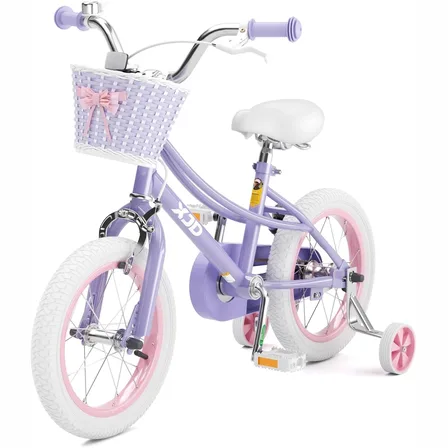
Girls' Training Wheel Bike by XJD with Basket – Purple
If you're shopping for a first bike for a girl roughly 3 to 12 years old (91–152…$75.99
-
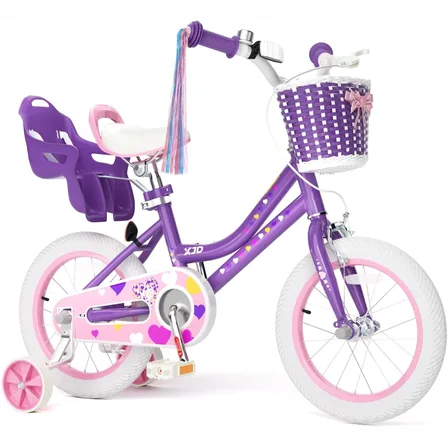
XJD Light Purple Girls Bike with Basket, Training Wheels, 12/14/16/20 Inch
The XJD Girls Bike with Basket in Light Purple is a single-speed training-wheel …$99.99
$119.99 -
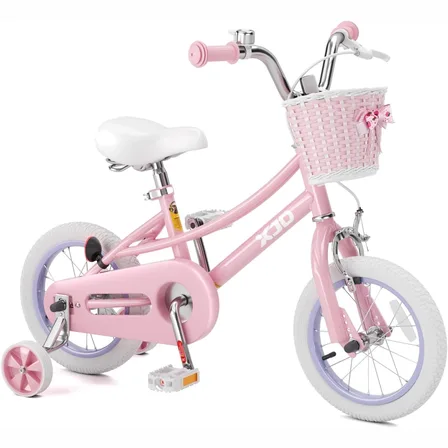
Pink 12/14/16/20" XJD Girls Bike with Training Wheels & Basket
The Pink XJD Girls Bike with Training Wheels & Basket is a first-bike pick f…$65.99
$75.99