

Why are there still boy and girl bikes
Boy and girl bikes still exist mainly because of naming, styling and shopping traditions—not because children need different bikes based on gender. Choose by fit, control and the child’s preferences instead.
What the labels really tell you
A “boys’” or “girls’” label may help a store organize colors, graphics or traditionally marketed styles. It does not establish whether a bicycle fits a particular child. Children of the same age can have different heights, inseams, arm lengths and levels of confidence, so gender is not a useful shortcut for sizing.
Treat the label as an invitation to consider the appearance, not as a rule about who may ride the bike. Let the child choose a design they like, then evaluate the bicycle itself. If two models look different, compare their actual fit and controls rather than assuming that one version belongs to boys and the other to girls.
Measure before comparing bikes
Measure the child’s height without shoes. Also measure inseam from the floor to the crotch while the child stands naturally. Height provides a wheel-size starting point; inseam helps you assess clearance and the ability to get on and off comfortably.
Have the child try the bicycle whenever possible. With the bike upright, check that the child can stand over it with practical clearance, reach the handlebar without stretching, steer without losing balance and operate the brakes comfortably. The child should also be able to start, stop and put a foot down with control.
Do not buy an oversized bicycle merely to allow room for growth. If the rider cannot manage it confidently now, a future theoretical fit does not solve the immediate control problem.
Use wheel size only as a starting point
| Wheel-size label | XBikes age starting point | Rider-height starting point |
|---|---|---|
| 12 Inch | Ages 3–4 | 34–40 in / 86–102 cm |
| 14 Inch | Ages 3–6 | 37–45 in / 94–114 cm |
| 16 Inch | Ages 4–7 | 40–48 in / 102–122 cm |
The overlapping ranges are intentional: age and height do not select a bike automatically. Prioritize measured height, inseam, reach, brake control and current confidence. A child near a boundary should try the relevant sizes rather than moving up by default.
Wheel size also does not prove that every bike with the same label has identical dimensions or adjustment range. Check the exact product manual for setup, compatibility, load limits, maintenance and any specifications not stated in the catalog. Ask a qualified bicycle mechanic when fit or assembly remains uncertain.
How the supplied unisex options relate
The catalog itself illustrates why strict gender divisions are unnecessary. The XJD Boys & Girls BMX Bike with Training Wheels, 12/14/16" – Blue is listed in Kids’ BMX Bikes, while the XJD Kids' Training Wheel Bike for Boys & Girls, 12/14/16 Inch – White is listed in Training Wheel Bikes. Both explicitly include boys and girls in their names and offer 12 Inch, 14 Inch and 16 Inch SKU labels. They are useful comparison options when one of those starting sizes is relevant; their different categories and colors are not evidence that either fits a particular child.
 XJD Boys & Girls BMX Bike with Training Wheels, 12/14/16" – Blue
A boys-and-girls Kids’ BMX Bikes option offered with 12 Inch, 14 Inch and 16 Inch SKU labels, useful for comparing fit within the supplied XBikes starting ranges.
 XJD Kids' Training Wheel Bike for Boys & Girls, 12/14/16 Inch – White
A boys-and-girls Training Wheel Bikes option offered in 12 Inch, 14 Inch and 16 Inch SKU labels; relevant when comparing training-wheel models after measuring the rider.
Compare the matching size labels first, then verify the individual fit. Do not infer brake type, frame dimensions, material, weight or other unsupplied features from “BMX,” “training wheel,” color or gender wording. For either model, consult its exact manual for assembly and adjustment instructions.
What to let the child decide
Once suitable candidates pass the fit and control checks, the child can choose between the appearances and categories they prefer. A blue bike is not restricted to boys, and a white bike is not restricted to girls. Enjoying the look of a bicycle can matter, but preference should decide among correctly fitting choices rather than override fit.
Current confidence matters as well. Training wheels appearing in both supplied titles may make these products relevant to a family specifically comparing training-wheel bicycles. That wording alone does not show whether training wheels are appropriate for this rider, how they should be adjusted or how long they should be used; follow the product manual or consult a qualified bicycle mechanic.
Make the final decision
- Ignore the boy-or-girl aisle boundary and record the child’s measured height and inseam.
- Use the XBikes ranges to identify a starting wheel size, not a guaranteed fit.
- Have the child try the bike and check stand-over clearance, reach, steering, braking, starting and stopping.
- Reject any option that is oversized or difficult to control, even if its age label appears suitable.
- Among the bikes that fit now, let the child choose the styling and category they genuinely prefer.
A boy or girl label should therefore change neither your measurements nor your safety checks. Choose the bike the child can control today—and let gendered marketing remain only a label.
Bikes for your next adventure
-
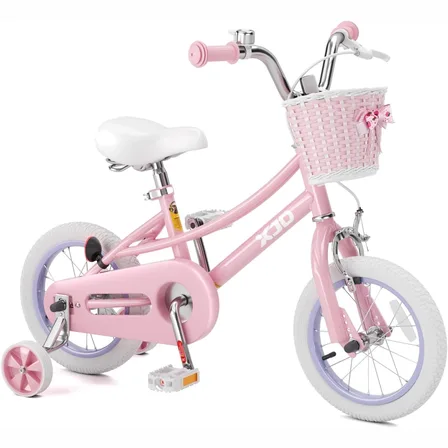
Pink 12/14/16/20" XJD Girls Bike with Training Wheels & Basket
The Pink XJD Girls Bike with Training Wheels & Basket is a first-bike pick f…$65.99
$75.99 -
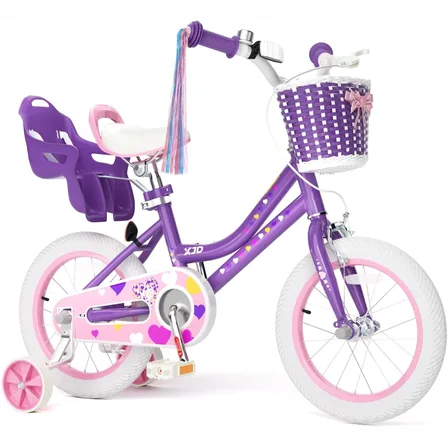
XJD Light Purple Girls Bike with Basket, Training Wheels, 12/14/16/20 Inch
The XJD Girls Bike with Basket in Light Purple is a single-speed training-wheel …$99.99
$119.99 -
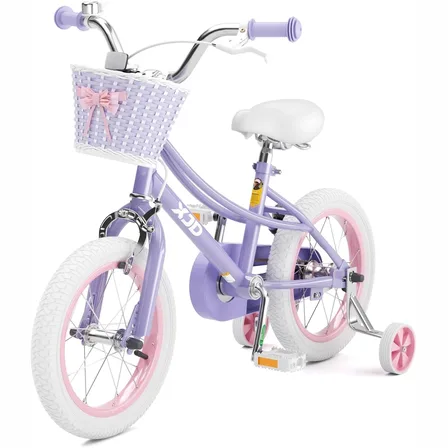
Girls' Training Wheel Bike by XJD with Basket – Purple
If you're shopping for a first bike for a girl roughly 3 to 12 years old (91–152…$75.99