

Why different girl boy bikes
Girls’ and boys’ bikes are often different mainly in colour, graphics and marketing—not in what determines a safe, comfortable fit. Choose by the child’s measurements, control and confidence rather than the gender label.
Why are girl and boy bikes presented differently?
Traditional designs may use different colours, themes or frame shapes. Those distinctions can affect appearance and, in some cases, how easily a child gets on and off. They do not tell you whether the bicycle actually fits a particular rider.
A bike labelled for girls is not automatically better for a girl, and a bike labelled for boys is not automatically better for a boy. Children of the same age can have different heights, inseams, arm lengths and riding abilities. The useful comparison is therefore between dimensions and controls, not between gender categories.
What should a parent measure?
Measure the child’s height without shoes. Also measure inseam from the floor to the crotch while the child stands naturally. Height provides a wheel-size starting point; inseam helps you judge stand-over clearance and whether the child can stop and steady the bike confidently.
Then have the child try the bicycle. Check these points:
- Stand-over: The child should be able to straddle the bike without the frame preventing a stable stance.
- Reach: The handlebars should be reachable without an uncomfortable stretch, locked elbows or loss of steering control.
- Brake control: The child must be able to reach and operate the bicycle’s braking controls reliably.
- Starting and stopping: The rider should be able to mount, start, stop and put a foot down with confidence.
- Overall control: Turning and balancing should feel manageable at the child’s current skill level.
Do not buy an oversized bicycle solely to allow room for growth. A larger bike can make mounting, steering, braking and stopping harder now.
Use wheel size only as a starting point
| Wheel size | Starting age | Rider height |
|---|---|---|
| 12 Inch | 3–4 | 34–40 in / 86–102 cm |
| 14 Inch | 3–6 | 37–45 in / 94–114 cm |
| 16 Inch | 4–7 | 40–48 in / 102–122 cm |
| 18 Inch | 5–9 | 43–52 in / 109–132 cm |
| 20 Inch | 7–12 | 48–60 in / 122–152 cm |
| 24 Inch | 10–14 | 54–64 in / 137–163 cm |
| 26 Inch | Youth and adults | Over 60 in / 153 cm |
The ranges overlap because age and wheel size cannot establish fit by themselves. Prioritize measured height, inseam, reach, brake control and current confidence. If a child falls into two rows, compare both sizes in person instead of assuming that the larger one is the better purchase.
Does frame style matter?
It matters only when it changes the rider’s real experience. Compare how easily the child can step over the frame, settle into a riding position and reach the controls. A lower-looking frame can be convenient for some riders, but its styling or gender category cannot replace an actual stand-over and control check.
Let the child choose an appearance they enjoy after suitable options have passed the fit checks. This separates personal preference from the measurements that affect handling.
How the supplied bike helps with the comparison
The XJD Kids' Training Wheel Bike for Boys & Girls, 12/14/16 Inch – White is catalogued for boys and girls and is offered with 12 Inch, 14 Inch and 16 Inch SKU labels. It is relevant because it demonstrates that one model can be presented without a girl-only or boy-only division while still requiring a choice among wheel sizes. Those options are comparison points; select among them using the corresponding height ranges and an individual fit check.

This product is relevant only if a 12, 14 or 16 Inch starting point suits the measured rider and the child can control the actual bicycle. It is not a substitute when the fit check points to 18, 20, 24 or 26 Inch wheels. The title’s “Boys & Girls” wording describes the catalog positioning, not proof that every child will fit it.
What to compare before deciding
- Measure height and inseam, then identify the overlapping wheel-size starting points.
- Have the child try each plausible size rather than choosing from age or gender wording.
- Compare stand-over, handlebar reach, brake access, turning, starting and stopping.
- Reject any option that is oversized, awkward to control or beyond the rider’s present confidence.
- Choose the preferred colour or styling only among the bicycles that genuinely fit.
A properly fitting helmet is also essential: it should sit level, fit correctly and have its straps adjusted according to the helmet manufacturer’s instructions. For assembly, maintenance, load limits, compatibility and torque, follow the exact bicycle manual or consult a qualified bicycle mechanic.
The practical answer is simple: ignore the girl-versus-boy label until after measuring and test-riding. Buy the size and layout the child can confidently stand over, reach, brake and control today.
Bikes for your next adventure
-
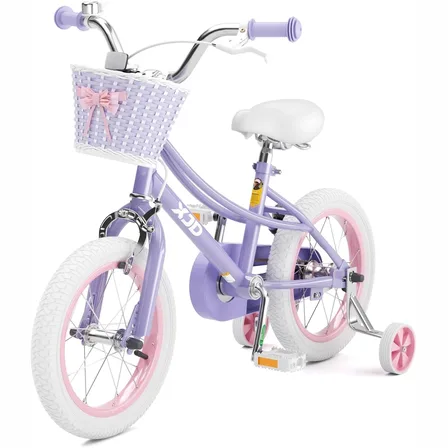
Girls' Training Wheel Bike by XJD with Basket – Purple
If you're shopping for a first bike for a girl roughly 3 to 12 years old (91–152…$75.99
-
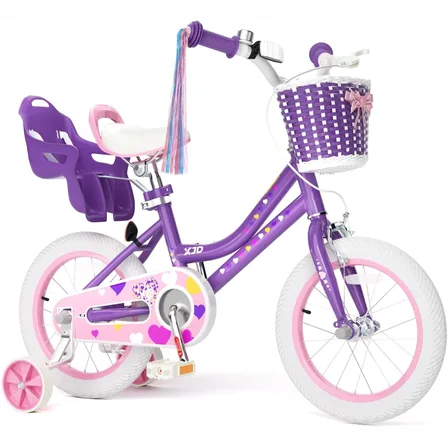
XJD Light Purple Girls Bike with Basket, Training Wheels, 12/14/16/20 Inch
The XJD Girls Bike with Basket in Light Purple is a single-speed training-wheel …$99.99
$119.99 -

Pink 12/14/16/20" XJD Girls Bike with Training Wheels & Basket
The Pink XJD Girls Bike with Training Wheels & Basket is a first-bike pick f…$65.99
$75.99