

Why do boys bikes have a bar and girls don't
Boys’ bikes traditionally have a high top bar for frame strength, while girls’ bikes often have a lowered bar for easier step-through access—not because boys and girls need different bicycles.
Why the frames became different
The familiar “boys’” frame uses a nearly horizontal top tube to form a compact triangle. That shape historically made a bicycle frame strong and straightforward to build. The traditional “girls’” frame lowered or removed the high top tube so a rider wearing a skirt or dress could mount without lifting a leg over the saddle.
Those conventions became gender labels, but the practical distinction is really high-step versus step-through frame design. Either design can be used by any child. Modern bicycle design and construction also allow many frame shapes, so the bar’s position alone does not tell you who should ride the bike.
What matters more than the label
Choose between frames by checking how comfortably the child can get on, stop, stand over the bicycle and control it. A lower top tube can offer more clearance and may feel less intimidating to a new or cautious rider. A higher bar is acceptable when it leaves suitable stand-over room and does not interfere with mounting or stopping.
Do not buy an oversized bicycle merely because the child may grow into it. Age is only a starting point. Measure the child’s height and inseam, then have the child try the bicycle while wearing normal riding shoes.
- Stand-over: The child should be able to straddle the frame without the top bar pressing uncomfortably into the body.
- Reach: The handlebars should be reachable without an extreme stretch, locked elbows or loss of steering control.
- Brakes: If the bicycle has hand controls, the child must be able to reach and operate them confidently.
- Starting and stopping: Check that the rider can mount, begin moving, stop and dismount without being obstructed by the bar.
Compare wheel size separately from frame shape
A low bar does not make an incorrectly sized bicycle fit, and a high bar does not automatically make a correctly sized one unsuitable. Use measured height as the first wheel-size reference, then confirm inseam clearance, reach, brake control and confidence on the actual bicycle.
| Wheel size | Height starting point | Age starting point |
|---|---|---|
| 12 Inch | 34–40 in / 86–102 cm | 3–4 |
| 14 Inch | 37–45 in / 94–114 cm | 3–6 |
| 16 Inch | 40–48 in / 102–122 cm | 4–7 |
The ranges overlap intentionally because children with similar ages may have different proportions and abilities. If a child falls between options, compare both in person rather than automatically selecting the larger wheel.
How the supplied bikes help with the comparison
The XJD Boys & Girls BMX Bike with Training Wheels, 12/14/16" – Blue is cataloged as a Kids’ BMX Bike, while the XJD Kids’ Training Wheel Bike for Boys & Girls, 12/14/16 Inch – White is cataloged as a Training Wheel Bike. Both are explicitly titled for boys and girls and offer 12 Inch, 14 Inch and 16 Inch SKU labels. They are therefore useful comparison options when testing whether fit and control—not a gender label—should decide the purchase.
 XJD Boys & Girls BMX Bike with Training Wheels, 12/14/16" – Blue
A boys-and-girls Kids’ BMX Bike offered in 12 Inch, 14 Inch and 16 Inch labels, making it relevant for comparing fit without treating frame style as a gender requirement.
 XJD Kids' Training Wheel Bike for Boys & Girls, 12/14/16 Inch – White
A boys-and-girls Training Wheel Bike available in 12 Inch, 14 Inch and 16 Inch labels; useful as a size comparison option when the child’s measured fit and control are checked individually.
These catalog facts do not establish each bicycle’s frame clearance, brake type, materials, weight, load limit or assembly requirements. Compare the exact selected size with the child present. For assembly, maintenance, compatibility and adjustment procedures, follow the exact product manual or use a qualified bicycle mechanic.
A quick decision at the bicycle
- Measure the child’s standing height and inseam without estimating from age.
- Use the wheel-size ranges to identify likely sizes, not to declare a final fit.
- Have the child straddle each candidate and compare top-bar clearance.
- Check mounting, handlebar reach, steering, braking, starting and stopping.
- Choose the frame the child controls confidently, regardless of whether it is marketed as a boys’, girls’ or unisex bicycle.
A properly fitting helmet is part of every ride: it should sit level, fit properly and use its straps according to the helmet manufacturer’s instructions.
So, should your child have the bar?
Choose the high bar only if it provides comfortable clearance and the child can mount, stop and control the bicycle easily. Choose a lower step-through shape if it improves access or confidence. The old boys-versus-girls distinction is not a fitting rule; measure the rider, compare the actual frames and let safe, confident control settle the question.
Bikes for your next adventure
-

Light Pink XJD Girls' Bicycle with Basket & Training Wheels
The Light Pink XJD Girls' Bicycle with Basket & Training Wheels is a retro-style…$109.99
$129.99 -

Blue XJD Girls Bike with Training Wheels – 12/14/16 Inch
If you're shopping for a first pedal bike for a daughter roughly 3 to 8 years ol…$149
$169 -
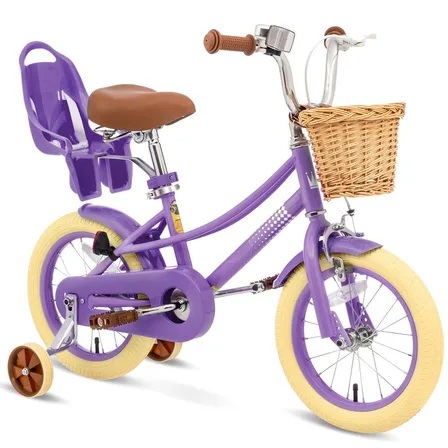
XJD Girls' Bike with Training Wheels, 12/14/16/20 Inch – Purple
The XJD girls' bike with training wheels in Purple is built to grow with your ri…$139
$159