

Why is there a difference between boy and girl bikes
Boy and girl bikes mainly differ in labeling, colors, styling and sometimes frame shape—not in the basic fit a child needs. Choose by body measurements, control and confidence rather than gender.
What the labels really mean
A bike sold for boys or girls may look different, and some designs may use a different top-tube shape. Those distinctions do not determine whether the bicycle fits. A child of either gender can ride a bike labeled for boys, girls or both if its dimensions allow a comfortable, controlled riding position.
The meaningful comparison is therefore not “boy versus girl,” but “does this bike fit this rider?” Do not assume that two bikes with the same wheel size will feel identical. Frame dimensions and component positions can vary, so the child should try the exact bicycle whenever possible.
Measure before comparing bikes
Measure the child’s height without shoes. Then measure inseam from the floor to the crotch while the child stands upright with feet slightly apart. Use height to identify a starting wheel size and inseam to assess clearance when the child straddles the actual frame.
During a fit check, look at the whole riding position:
- Stand-over: The child should be able to straddle the bicycle without the frame preventing a stable stance.
- Reach: The handlebars should be reachable without an exaggerated stretch, locked elbows or an awkwardly hunched posture.
- Brake control: If the bicycle has hand-operated brakes, the child must be able to reach and operate them confidently.
- Starting and stopping: The rider should demonstrate controlled starts, stops and turns at their present skill level.
- Confidence: Hesitation caused by excessive size or difficult controls is evidence that the fit is not ready, regardless of the label.
Use wheel size only as a starting point
| Wheel size | Age starting point | Rider-height starting point |
|---|---|---|
| 12 Inch | 3–4 | 34–40 in / 86–102 cm |
| 14 Inch | 3–6 | 37–45 in / 94–114 cm |
| 16 Inch | 4–7 | 40–48 in / 102–122 cm |
| 18 Inch | 5–9 | 43–52 in / 109–132 cm |
| 20 Inch | 7–12 | 48–60 in / 122–152 cm |
| 24 Inch | 10–14 | 54–64 in / 137–163 cm |
| 26 Inch | Youth and adults | Over 60 in / 153 cm |
Overlapping ranges are normal. Prioritize measured height, inseam, reach, brake control and current confidence over age alone. A larger bike should not be bought merely so a child can grow into it; an oversized bicycle can make mounting, steering and stopping harder.
How the supplied option relates to the question
The XJD Kids' Training Wheel Bike for Boys & Girls, 12/14/16 Inch – White is explicitly cataloged for boys and girls, which illustrates that gender does not have to define the bicycle choice. It is a training-wheel bike offered with 12 Inch, 14 Inch and 16 Inch SKU labels. Those sizes let you compare three starting points against the child’s measurements, but the catalog facts do not establish the bike’s frame dimensions, brake type or individual fit.
This particular catalog option helps answer the title because the same product spans both gender labels while offering multiple wheel-size choices. Its relevance is greatest for a rider whose measured height falls near the supplied 12, 14 or 16 Inch starting ranges and who is considering a training-wheel bicycle.

It is not a substitute when the measured starting point is 18, 20, 24 or 26 Inch. Those are different sizes, and the supplied product does not include them. It may also be irrelevant if training wheels do not match the child’s current confidence or learning needs. Confirm all adjustments, assembly details, load limits and maintenance procedures in the exact product manual or with a qualified bicycle mechanic.
Try the exact bike before deciding
Have the child wear ordinary riding clothes and shoes for the trial. Check stand-over first, then seated reach and access to every control. Ask the child to show a calm start, a controlled stop and an easy turn in an appropriate traffic-free area. A visually preferred “girl” or “boy” design should be rejected if the child cannot control it comfortably.
Also fit a bicycle helmet separately. It should be the correct size, sit level on the head and use its straps according to the helmet manufacturer’s instructions. A gender label, wheel-size label or helmet alone cannot correct poor bicycle fit.
The decision to make
Ignore the boy-or-girl category as a sizing rule. Record the child’s height and inseam, identify the wheel-size starting point, and compare stand-over, reach, brake operation and confidence on the exact bike. Choose the design the child likes only after those checks pass; if they do not, try a different size or frame rather than expecting the child to grow into it.
Bikes for your next adventure
-
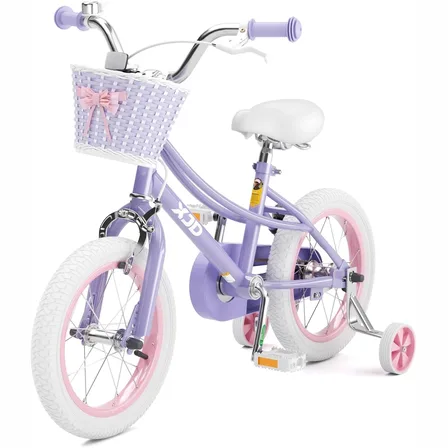
Girls' Training Wheel Bike by XJD with Basket – Purple
If you're shopping for a first bike for a girl roughly 3 to 12 years old (91–152…$75.99
-
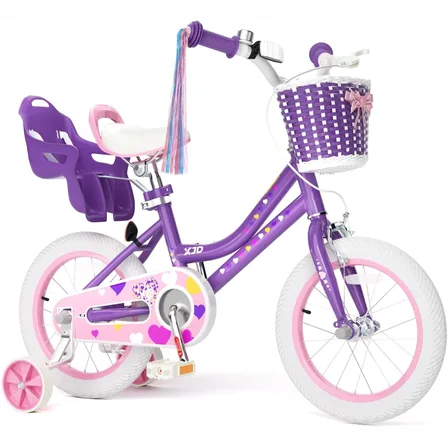
XJD Light Purple Girls Bike with Basket, Training Wheels, 12/14/16/20 Inch
The XJD Girls Bike with Basket in Light Purple is a single-speed training-wheel …$99.99
$119.99 -
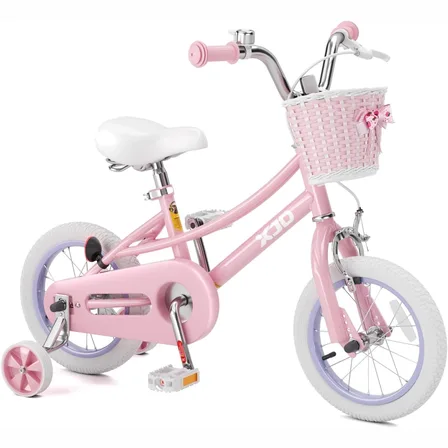
Pink 12/14/16/20" XJD Girls Bike with Training Wheels & Basket
The Pink XJD Girls Bike with Training Wheels & Basket is a first-bike pick f…$65.99
$75.99