How old children ride bike with training wheels
Children commonly ride bikes with training wheels from about age 3 to 7, but age alone cannot determine readiness or size. Measure the child and check control before choosing.
Age is only a starting point
Training wheels do not create one correct age range. In the XBikes sizing guide, the wheel sizes commonly associated with younger riders overlap: 12-inch bikes start at ages 3–4, 14-inch bikes at 3–6, and 16-inch bikes at 4–7. Some children may be ready earlier or later within those ranges because height, proportions, coordination and confidence differ.
Choose according to the child who will ride today. Do not buy an oversized bicycle merely to allow room for growth. A bike that matches an age label can still be unsuitable if the rider cannot stand over it comfortably, reach the controls or operate the brakes.
Measure before comparing wheel sizes
Measure the child's height without shoes, then measure the inseam from the floor to the crotch while the child stands upright. Use height to identify possible wheel sizes and the inseam to help assess stand-over clearance when the actual bike is available.
| Wheel size | XBikes age starting point | Rider-height starting point |
|---|---|---|
| 12 Inch | Ages 3–4 | 34–40 in / 86–102 cm |
| 14 Inch | Ages 3–6 | 37–45 in / 94–114 cm |
| 16 Inch | Ages 4–7 | 40–48 in / 102–122 cm |
| 18 Inch | Ages 5–9 | 43–52 in / 109–132 cm |
| 20 Inch | Ages 7–12 | 48–60 in / 122–152 cm |
| 24 Inch | Ages 10–14 | 54–64 in / 137–163 cm |
| 26 Inch | Youth and adults | Over 60 in / 153 cm |
Overlapping ranges are comparison points, not interchangeable fits. If the child's measurement falls into two rows, have the child try both relevant sizes rather than choosing the larger one automatically.
Confirm the fit on the actual bicycle
A sizing table narrows the options; it does not complete the fit check. With an adult stabilizing the bicycle, assess whether the child can:
- Stand over the bicycle with comfortable clearance.
- Reach the handlebars without stretching or becoming cramped.
- Turn the bars while remaining balanced and in control.
- Reach and operate the available brake controls reliably.
- Start, steer and stop with confidence appropriate to the riding area.
If any of these checks fail, do not treat the suggested age range as proof that the bike fits. Compare another size or ask a qualified bicycle mechanic to assess the setup.
How the supplied catalog option helps
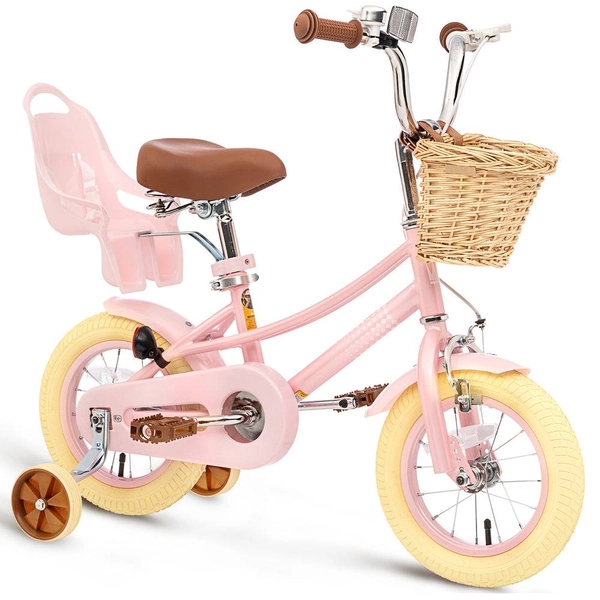
The Purple XJD Girls' Bike with Doll Seat & Basket is relevant because its supplied size labels are 12 Inch, 14 Inch and 16 Inch. Those options let a parent compare the three overlapping XBikes starting ranges associated with ages 3–7, then select which actual bicycle the child can control. The doll seat and basket are catalog-title details, not evidence of fit, readiness or safety.
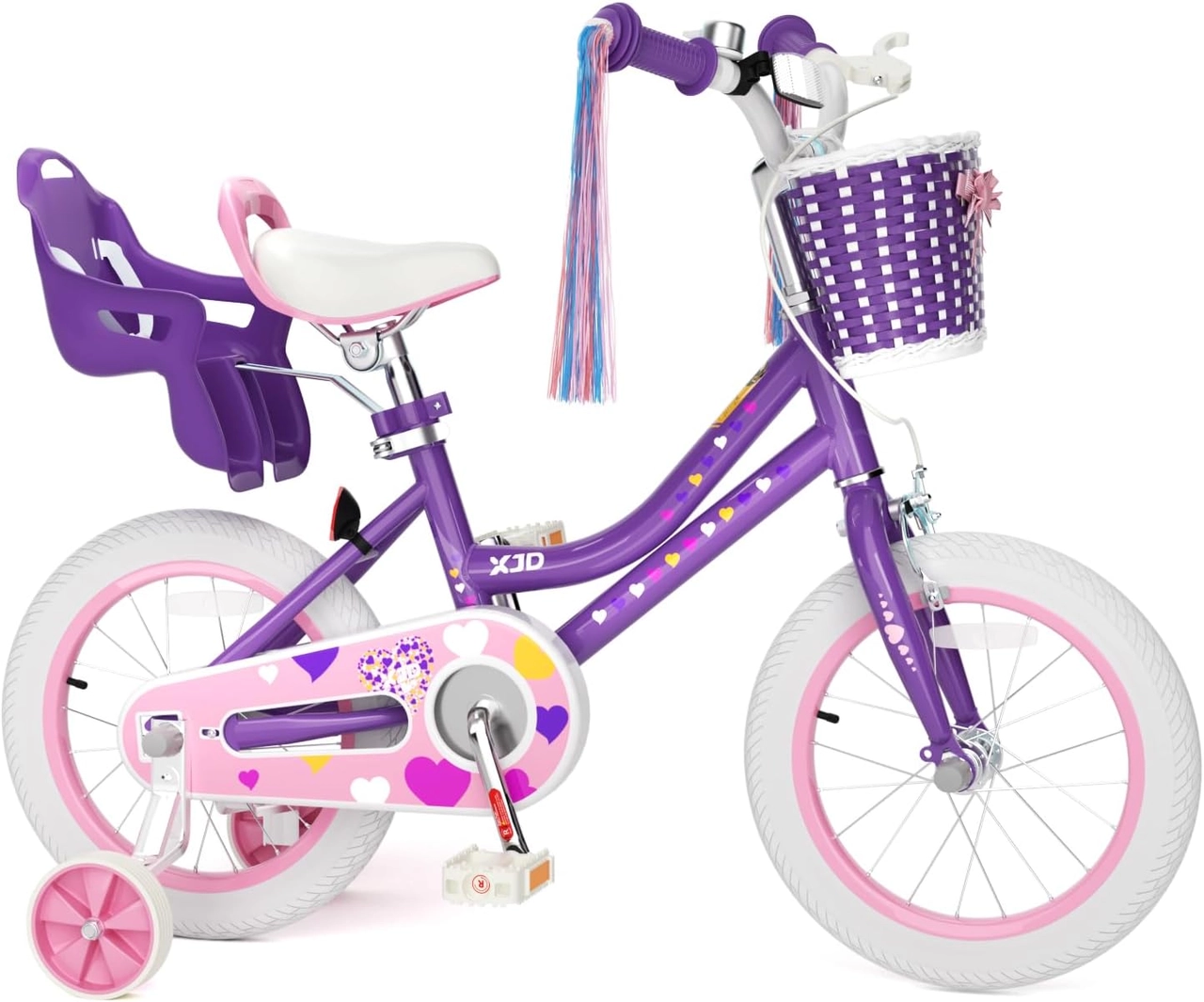
This product is relevant only if the child's measurements and individual fit check point to one of its three supplied sizes. It is not the appropriate catalog match when the rider needs an 18-inch, 20-inch, 24-inch or 26-inch bicycle. Availability of a size label also does not establish brake reach, stand-over clearance or confidence for a particular child.
Use training wheels as support, not proof of readiness
A child should practice in a controlled area under close adult supervision. Training wheels can support early riding, but they do not correct an oversized frame, poor reach or difficulty operating the brakes. Stop and reassess if the child cannot steer predictably, reach the controls or stop when asked.
For training-wheel installation, adjustment, compatibility, maintenance, load limits and torque, follow the exact product manual. If instructions are missing, unclear or cannot be followed precisely, use a qualified bicycle mechanic rather than inventing a setup.
Complete the helmet and pre-ride checks
Use a bicycle helmet that fits properly. It should sit level, with its straps adjusted according to the helmet manufacturer's instructions. A helmet cannot compensate for an unsuitable bicycle size or a child who cannot control the bike.
Before each ride, an adult should inspect the bicycle and training-wheel setup as directed by the exact bicycle manual. Address looseness, damage or uncertain assembly before riding; refer unfamiliar repairs to a qualified bicycle mechanic.
Make the age-and-size decision
Start with age only to locate a likely row, then decide by measured height, inseam, stand-over clearance, reach, brake control and current confidence. For a child within the overlapping 3–7 starting ranges, compare the relevant 12-, 14- or 16-inch option in person. Choose only the size the child can control now, even if a larger bicycle appears to offer more growing room.
Recommended products
-
Save 12%
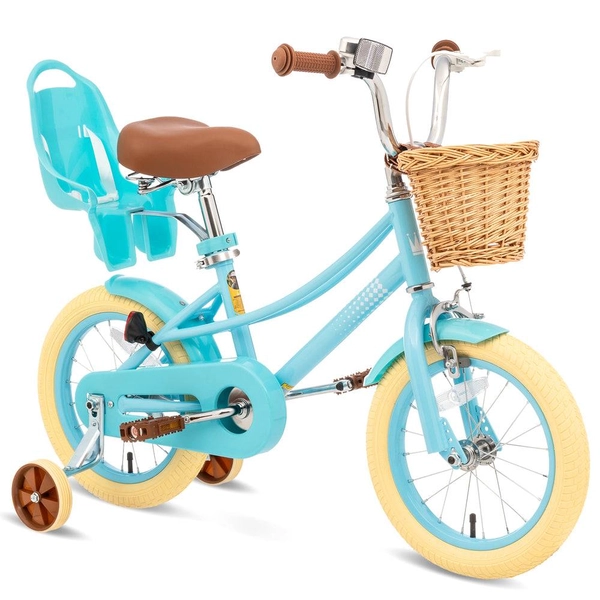
Girls' Training Wheel Bike by XJD, 12–20 Inch Wheels – Blue
This XJD girls' training wheel bike in Blue covers one of the widest fit ranges …
Training Wheel Bikes Wheel Size 12 Inch / 14 Inch / 16 Inch / 20 Inch Recommended Height 86–152 cm Training Wheels Yes 12 Inch -
Save 15%
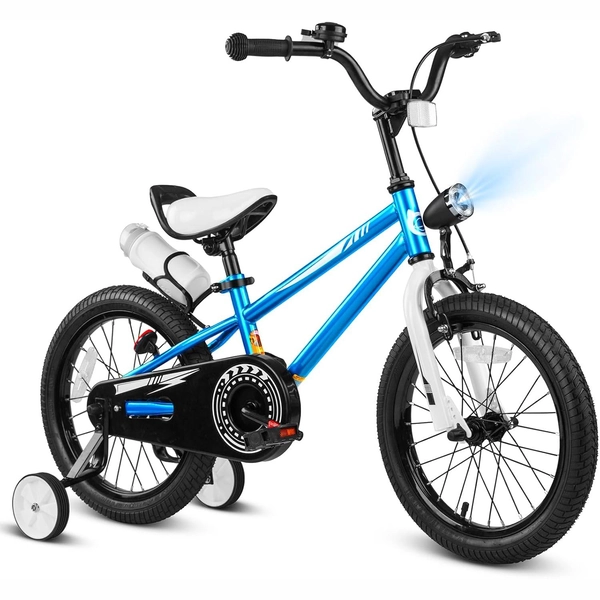
XJD Boys 12/14/16" Training Wheel Bike – Blue
The XJD Boys Bike in Blue is a training wheel bike for riders 71–122 cm tall—rou…
Training Wheel Bikes Wheel Size 12 Inch / 14 Inch / 16 Inch Recommended Height 86–122 cm Training Wheels Yes 16 Inch -
Save 15%
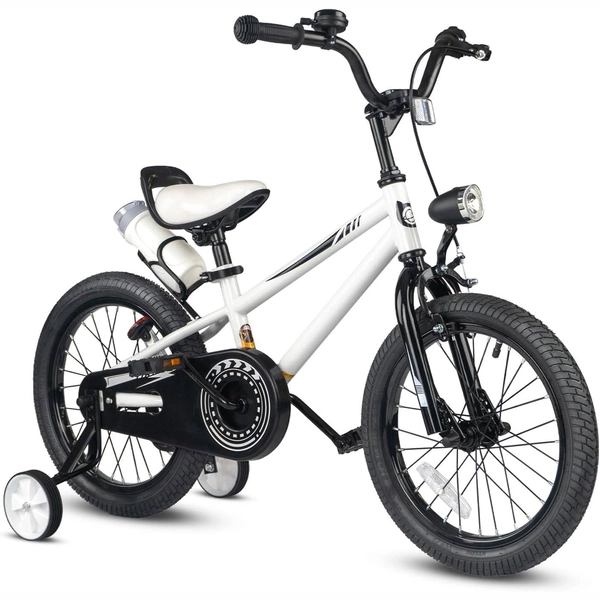
XJD Kids' Training Wheel Bike for Boys & Girls, 12/14/16 Inch – White
The XJD kids' training wheel bike in White is made for riders ages 3–8 (roughly …
Training Wheel Bikes Wheel Size 12 Inch / 14 Inch / 16 Inch Recommended Height 86–122 cm Training Wheels Yes 14 Inch -
Save 12%
XJD Kids Bike for Girls – Pink, 12/14/16/20 Inch with Training Wheels
The XJD Kids Bike for Girls in Pink is a training-wheel bike built to carry your…
Training Wheel Bikes Wheel Size 12 Inch / 14 Inch / 16 Inch / 20 Inch Recommended Height 86–152 cm Training Wheels Yes 12 Inch