

What size bike does my 4 year old need
A 4-year-old usually needs a 12-, 14- or 16-inch bike, depending on measured height and fit. Start with height, then check inseam, reach, brake control and confidence in person.
Choose the starting wheel size by height
Age narrows the search, but it does not determine the correct size. Measure your child without shoes, standing straight against a wall, and compare that height with these XBikes starting points:
| Wheel size | XBikes age starting point | Rider height |
|---|---|---|
| 12 Inch | 3–4 | 34–40 in / 86–102 cm |
| 14 Inch | 3–6 | 37–45 in / 94–114 cm |
| 16 Inch | 4–7 | 40–48 in / 102–122 cm |
For example, a 4-year-old who is 38 inches tall falls within both the 12- and 14-inch ranges, so both deserve a fit check. A child measuring 42 inches falls within the 14- and 16-inch ranges. When ranges overlap, current confidence and control should decide—not the desire to leave extra growing room.
Measure height and inseam before comparing bikes
Record total height first. Then measure inseam: have the child stand in socks with feet slightly apart, place a book upright between the legs to imitate a saddle, and measure from the floor to the top edge of the book. This is a body measurement, not a promise that a particular frame will fit.
Compare the measurements with the sizing information for the exact bicycle. Because the supplied catalog facts do not include frame geometry or stand-over dimensions, consult the exact product manual or seller-provided specification before deciding. If those details are unavailable, arrange an in-person fit check.
Check the bike around the child
Have your child try the bicycle rather than choosing from the wheel label alone. With the child straddling the frame, confirm there is comfortable clearance and no pressure from the top of the bike. Follow the exact product manual when evaluating or adjusting saddle position.
Next, watch the child sit naturally and hold the handlebar. They should not have to stretch, lock their elbows or twist to steer. Ask them to operate the brakes while maintaining a secure grip. Brake reach and control matter even when the height chart suggests the wheel size could work.
Finally, observe a slow start, straight ride, turn and controlled stop in a clear area with close adult supervision. A suitable bike should let the child control it now. American Academy of Pediatrics guidance supports trying the bicycle, checking stand-over and brake reach, and avoiding an oversized bike bought merely for future growth.
Compare the relevant XBikes options
The supplied catalog options are useful because each offers 12-, 14- and 16-inch SKU labels—the three wheel sizes that can overlap with age four in the XBikes starting points. They let you compare the size indicated by your child’s measurement while considering either a Kids’ BMX Bikes listing or Training Wheel Bikes listings. Their labels are starting points, not proof of individual fit.
 Black XJD Kids' BMX Bicycle with Training Wheels
Available in 12 Inch, 14 Inch and 16 Inch labels, this Kids’ BMX Bikes option covers the XBikes size starting points most relevant to age four, subject to an individual fit check.
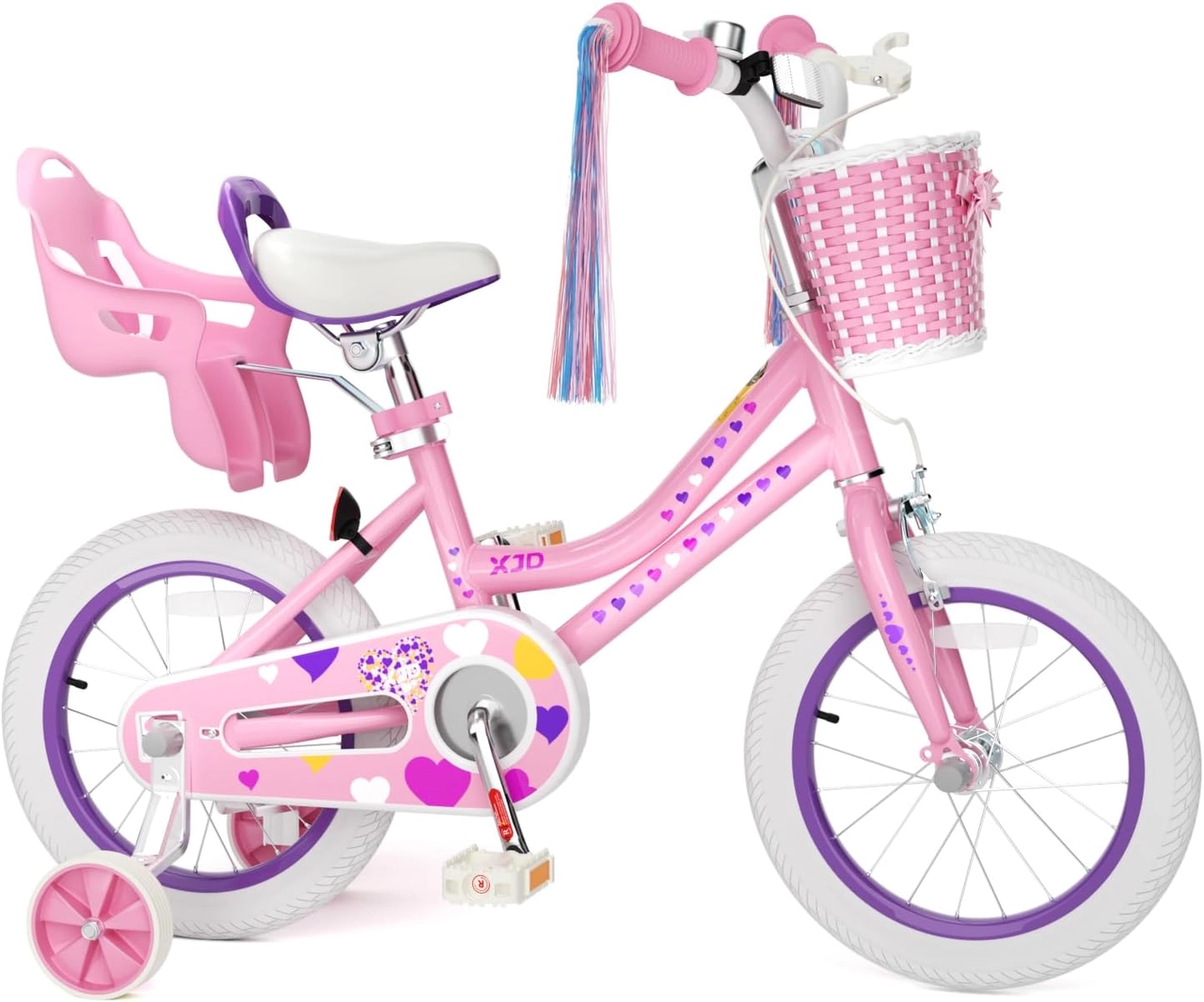 Pink Girls' 12/14/16" Bike by XJD – Basket & Doll Seat
This Training Wheel Bikes listing offers 12 Inch, 14 Inch and 16 Inch labels, allowing comparison against a 4-year-old’s measured height, inseam, reach, brake control and confidence.
 Pink 12/14/16/20" XJD Girls Bike with Training Wheels & Basket
This Training Wheel Bikes option has 12, 14, 16 and 20 Inch labels. Its first three sizes may be relevant at age four; the 20 Inch XBikes starting range begins at age seven and 48 inches.
Black XJD Kids' BMX Bicycle with Training Wheels is categorized as a Kids’ BMX Bike and is listed in 12 Inch, 14 Inch and 16 Inch options.
Pink Girls' 12/14/16" Bike by XJD – Basket & Doll Seat is categorized as a Training Wheel Bike and likewise has 12 Inch, 14 Inch and 16 Inch labels.
Pink 12/14/16/20" XJD Girls Bike with Training Wheels & Basket is also categorized as a Training Wheel Bike and adds a 20 Inch label to its 12-, 14- and 16-inch choices. The 20 Inch option is not an age-four substitute: the supplied XBikes starting point for 20 Inch is ages 7–12 and 48–60 inches / 122–152 cm.
The catalog facts do not supply frame geometry, brake type, weight, load limit, assembly details or compatibility information for these bicycles. Verify those points in the manual for the exact product and SKU, or ask a qualified bicycle mechanic. Do not infer that two bikes fit identically merely because their wheel labels match.
Resolve an overlap or borderline measurement
If height fits two ranges, try both wheel sizes. Prefer the option on which the child can stand over the frame comfortably, reach the handlebar without stretching, operate the brakes reliably and maneuver with present confidence. Do not move up solely because a larger bike may last longer.
If height is close to a range boundary, do not round toward a preferred size. Recheck the measurement and compare both candidates in person. Inseam, frame shape and reach can separate bikes carrying the same nominal wheel size.
Make the final decision safely
- Measure height and inseam without shoes.
- Use height to shortlist 12, 14 or 16 Inch.
- Check stand-over clearance, reach and brake operation on the exact bike.
- Observe controlled starting, steering and stopping.
- Follow the exact manual for assembly, adjustments and maintenance, or use a qualified bicycle mechanic.
Add a properly fitting bicycle helmet. It should sit level, fit securely and have its straps used according to the helmet manufacturer’s instructions. For your 4-year-old, choose only the shortlisted size they can comfortably control today; if none passes every fit check, keep looking rather than buying oversized.
Bikes for your next adventure
-

Green XJD Toddler Bike Helmet with Adjustable Fit, XS (46–51 cm)
The XJD toddler bike helmet in Green is built for the youngest riders — the size…$20.39
$23.99 -

Kids Bike Helmet by XJD for Boys & Girls – Black, Blue, Green, Pink, Purple
The XJD Kids Bike Helmet covers a wide 2-to-8-year age range thanks to two head-…$59.99
-

Kids Bike Helmet by XJD for Girls – Pink
The XJD Kids Bike Helmet in Pink is a lightweight multi-sport helmet for girls r…$59.99
$99